
Public competitor-ad analysis reliably shows you messaging patterns, format bets, platform allocation, and which creatives have staying power. What it cannot show is cost per acquisition, return on ad spend, or actual profit. The right move is to pull the ads that have been running longest, log their hooks and landing pages, and turn those into three prioritized test ideas this week, not next quarter.
TL;DR:
- Ads running longer than 60 days or costing above the median account spend indicate validated messaging concepts worth testing further.
- Tracking creativity format and hook categories reveals which tactics resonate, such as video ads for higher engagement or social proof for trust building.
- Consistent, long-term ads with stable messaging and CTAs suggest effective strategies, while frequent changes point to ongoing testing and iteration.
- Utilizing automated tools like Prowl speeds up data collection, sorting, and report generation, making weekly competitor audits feasible at scale.
- Analyzing ad tone, imagery, and landing page alignment helps infer audience targeting and funnel stage, allowing better message and offer optimization.
Table of Contents
- What Analyzing Competitor Ads Actually Tells You
- Where to Find the Evidence: Ad Libraries, Platform Tools, and Indexers
- The 60 to 90 Minute Competitor Ad Audit, Step by Step
- How to Read the Signals Without Fooling Yourself
- How Prowl Speeds Up the Audit Loop
- Reading Audience Targeting Signals Hidden in the Ads Themselves
- What Competitor CTAs Reveal About What Actually Converts
- Benchmarking Performance When You Only Have Public Data
- Spotting Creative Testing Patterns in Competitor Accounts
- Reading Brand Positioning Through Tone, Style, and Word Choice
- Where to Focus First When Resources Are Limited
- Turn This Workflow Into a Weekly Habit With Prowl
- Sources
- FAQ
What Analyzing Competitor Ads Actually Tells You
The phrase “competitor ad analysis” gets thrown around loosely, but the discipline underneath it has a name in the performance-marketing world: creative intelligence. It’s the practice of systematically observing what rivals publish, rather than guessing based on a few screenshots someone forwarded in Slack.
A repeatable process runs through six layers: audit, creative mix, messaging, platform allocation, calendar, and landing page. Skip any layer and you end up with an opinion dressed up as an insight.
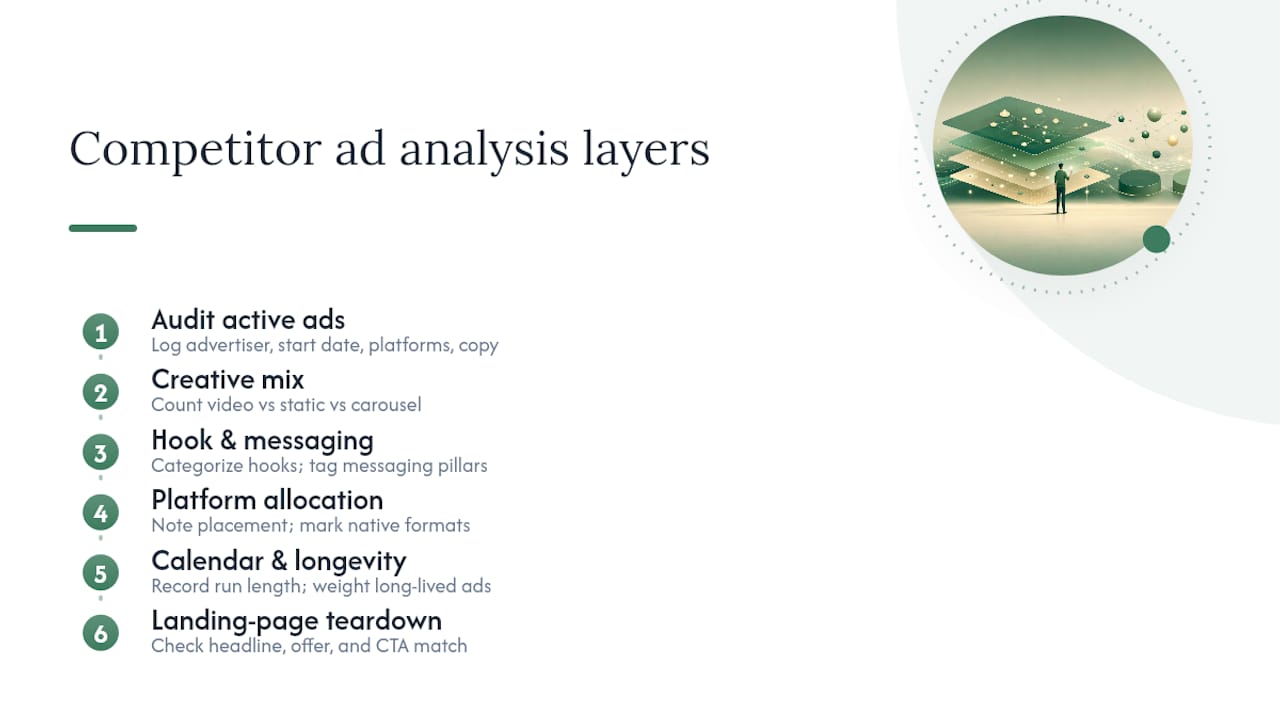
Layer 1: Audit active ads. For each competitor, log advertiser name, ad start date, platforms shown, creative type, and the first line of copy. This becomes your working dataset.
Layer 2: Creative mix. Count how many ads are video versus static versus carousel. A competitor running 80% video signals a production budget and a bet on watch time; a static-heavy account signals either a leaner team or a belief that scroll-stopping images convert better for their audience.
Layer 3: Hook and messaging classification. Sort opening lines into categories: pain-point callouts, social proof, curiosity gaps, price anchors, urgency. Tag the messaging pillar each ad leans on (speed, price, trust, status).
Layer 4: Platform allocation. Note where each ad appears and whether the creative is a straight port or adapted natively (vertical for Reels, square for feed).
Layer 5: Calendar and longevity. Ads that have run for several months are delivery signals worth weighting heavily.
Layer 6: Landing-page teardown. Check whether the ad’s promise matches the page headline, offer, and CTA.
Where to Find the Evidence: Ad Libraries, Platform Tools, and Indexers
Start with Meta’s own archive. The Meta Ad Library shows advertiser name, creative, copy, platforms, and delivery dates for every active ad, but it stops short of purchases, cost per acquisition, or return on ad spend. Sort by “date created” to spot which creatives have survived the longest. That’s your first longevity signal.
Google doesn’t run an identical public archive, but its Insights Finder surfaces audience and content trends you can pair with what you observe in ad creative. Use it to sanity-check whether a competitor’s messaging lines up with broader category demand.
For post-click behavior, Microsoft Clarity’s Campaign Insights tool reveals session replays and engagement data once traffic lands on your own pages, which helps you judge whether a “winning” competitor ad concept would actually survive contact with a real landing page.
Third-party indexing tools add what the native libraries skip: saved swipe files, longevity sorting, and export workflows. That’s real time saved if you’re tracking a dozen accounts weekly.
- Free and manual: Meta Ad Library, Google Insights Finder screenshots. Fine for one-off spot checks.
- Paid and automated: Third-party indexers or an intelligence connector. Worth it once you’re tracking more than five competitors on a recurring basis.
The 60 to 90 Minute Competitor Ad Audit, Step by Step
You don’t need a week for this. You need a focused hour and a half, a spreadsheet, and a rule for what counts as a winner.
- Pick your targets (10 minutes). Choose three to five direct competitors, not ten. Set your economics gate now: a candidate “winner” is any ad that’s been live 60+ days or shows spend well above the account’s typical pattern. A combined delivery rule plus economics gate, such as 10 times the account median spend or 60+ days live, filters out noise before you waste time on it.
- Collect (30 minutes). For every ad that clears your gate, capture: first line of copy, creative type, start date, landing page URL, and the CTA button text. Screenshot the creative. Don’t skip the landing page URL. It’s the step most people forget.
- Prioritize (15 minutes). Sort by longevity first, then by message consistency across multiple ads. An advertiser repeating the same core promise across five creatives has found something that sticks.
- Convert (25 minutes). Turn your top three findings into test briefs: one format test (video versus static), one hook test (pain point versus social proof), one landing-page test (headline rewrite to match the ad’s actual promise).
- Follow-up measurement. Run each test for at least one full purchase cycle, and don’t call a winner before you’ve hit statistical relevance in your own account.
Pro Tip: Log the landing page URL every single time, even when you’re rushed. Without it, you can’t run the message-match check that catches half the wasted ad spend in the first place.
How to Read the Signals Without Fooling Yourself
Longevity and spend are delivery signals, not profit signals. A competitor spending heavily and running an ad for months proves the platform’s algorithm is comfortable delivering it, and that they haven’t killed it. It does not prove the ad is contribution-positive. Confusing the two is the single most common mistake in this exercise.
A sample of 578,750 Meta ad creatives shows spend and format hit rates are highly concentrated among a small share of ads. Treat tables built on that kind of data as hypothesis generators, never as causal proof that a format or hook is universally superior.
A few rules keep you honest:
- Ignore ads with minimal spend or a lifespan under two weeks. That’s noise, not signal.
- Frame every observation as a hypothesis, gated by your own target CPA or contribution margin, before you commit budget to testing it.
- Pair ad observation with your own post-click data (session replays, funnel drop-off) before scaling anything you’ve copied. Combining the two catches friction that raw ad metrics never surface, and reduces false positives when deciding which competitor creative concepts are worth emulating.
- Give your own tests at least three to five days of sufficient session volume before drawing conclusions. That’s the same minimum Clarity recommends for reliable campaign-level reads.
How Prowl Speeds Up the Audit Loop
Manually logging fields across five competitor accounts is doable in 90 minutes. Doing it across twenty, every week, is a job nobody wants. That’s the gap an intelligence connector closes.
Prowl gives an agent access to 448 market-intelligence tools through a single connector, so instead of stitching together a scraper, a spreadsheet macro, and a manual longevity sort, the same agent can run the whole audit loop as one workflow.
Practical tasks that shift from manual to automated:
- Cross-platform ad indexing across multiple competitor accounts at once, instead of one browser tab per advertiser.
- Longevity sorting that flags 60+ day creatives automatically, so you’re not eyeballing dates in a spreadsheet.
- Generating prioritized test briefs directly from the flagged creatives.
- Exporting the whole audit as a PDF or PPTX ready to hand to a creative team.
The value isn’t a new insight category. It’s compressing the six layers into a workflow that runs on a schedule rather than on whoever remembered to check last Tuesday.
Reading Audience Targeting Signals Hidden in the Ads Themselves
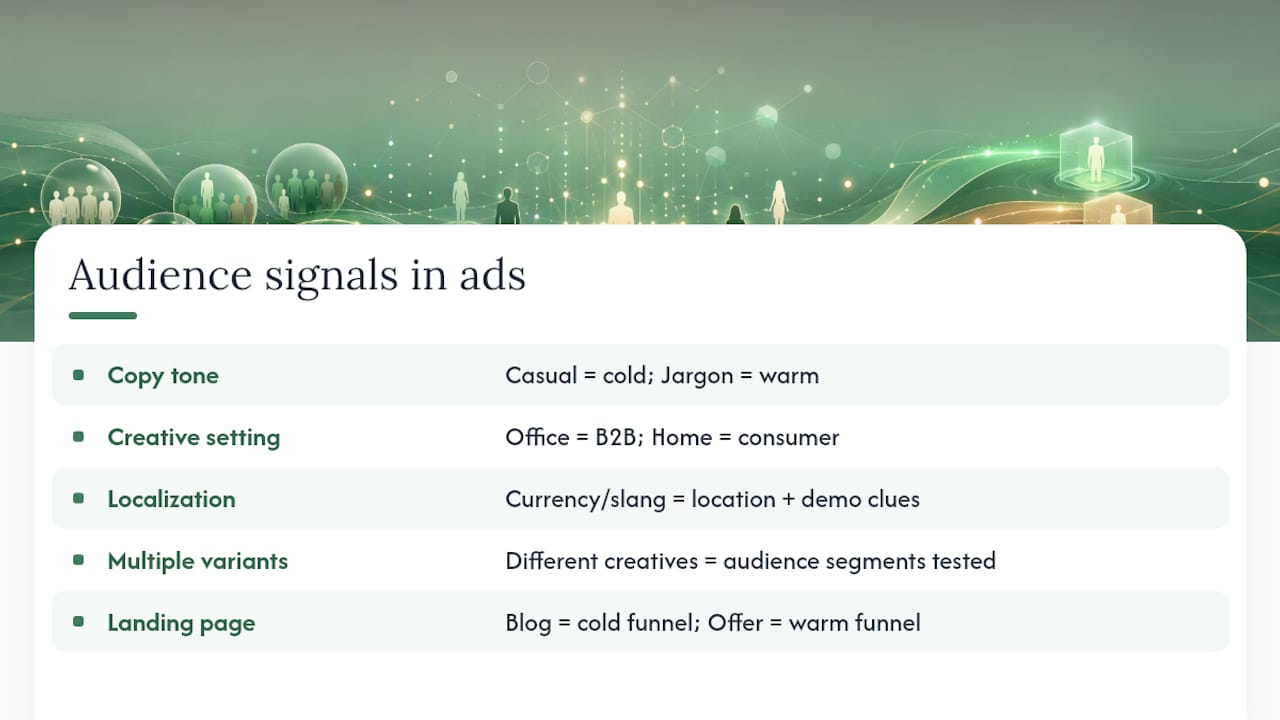
You can’t see a competitor’s audience settings, but you can infer a lot from what the ad itself reveals. Copy tone is the first clue: an ad written in casual, first-person language (“I switched to this and here’s what happened”) usually targets a colder, broader audience being introduced to a category. Dense, jargon-heavy copy with specific pain points usually targets warmer, more informed buyers.
Creative choices reinforce this. Ads showing a product in a busy office setting suggest B2B targeting; ads shot in a home kitchen suggest a consumer audience. Language localization, currency symbols, and even the specific slang used point to geographic and demographic targeting choices you’d otherwise never see.
Watch for multiple simultaneous variants of the same core offer with different imagery or opening lines. That pattern usually means the advertiser is running audience segments in parallel, testing which visual resonates with which demographic slice. If you see a fitness ad showing a runner in one version and someone lifting weights in another, that’s very likely two different age or interest segments getting tailored creative.
The landing page adds a final layer of confirmation. A competitor sending cold-audience ad traffic to an educational blog post, versus warm-audience traffic to a direct offer page, is telegraphing exactly where each segment sits in their funnel. Match the ad’s tone and the landing page’s ask, and you can reverse-engineer a rough funnel map without ever seeing their targeting settings.
What Competitor CTAs Reveal About What Actually Converts
The call-to-action button is one of the few fields the ad platforms expose directly, and it’s more revealing than most marketers give it credit for. “Shop Now,” “Learn More,” “Sign Up,” and “Get Offer” each imply a different stage of buyer readiness the advertiser believes their audience has reached.
A competitor running “Learn More” almost exclusively across dozens of ads is likely still building awareness or testing a new offer before pushing hard toward purchase. One that shifts the same creative concept to “Shop Now” after a few weeks has probably validated demand and moved to a harder conversion push.
Track CTA button text alongside your longevity data. If an advertiser sticks with the same CTA across every long-running ad, that’s a stable, validated choice. If the CTA keeps rotating on otherwise-similar creative, they haven’t settled on what converts, and you’re watching an active test in progress.
Pay attention to CTA and copy mismatches, too. An ad urging urgency in the copy (“Only today”) paired with a soft CTA like “Learn More” usually signals inconsistent messaging, not a proven pattern. That’s a weakness to note, not one to copy. The strongest signal is alignment: urgent copy paired with an urgent CTA, held stable for months, is worth building a hypothesis around.
Benchmarking Performance When You Only Have Public Data
You will never see a competitor’s actual click-through rate, conversion rate, or cost per acquisition from public sources. What you can benchmark is relative creative behavior across the ads you’ve logged, which gets you further than most marketers assume.
Start with format hit rates within a single advertiser’s account. If 70% of their active ads are video and only 30% are static, and the video ads are disproportionately represented among the long-running set, that’s a directional benchmark: video is likely outperforming static for this advertiser’s audience and offer.
Compare hook types the same way. Tag each ad’s opening line by category, then check which categories dominate the long-running subset versus the ones that disappeared within two weeks. That ratio is your benchmark, built entirely from delivery and longevity data rather than invented performance numbers.
Cross-competitor comparison sharpens the picture further. If three separate competitors in your category are all leaning on social-proof hooks in their longest-running ads, that’s a category-level signal worth taking seriously, not a coincidence. Log these ratios in a simple spreadsheet, updated monthly, and you’ll build your own internal benchmark dataset that’s more relevant to your category than any generic industry average.
Spotting Creative Testing Patterns in Competitor Accounts
Advertisers who test systematically leave fingerprints. Look for the same core creative concept appearing in multiple variants: same product shot, different headline; same headline, different visual. That’s an A/B test in motion, and the fact that it’s still running after several weeks tells you the advertiser hasn’t picked a winner yet, or is running a genuine split test rather than a single locked-in ad.
Compare creative “families” over time. If a competitor launches a batch of five ads around a new offer and, three weeks later, only two of the five are still active, the other three lost. Note what the survivors share: same hook style, same visual treatment, same CTA. That shared trait is their working hypothesis.
Iteration speed matters too. An account that refreshes creative every one to two weeks is running a tight testing cadence, likely with a dedicated creative team and enough budget to iterate fast. An account running the same handful of ads for six months either has a genuine long-term winner or simply isn’t testing much. Both are useful to know, for different reasons.
Watch particularly for landing-page changes tied to creative refreshes. When a competitor swaps both the ad hook and the landing page headline at the same time, that’s a sign they’re testing message match as a system, not just swapping images. That combined move is usually the strongest signal of a serious testing operation.
Reading Brand Positioning Through Tone, Style, and Word Choice
Ad copy is a brand’s personality on display without the filter of a mission statement. Word choice, sentence length, and even punctuation reveal where a competitor wants to sit in the market, whether or not that positioning statement exists anywhere in their public materials.
Short, blunt copy with numbers and specifics (“47% faster setup”) signals a performance-first, no-nonsense positioning aimed at buyers who want proof over polish. Longer, narrative-driven copy with emotional language signals a brand betting on connection and story over hard specs.
Visual style reinforces or contradicts the copy. A minimalist, high-contrast design paired with premium-sounding copy usually signals a luxury or professional positioning. Bright colors, casual fonts, and exclamation points signal a mass-market or younger-skewing brand, regardless of what the product actually is.
Consistency across the ad set matters as much as any single ad. A brand that maintains the same tone, color palette, and sentence rhythm across dozens of ads over months has a disciplined brand system behind the creative. One with wildly inconsistent tone from ad to ad, sometimes formal, sometimes casual, is either testing personas or lacks a settled brand voice. Either reading is useful competitive intelligence, and neither requires anything beyond the public ad itself to spot.
Where to Focus First When Resources Are Limited
Trust long-running, production-quality creative before anything with a short lifespan or an amateur cut. An ad that survived 90+ days earned that survival somehow, even if you can’t see the exact number behind it.
Fix your own message match and funnel friction before you copy anyone’s hook. A borrowed hook pointed at a broken landing page will underperform regardless of how well it worked for the competitor who wrote it.
If you only run one test this quarter, change the hook and the landing-page promise together. Testing them separately tells you less, since a hook and its promised outcome either reinforce each other or they don’t, and half-measuring that pairing wastes your test budget.
— Sergey
Turn This Workflow Into a Weekly Habit With Prowl
Running the six-layer audit by hand once is a good exercise. Running it every week across a dozen competitors is a staffing problem, and that’s the gap Prowl closes. Prowl connects any agent to 448 market-intelligence tools through one connector, so the longevity sorting, hook classification, and landing-page checks described above become a scheduled workflow instead of a recurring afternoon on someone’s calendar.
If your team is already running this audit manually, the honest next step is to see whether automation actually saves the time you think it does. Check the Getting Started guide to connect an agent, or go straight to pricing to compare the Recon, Exploit, Blackops, and Syndicate plans against how much analyst time this audit currently costs you each month. Credit packs starting at $10 are also available if you’d rather test the workflow on a single account before committing to a monthly plan.
Sources
- What 578,750 Meta Ad Creatives Reveal About Hooks, Formats, and “Winning” Ads | AdRiseLab
- Campaign Insights | Microsoft Learn
- Competitor Ad Research - See every Meta ad your competitors run | AdMakeAI
- Benly
FAQ
What Does Analyzing Competitor Ads Actually Reveal?
It reliably shows messaging patterns, creative format bets, platform allocation, and which ads have run long enough to signal a validated concept. It cannot show internal metrics like CPA, ROAS, or profit.
Can I See a Competitor’s ROAS or Ad Spend Budget?
No. Public ad libraries, including Meta’s, show creative, copy, platforms, and delivery dates, but never purchases, cost per acquisition, or return on ad spend.
How Long Should an Ad Run Before I Treat It as a Winner?
Combine a delivery rule, such as 60+ days live or well above median account spend, with an economics gate tied to your own target CPA before treating anything as validated.
What Tools Speed Up Competitor Ad Tracking?
Native archives like the Meta Ad Library and Google’s Insights Finder cover the basics for free. A connector like Prowl that pulls from 448 intelligence tools automates the indexing, longevity sorting, and report generation for teams tracking more than a handful of accounts.
How Often Should I Re-Run This Audit?
Monthly is a reasonable baseline for most categories; weekly if you’re in a fast-moving vertical where competitors iterate creative every one to two weeks.