
Agentic workflows are marketing systems that sense real-time signals, reason about a goal, and act on their own, then correct course based on results, instead of following a fixed if-this-then-that script. The payoff for marketers is real-time personalization and operational speed you can’t get from static automation. Before piloting anything, check two things: your data maturity (identity resolution, event streaming) and your governance guardrails. This guide covers the framework, an engineering checklist, and a working example.
TL;DR:
- Agentic workflows require resolved customer identities and real-time event streaming as the foundational data prerequisites for effective decision-making.
- Building a single connector layer that reduces API hops is essential to mitigate latency and enable truly real-time marketing actions.
- Focus on narrow, single-purpose agents with explicit input-output contracts, validation gates, and versioned prompts to ensure reliable and transparent operations.
- Pilot these workflows on repeatable, low-strategic tasks like budget pacing, anomaly detection, or personalized messaging to demonstrate ROI before expanding.
- Establish strict governance, including decision boundaries and thorough logging, to prevent missteps and handle model drift or data gaps effectively.
Table of Contents
- What Are Agentic Workflows in Marketing?
- How Agentic Workflows Actually Run: Agents, Connectors, and Observability
- Where Agentic Workflows Deliver Value in Marketing Today
- Building Production-Grade Agentic Marketing Workflows
- How Do You Pilot an Agentic Marketing Workflow?
- What Are the Risks of Agentic Workflows in Marketing?
- Solving the Connector Problem: A Practitioner’s Example
- Where Agentic Workflows Will Actually Pay Off First
- Get Your Agentic Marketing Pilot Off the Ground
- Sources
- FAQ
What Are Agentic Workflows in Marketing?
An agentic workflow runs on a loop: sense, reason, act. An agent perceives a signal (a dropped cart, a spiking CPC, a negative review trend), reasons about what that signal means against a stated goal, and takes an action, then watches what happens and adjusts. Google Cloud describes this as a continuous cycle where a system decomposes a high-level goal into sub-tasks, executes them through tool-augmented agents, and self-corrects using live feedback instead of a pre-written rule.
That’s a fundamentally different animal than the automation most marketing teams already run. A traditional workflow says: if the email isn’t opened in 48 hours, send a follow-up. It’s deterministic, brittle, and blind to context. A single-prompt LLM tool is a step up. You ask a model to write ad copy, it writes ad copy, the interaction ends. Neither one decomposes a goal, chooses among tools, or revises its own plan when the first attempt fails.
A workflow earns the “agentic” label when three things are true at once:
- It has autonomy over a bounded decision. The agent picks the next action from a set of options rather than following one scripted path.
- It corrects itself iteratively. It observes the outcome of its own action and updates the next step, rather than executing a one-shot instruction.
- It uses tools, not just text. It calls APIs, queries a CDP, pulls a competitor’s pricing page, or triggers a send, and treats the results as new input for reasoning.
Picture the difference this way: a rule-based system is a light switch. An agentic system is a thermostat. The switch does one thing when triggered. The thermostat reads the room, compares it to a target, adjusts, and keeps checking. That’s the mental shift marketing leaders need before they start mapping pilots. You’re not buying a smarter macro. You’re designing a system that makes bounded decisions on its own, which means you also need to design what it’s not allowed to decide, and that boundary is where most of the real engineering work lives.
How Agentic Workflows Actually Run: Agents, Connectors, and Observability
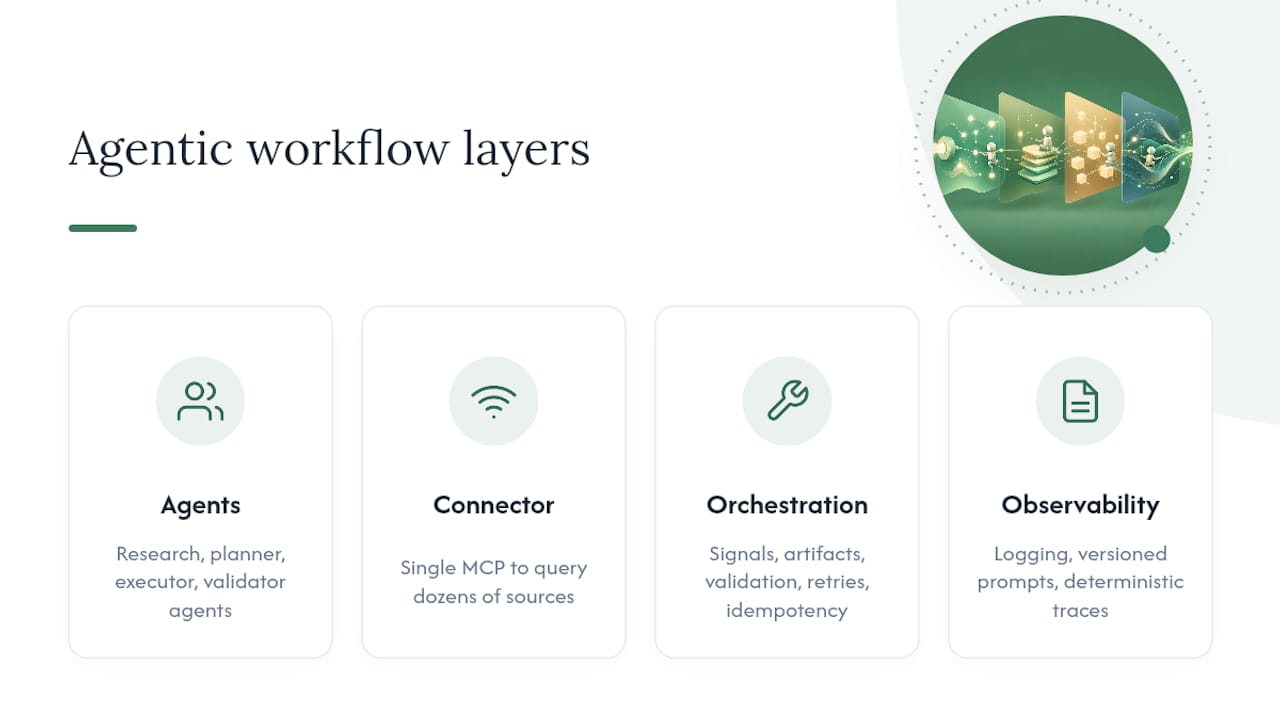
Underneath the “sense, reason, act” loop sits an architecture with four moving parts: agents, a connector layer, an orchestration layer, and observability. Skip any one of them and the pilot either stalls in a demo or breaks in production.
Agent roles. Production systems split responsibility across narrow, single-purpose agents rather than one generalist agent trying to do everything. A typical marketing pipeline has a research agent that gathers signals, a planner agent that decides what to do with them, an executor agent that takes the action (sends the email, adjusts the bid, publishes the draft), and a validator agent that checks the output before it ships. This single-responsibility pattern shows up repeatedly in production-grade engineering guidance for agentic AI, and for good reason: a narrow agent is easier to test, easier to swap out, and easier to audit than a monolith that reasons about everything at once.
The connector layer. Agents are only as useful as the tools they can reach. A single connector, often called an MCP (a market intelligence connector, in Prowl Agent’s case), gives an agent one consistent way to query dozens of data sources instead of maintaining separate integrations for each. That matters most when a decision has to happen in real time. Every extra API hop between “signal detected” and “action taken” adds latency, and latency is what kills the “real-time” promise of agentic marketing.
Orchestration primitives. Below the agents, an orchestration layer manages the mechanics: signals that trigger a workflow, artifacts that agents produce and hand to the next step, validation gates that block a bad output before it reaches a customer, retry logic for failed tool calls, and idempotency so a retried action doesn’t fire twice. Open-source reference patterns for agentic marketing pipelines treat these signal and artifact contracts as the backbone of the whole system, not an afterthought.
Observability. You cannot govern what you cannot see. Production deployments need logging on every agent decision, versioned prompts so you know exactly what instruction produced a given output, and deterministic traces that let you replay a decision after the fact. Without this, a marketing team debugging a bad autonomous send is stuck guessing.
Pro Tip: Version every prompt template the way you’d version code. When an agent’s output quality suddenly drops, the first question your team should be able to answer in five minutes is “what changed in the prompt or the model,” not “let’s investigate for a week.”
Where Agentic Workflows Deliver Value in Marketing Today
Four use cases show up repeatedly across current marketing deployments, and each one maps to a different combination of signals, decisions, and metrics.
- Real-time campaign optimization. An agent watches channel performance (CPC, conversion rate, spend pacing) throughout the day and reallocates budget or pauses underperforming ad sets without waiting for a human to check a dashboard. The signal is live spend data; the decision is a bounded budget shift within a preset range; the metric marketers track is cost per acquisition against a daily target. Slack’s guide to agentic workflows describes this exact pattern: agents perceive performance, reason about the data, and take bounded action while humans stay in control of strategy.
- Personalization at scale. An agent selects which message, offer, or product recommendation a specific visitor sees, based on browsing behavior, purchase history, and lifecycle stage, then updates that choice as new behavior comes in. The context signals are session activity and a resolved customer profile. Feeding outcomes back into a unified profile within seconds is what separates a genuinely adaptive personalization loop from a static segmentation rule that only updates overnight.
- Creative ops pipelines. A brief comes in, a drafting agent produces a first pass, a review agent checks it against brand and legal guidelines, and only work that clears the gate moves to a human editor. This is where agentic workflows earn their keep on repetitive, high-volume creative tasks. A comparable pattern shows up in the media production world, where teams use AI-assisted editing tools to move a rough cut through review stages before a human signs off on the final version.
- Reporting and anomaly detection. An agent scans performance data overnight, flags anomalies (a sudden conversion drop on one landing page, a spike in cost on one keyword group), and drafts a recommended action for a human to approve in the morning. This replaces the manual dashboard-scanning that eats an analyst’s first hour of every day.
The common thread across all four: the agent handles execution and detection, and a human sets the goal and approves anything above a defined risk threshold. Teams that report the strongest results tend to be the ones that kept a human in strategic control while automating the repeatable execution work underneath it, rather than trying to hand the whole campaign over to an agent on day one.
Building Production-Grade Agentic Marketing Workflows
Most agentic marketing pilots that fail don’t fail because the model was bad. They fail because the engineering around the model was sloppy. A comprehensive engineering guide for production-grade agentic AI lays out nine practices worth adopting wholesale for marketing teams, not just software teams.
- Modularity. Build small, composable agents instead of one do-everything system.
- Single-responsibility agents. Each agent does one job (research, planning, execution, validation) and does it well.
- Tool-first design. Agents should call defined tools with clear inputs and outputs, not free-text their way through a task.
- Externalized prompt management. Prompts live outside the code, versioned and testable, so you can change behavior without a redeploy.
- Model-consortium reasoning. For high-stakes decisions, use more than one model or check to reduce single-model blind spots.
- Separation of logic and connector layer. Business logic shouldn’t be tangled up with the code that calls external tools; the connector layer stays swappable.
- Containerized deployment. Package agents so they run consistently across staging and production environments.
- Validation gates. No output reaches a customer without passing an explicit check.
- Keep it simple. Resist the urge to add agents or complexity the workflow doesn’t need yet.
Operationalizing this inside a marketing team means assigning real ownership: a marketing ops lead who owns the KPI definitions and approval thresholds, an analytics engineer who owns the data contracts feeding the agents, and someone (in-house or from IT) who owns the connector layer and deployment pipeline. Each agent should have a written artifact contract, meaning a defined schema for what it produces, so the next agent in the chain isn’t guessing at the format.
Rollout follows a familiar software pattern, applied to campaigns instead of code. Run the workflow in staging against historical data first. Move to a canary pilot on a small slice of real traffic or budget, with tight monitoring. Define a rollback path before you launch, not after something breaks. And set observability service-level objectives up front, things like “every agent decision must be traceable within 60 seconds,” so your team has a concrete target instead of a vague promise of visibility.
Pro Tip: Treat your validation gate as non-negotiable even under pressure to ship fast. The gate is what turns an “agentic experiment” into a “production system,” and skipping it to hit a launch date is how a budget-reallocation agent ends up draining spend on the wrong campaign overnight.
How Do You Pilot an Agentic Marketing Workflow?
Getting from framework to a working pilot takes four phases. Here’s the sequence that keeps risk contained while still moving fast enough to show results within a quarter.
- Audit data readiness first. Before touching any agent logic, confirm you have resolved customer identities across channels and real-time (or near-real-time) event streaming. This is the prerequisite the entire system depends on. Martech places resolved identity and streaming data as the baseline requirement for any autonomous marketing capability, not a nice-to-have you add later. If your customer data still lives in three disconnected spreadsheets, an agentic workflow will just make bad decisions faster.
- Pick a pilot with the right shape. The best candidates are repeatable, high-effort, low-strategic-complexity tasks: budget pacing checks, anomaly flagging, first-draft creative generation. Avoid piloting on your highest-stakes campaign. Define KPIs tied directly to revenue or retention (cost per acquisition, lift in repeat purchase rate) rather than vanity metrics like “number of agent actions taken.” Practitioners consistently recommend starting with one narrow workflow to prove ROI quickly before expanding scope.
- Build with contracts and gates from day one. Connect your MCP or connector layer, write explicit contracts for what each agent produces and consumes, add validation gates before any customer-facing action, and instrument logging from the first line of code, not after something breaks.
- Scale with governance built in. Once the pilot proves out, expand cautiously: define who can approve new agent permissions, set a cadence for auditing agent decisions against outcomes, and keep measuring the same KPIs you defined at the start so scale doesn’t quietly erode ROI.
Gartner’s own forecasting underlines why the discipline in steps 1 and 3 matters: analysts project a large proportion of agentic AI projects will be canceled by the end of 2027 without disciplined engineering and governance behind them. A rushed pilot skipping the data audit is the single most common reason marketing teams end up in that statistic.
What Are the Risks of Agentic Workflows in Marketing?
Four failure modes show up again and again once teams move past the demo stage, and each has a corresponding control worth building in before launch, not after an incident.
Integration latency. Chaining together five or six separate APIs to gather the signals an agent needs introduces delay at every hop, and delay is fatal to a system whose entire value proposition is reacting in real time. Forbes’ analysis of agentic AI in programmatic advertising flags this as one of the industry’s most common technical pitfalls, and the fix is architectural: favor a single low-latency connector over a patchwork of point-to-point integrations.
Data gaps and identity resolution failures. When a customer profile is fragmented across channels, an agent reasoning over incomplete data will make confidently wrong decisions, like re-targeting someone who already converted under a different device ID. Test for this before launch by deliberately feeding an agent partial data and checking whether its decision quality degrades gracefully or falls apart.
Model risk: hallucination and drift. Any model-driven agent can generate a plausible-sounding but wrong output, and model behavior can shift after an update you didn’t request. Mitigate with validators that check outputs against ground truth, ensemble checks for high-stakes decisions, and scheduled re-testing after any model version change.
Governance gaps. Every agent needs a defined boundary for what it can do without human approval, an audit trail for every action it takes, a service-level objective for how fast issues get flagged, and an escalation path when something goes wrong. The broader market’s rapid growth in agentic AI investment means more vendors and more pressure to move fast. Governance discipline is what keeps that speed from becoming a liability.
- Set explicit safe-action boundaries per agent, not per workflow.
- Require an approval gate for any action touching spend above a defined threshold.
- Log every decision with enough context to reconstruct it later.
- Review agent decisions on a fixed cadence, not just when something breaks.
Solving the Connector Problem: A Practitioner’s Example
The latency and integration problems described above aren’t hypothetical. They’re the exact reason a single connector layer matters more in marketing than in almost any other agentic use case, because campaign decisions are time-sensitive in a way batch analytics work isn’t.
A platform built around that specific problem connects any agent or workflow to hundreds of marketing intelligence tools through one API, so an agent researching a competitor’s pricing, checking SEO rankings, and pulling ad performance data doesn’t need multiple separate integrations. A single-connector setup addresses integration-latency by reducing hops between a signal and a decision, and enabling cross-referenced data pulled from multiple providers in one pass instead of stitching data together after the fact.
For a pilot, that includes capabilities like synthesized report generation across SEO, ad performance, and competitor data without configuring individual tools first; cross-source signal synthesis to provide comparable, cross-referenced data; and analytics output in formats usable by downstream workflows, from interactive reports to PDFs and structured data.
None of that replaces the identity resolution and streaming infrastructure a marketing team needs on the customer-data side. What it does solve is the tool-access half of the agentic equation: getting an agent reliable, fast, cross-referenced market intelligence without the setup overhead of integrating dozens of individual research tools by hand.
Where Agentic Workflows Will Actually Pay Off First
Hybrid models, human strategy paired with agent execution, will keep outperforming both fully manual and fully autonomous setups for the next few years. That’s not a hedge; it’s where the evidence already points. The near-term wins sit in campaign operations, personalization, and reporting automation, where decisions are bounded and repeatable. Strategic calls, positioning, and budget allocation across channels stay human-led for good reason: the cost of a wrong autonomous decision there is too high. Budget pilots modestly, expect the ROI case to sharpen in the scale phase rather than the pilot, and resist the pressure to skip the data audit just to hit a launch date.
— Sergey
Get Your Agentic Marketing Pilot Off the Ground
The connector problem is usually the first thing that stalls an agentic marketing pilot, not the agent logic itself. One platform solves that problem by providing a single API that connects an agent to hundreds of market intelligence tools, enabling it to pull cross-referenced SEO, ad performance, and competitor data in one pass instead of waiting on multiple separate integrations.

Before you write a single agent contract, run a data readiness audit against your identity resolution and streaming setup, that’s the prerequisite this whole guide keeps coming back to. Once that’s solid, the Getting Started guide walks through connecting Prowl to your agent, and the use cases page shows what a first report pipeline looks like in practice. Plans run from Exploit at $60 per month up to Syndicate at $240 per month, or you can start with a one-off $10 credit pack if you’d rather test a single report before committing to a plan. Check the pricing page and pick the option that matches your pilot’s scope.
Sources
- Agentic workflows — Google Cloud
- Martech
- A Practical Guide for Designing, Developing, and Deploying Production-Grade Agentic AI Workflows — arXiv
- Agentic workflows: a guide to understanding what they are — Slack Blog
FAQ
What Is an Agentic Workflow?
An agentic workflow is a system where AI agents sense real-time signals, reason about a goal, and take bounded actions, then correct course based on the results, rather than following a fixed rule. Google Cloud frames this as a continuous loop of goal decomposition, tool-based execution, and self-correction.
How Is Agentic AI Used in Marketing?
Marketing teams use agentic AI to reallocate ad budget in real time, personalize offers based on live behavior, run creative through automated draft-and-review pipelines, and flag performance anomalies overnight. In each case, an agent handles execution while a human retains control over strategy and approval thresholds, a pattern Slack’s own guidance recommends for reliable results.
What Are Some Examples of Agentic AI Workflows?
Common examples include a research agent that gathers competitor pricing data, a planner agent that decides how to adjust a campaign, and a validator agent that checks a creative asset against brand guidelines before it ships. A connector platform like Prowl Agent can supply the underlying data these agents act on, pulling SEO, ad performance, and competitor signals through one API instead of separate tool setups.
What Are Some Examples of AI Workflows for Marketers?
Beyond campaign optimization, marketers run AI workflows for automated reporting (an agent scans performance data and drafts a recommended fix), personalization at scale (an agent selects the next best offer per customer), and creative ops (a draft moves through an automated review gate before reaching a human editor).
What Data Does a Marketing Team Need Before Piloting Agentic Workflows?
Resolved customer identity across channels and near real-time event streaming are the baseline requirements, according to Martech.org’s maturity framework. Without that foundation, an agent will reason over fragmented or stale data and make confidently wrong decisions.