
AI business analytics uses machine learning, natural language processing, and generative models to compress the analysis lifecycle, turning weeks of manual work into minutes. The single best first move for any analyst is to pick one narrow, high-stakes use case and check whether your underlying data can actually support it before you touch a model.
That sequencing matters more than the technology choice. Rushing into a platform before your data is clean, connected, and labeled correctly is the number one reason pilots stall.
Quick wins to expect once you get the sequencing right:
- Time-to-insight decreases significantly on well-scoped questions.
- Manual reporting hours shrink, freeing analysts for interpretation work.
- Non-technical stakeholders can query data directly through natural language, reducing bottlenecks on the analytics team.
Pick one use case narrow enough to finish in two weeks. If you can’t define success criteria for it in a sentence, it’s not ready for a pilot.
Key Takeaways
AI business analytics works best when a narrow, well-scoped pilot proves value before any team scales it into production workflows.
| Point | Details |
|---|---|
| Start narrow | Pick one use case with a clear metric and a two-to-six-week timeline before scaling. |
| Data readiness comes first | Clean, connected data is the top barrier to generative AI success, so audit it before modeling. |
| Prioritize quick-win use cases | Sentiment analysis and anomaly detection often deliver faster proof points than enterprise forecasting. |
| Govern from day one | Set access controls, approval gates, and one named model owner before agentic queries go live. |
| Integrate, don’t isolate | Connecting agents to existing tools through platforms like Prowl avoids new data silos and speeds pilot delivery. |
Table of Contents
- What Is AI Business Analytics?
- What Are the Best Early Use Cases for AI Analytics?
- How Does AI Change Analytics Workflows and Roles?
- How Do You Run a Successful AI Analytics Pilot?
- What Tools and Platforms Power AI Business Analytics?
- How Do You Keep AI Analytics Governed and Trustworthy?
- Security and Privacy Considerations Unique to AI-Enabled Analytics
- What Should Analysts Actually Prioritize When Adopting AI?
- Where Prowl Fits Into an AI Analytics Rollout
- Frequently Asked Questions
- Sources
What Is AI Business Analytics?
AI business analytics layers machine learning, NLP, generative AI, and increasingly agentic automation onto the analytics workflows you already run. Instead of a human building a query, pulling a report, and interpreting a chart, an AI system can draft the query, generate the summary, flag the anomaly, and in more advanced setups, take a follow-up action on its own.
The differences from traditional business intelligence (BI) show up at almost every step:
- Speed: Traditional BI refreshes on a schedule; AI-driven systems can deliver real-time insight as data lands.
- Automation: Classic BI needs an analyst to build every dashboard; AI analytics can generate first-draft reports and flag what matters without a request.
- Access: BI tools require SQL or a trained analyst; AI analytics lets people ask questions in plain language.
- Behavior: BI is passive, reporting what happened. AI analytics increasingly includes prescriptive and agentic behavior, suggesting or even executing a next step.
What hasn’t changed is the need for judgment. AI can surface a correlation, but deciding whether that correlation reflects a real business driver, a data artifact, or a coincidence still belongs to a human who understands the business context.
What Are the Best Early Use Cases for AI Analytics?
Not every use case deserves your first pilot. The ones below tend to produce a measurable result fast, provided you scope them tightly.
- Predictive forecasting: Demand or revenue forecasts built on historical patterns typically tighten forecast accuracy within one or two quarters of clean data.
- Prescriptive budgeting: Marketing mix models now use transformer-based architectures with rich embeddings, which can improve predictive power and let analysts simulate budget shifts before spending a dollar.
- Customer segmentation and CLV: Clustering models group customers by behavior, often surfacing a high-value segment nobody had flagged manually.
- Anomaly detection and root-cause analysis: A sudden churn spike or conversion drop gets flagged the day it happens instead of the month-end review.
- Real-time and edge analytics: Retail and operations teams use streaming models to catch inventory or fraud issues as they occur.
- Sentiment and voice-of-customer analysis: NLP models score support tickets and reviews at a volume no team could read manually.
For a first pilot, favor low-data-complexity, high-visibility use cases over ambitious ones. Sentiment analysis on existing support tickets or anomaly detection on a single well-understood metric usually beats an enterprise-wide forecasting overhaul. You get a working model faster, and a faster proof point buys you credibility for the harder projects later.
Pro Tip: Score each candidate use case on two axes: data readiness and stakeholder visibility. The best pilot sits high on both, not just high on potential impact.
How Does AI Change Analytics Workflows and Roles?
The analysis lifecycle shifts at every stage. Data preparation, once a manual cleaning exercise, becomes largely automated, with AI handling the tedious joins and normalization. Model building moves from bespoke scripting toward configuring pre-built pipelines. Insight generation and even some initial action steps can now happen without a human in the loop for the first pass.
New roles are emerging around these shifts:
- AI steward: Owns which models get deployed and monitors their outputs.
- Prompt or query designer: Shapes how business users interact with natural-language interfaces.
- Analytics conductor: Coordinates automated workflows across teams instead of building every report personally.
- Model validator: Checks AI outputs against ground truth before they reach decision-makers.
For working analysts, the re-skilling priority list is short: sharpen data literacy, learn to validate model outputs rather than just consume them, and practice writing clear prompts. Data literacy is what lets analysts catch a wrong AI-generated insight before it reaches a business decision.
Pro Tip: Never let an AI-generated recommendation go straight to a business owner without a human review step, even a five-minute one, until the model has a track record.
How Do You Run a Successful AI Analytics Pilot?
A pilot that scales follows a fairly consistent sequence, and skipping steps is a common reason projects get shelved early.
- Select a narrow use case. Pick a question with a clear metric and a two to six-week timeline for a first result.
- Assess data readiness. Check for missing values, inconsistent labels, and whether the data actually covers the scenario you want to model. Data readiness is consistently cited as the top barrier to generative AI success, and skipping this step is where most timelines blow up.
- Build a quick proof of concept. Use existing tools before commissioning custom infrastructure.
- Validate outputs against known truth. Compare AI-generated forecasts or segments against what your team already knows to be accurate.
- Instrument KPIs from day one. Track time-to-insight, accuracy lift, and adoption, not just “did it work.”
- Iterate on feedback. Expect at least one full revision cycle before results are presentable to leadership.
- Scale into production pipelines. Move from a notebook or spreadsheet prototype into a scheduled, monitored pipeline only after the proof of concept holds up.
Typical timeline expectations: a scoped proof of concept runs several weeks. Validation and stakeholder buy-in typically add additional weeks. Full production rollout, including monitoring and governance sign-off, often takes several months depending on how much of your data infrastructure needs rework first.
Cost buckets follow a predictable order of priority. Early spend should go toward data engineering (cleaning, connecting sources) and model validation tooling, not toward flashy generative front-ends. Change management, meaning training and stakeholder communication, deserves its own budget line rather than an afterthought.
A minimal but useful KPI set for any pilot:
- Time-to-insight (how long from question to actionable answer)
- Forecast or classification accuracy lift versus the prior baseline
- Cost or hours saved on manual reporting
- Activation rate (how often the insight actually leads to a decision or action)
What Tools and Platforms Power AI Business Analytics?
The technology landscape breaks into a handful of categories, and most successful setups combine several rather than buying one all-in-one suite.
- Data platforms and warehouses: Central storage like a cloud warehouse feeding every downstream model.
- Feature stores and transformation layers: Where raw data gets turned into model-ready inputs.
- Model infrastructure and MLOps: Training, deployment, and monitoring for machine learning models at scale.
- Generative and LLM services: Power the natural-language querying and report-drafting layer.
- Agent frameworks: Coordinate multi-step workflows, increasingly described as virtual co-workers that act on behalf of analysts rather than passive tools.
- Analytics front-ends: Dashboards and reporting layers where humans consume the output.
- Integration APIs to intelligence tools: Connectors that pull in market, competitive, and performance data without custom scraping.
A common reference architecture pairs a warehouse, a transformation layer, a model training and inference layer, and an agent or LLM layer that routes outputs to dashboards or alerting systems.
The bigger strategic question is platform versus best-of-breed. A single integrated platform reduces integration overhead but can lock you into its own limitations. Composing specialized tools gives more flexibility but demands more engineering time to connect them, which is exactly the kind of overhead API-based integration into your existing stack is designed to avoid.

Pro Tip: Before adopting a new AI analytics tool, ask how it connects to what you already have. A tool that requires a new data silo will cost you more in integration time than it saves in analysis time.
How Do You Keep AI Analytics Governed and Trustworthy?
Governance is not a formality bolted onto AI analytics after launch. It is the difference between a model that gets trusted and one that gets quietly ignored after the first bad recommendation.
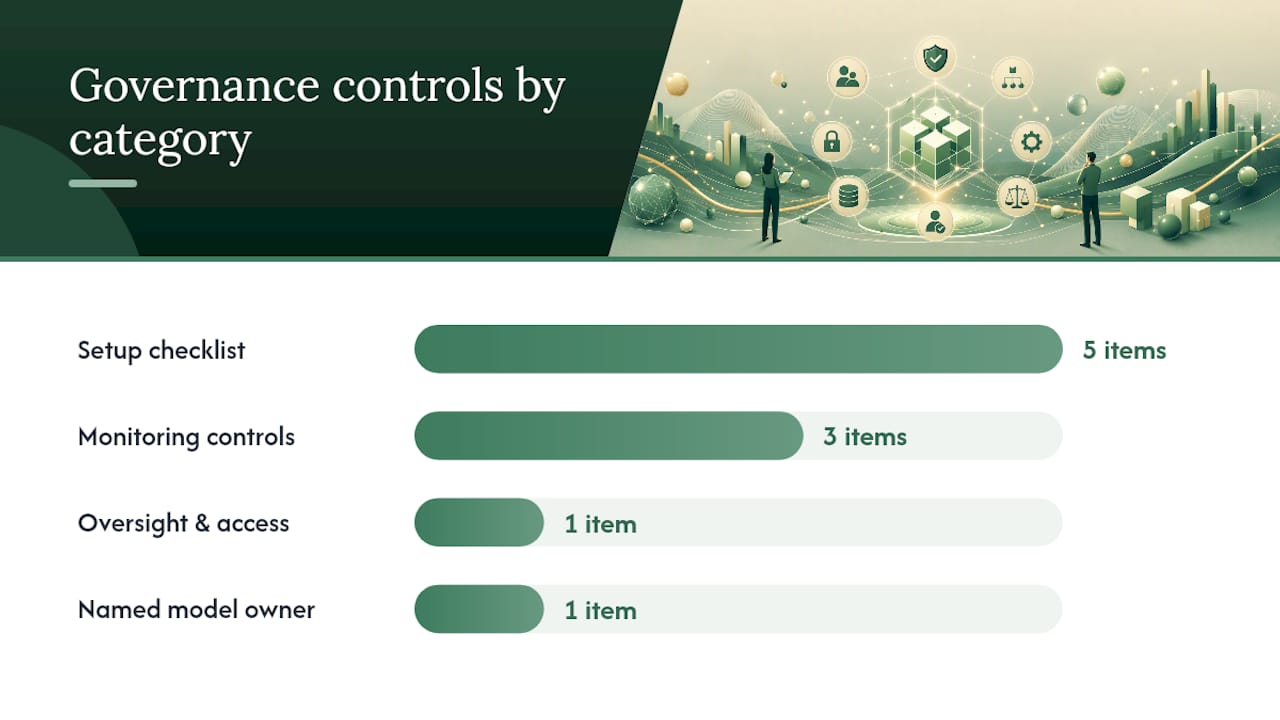
A minimal governance checklist includes:
- Data lineage tracking, so you can trace any output back to its source data.
- Model documentation covering what the model does, its training data, and known limitations.
- Explainability checks that let a non-technical stakeholder understand why a model flagged something.
- Access controls defining who can run agentic queries versus who can only view results.
- Approval gates before a model’s output triggers a real business action, like a budget shift.
Monitoring matters just as much as setup. Drift detection catches when a model’s accuracy degrades as real-world conditions change. Anomaly thresholds and runbooks tell your team what to do when the model throws a false positive, rather than leaving that decision improvised in a Slack thread. Bias checks deserve specific attention in business analytics: watch for sample bias in training data, feature leakage that inflates apparent accuracy, and proxy variables that smuggle in a protected characteristic through a correlated field.
On democratization versus oversight, a workable rule is tiered access: broad natural-language query access for exploration, but a review gate before any AI-generated insight reaches a decision with real budget or personnel consequences. Deeper frameworks for managing this trade-off are covered in analysis of agentic AI’s implications for compliance and risk.
Pro Tip: Assign one named owner for every deployed model, not a committee. Accountability disappears the moment more than one person is “responsible” for monitoring it.
A Compact Example: Agentic Analytics in Practice
Connecting an AI agent to a single API that reaches 448 market-intelligence tools, rather than wiring up each tool individually, shows what a fast agentic pilot looks like:
- Agent queries route through one connector into SEO, ad performance, and competitor data sources.
- Reports generate automatically in formats like PDF, interactive dashboards, or slide decks.
A basic pilot checklist: connect two or three priority data sources, run a handful of test queries against a known competitor, and check the output format matches what stakeholders actually need. Teams typically report cutting research time from days to under an hour.
Security and Privacy Considerations Unique to AI-Enabled Analytics
AI analytics introduces risk categories that traditional BI mostly avoided. A dashboard pulling from a governed warehouse has a predictable data path. An AI agent that can query multiple systems, summarize sensitive fields, and generate a report on demand has a much larger surface area to secure.
The first concern is data exposure through natural-language outputs. A model summarizing customer records in plain English can inadvertently surface personally identifiable information in a report that gets forwarded outside its intended audience. Access controls need to extend to what a model is allowed to retrieve, not just who can log into the dashboard.
The second concern is model-level leakage. Some AI systems, particularly those relying on external APIs, may send data to third-party services for processing. Confirm exactly where your data goes before connecting a sensitive dataset to any AI analytics tool, and read the vendor’s data retention policy rather than assuming it matches your expectations.
Third, agentic systems that can take action, not just generate a report, need stricter permission boundaries than a read-only dashboard. An agent with write access to a CRM or ad platform is a bigger liability if compromised or misconfigured than a chatbot that only answers questions.
Finally, audit trails matter more with AI in the loop. When a model made a recommendation and a human acted on it, you need a record of both the input data and the model version used, particularly in regulated industries where a decision might face later scrutiny.
What Should Analysts Actually Prioritize When Adopting AI?
Treat AI as a layer in your existing stack, not a replacement for it. The teams that get real value connect AI tools to the data and workflows they already trust, rather than standing up a parallel system that nobody fully integrates.
Change management matters more than model accuracy in the first six months. Stakeholders who don’t trust a forecast won’t act on it, no matter how good the underlying model is. Spend real time showing your business partners how a model’s output was derived, not just what it concluded.
My advice: skip the big-bang migration. Run small pilots that scale, each one proving out a specific use case before you touch the next. A narrow win that stakeholders trust beats an ambitious rollout that nobody adopts.
Where Prowl Fits Into an AI Analytics Rollout
Most of the friction in an AI analytics pilot comes from stitching together data sources, not from the modeling itself. Prowl connects any AI agent to 448 market-intelligence tools through one API, so instead of building custom integrations for SEO tracking, ad performance monitoring, and competitor research, an analyst can point an agent at a single connector and get all three.
Common outputs include real-time competitive reports, SEO and ad performance summaries, and pricing or market trend research, delivered as interactive reports, PDFs, or slide decks depending on who needs to see them. For a pilot, this matters because it collapses weeks of tool setup into a single integration step, which is exactly the kind of quick win that builds stakeholder trust for a bigger rollout. Check the use cases for analysts and agencies running similar pilots, or head straight to getting started with Prowl to connect your first agent.
Frequently Asked Questions
What is AI business analytics in simple terms? It’s the use of machine learning, natural language processing, and generative AI to automate analysis, generate insights faster, and let non-technical staff query data directly instead of waiting on a dedicated analyst.
How is AI business analytics different from traditional BI? Traditional BI relies on scheduled dashboards and manual query building. AI analytics adds real-time processing, natural-language access, and increasingly agentic behavior that can flag or act on insights without a direct request.
How long does a typical AI analytics pilot take? A scoped proof of concept usually runs two to six weeks, with validation and stakeholder buy-in adding another four to eight weeks before a wider rollout.
What’s the biggest risk in adopting AI for business analytics? Poor data readiness. Skipping data quality checks is the most common reason pilots produce unreliable outputs and lose stakeholder trust early.
Do analysts need to learn to code to use AI analytics tools? Not necessarily. Natural-language interfaces reduce the coding requirement, but analysts still need strong data literacy to validate what the AI produces before acting on it.
Sources
- How artificial intelligence makes business analytics more actionable | Kogod School of Business
- How AI data analytics is transforming data analytics | Databricks Blog
- AI agents are your new coworkers | Forrester via Forbes
- NNN: Next-Generation Neural Networks for Marketing Measurement | arXiv