
A backlink gap analysis finds domains linking to your competitors but not to you, then ranks those domains into a prioritized outreach list you can act on today. Run it by pulling backlink exports for your site and two to five competitors, filtering out junk links, and scoring what’s left.
- Inputs: your domain plus 2 to 5 competitor domains
- Output: a spreadsheet or CSV of competitor-only referring domains, scored and assigned to an owner
- Time to first action: usually under a day once exports are pulled
Key Takeaways
A backlink gap analysis works because it isolates domains already linking to your competitors, which turns a cold outreach list into a warm one.
| Point | Details |
|---|---|
| Define scope first | Decide root domain, subdomain, or URL comparison before exporting anything. |
| Pick 2 to 5 real competitors | Choose sites that compete for your actual target keywords, not just brand rivals. |
| Score before you outreach | Rank by relevance, authority, link context, and traffic proxy using a 0 to 10 column. |
| Watch link attributes | Nofollow, sponsored, and UGC tags change a link’s real value and outreach worth. |
| Automate the slow steps with Prowl | Prowl pulls, normalizes, and scores backlink exports through one connected workflow. |
Table of Contents
- What Is a Backlink Gap Analysis, Exactly?
- How Do You Run a Backlink Gap Analysis Step by Step?
- How Do You Score and Prioritize Gap Opportunities?
- What Mistakes Wreck a Backlink Gap Analysis?
- How Prowl Speeds Up the Slow Parts of the Process
- What I’ve Learned Running Dozens of These
- Automate the Export, Normalize, and Score Steps With Prowl
- Useful Resources for Backlink Gap Work
- Sources
What Is a Backlink Gap Analysis, Exactly?
A backlink gap is any domain that links to one or more competitors but has never linked to you. If three rivals all get a link from a university resource page and your site doesn’t appear there, that’s a gap worth chasing.
This differs from a general competitor backlink audit, which just catalogs who links to whom. Gap analysis goes a step further: it isolates the difference between link profiles, not the overlap.
- Shared links (you and competitors both have them) tell you what’s table stakes
- Competitor-only links tell you what to go get
- The gap list is where the actual leverage lives, because those site owners have already shown willingness to link to businesses like yours
That last point matters more than most guides admit. A publisher who links to three of your competitors isn’t a cold prospect. They’ve built a pattern.
How Do You Run a Backlink Gap Analysis Step by Step?
The workflow is mechanical once you’ve done it a couple of times. Here’s the reproducible version.
- Define scope. Decide if you’re comparing root domains, a subdomain, or specific URLs (a blog post competing against other blog posts needs URL-level comparison, not domain-level).
- Pick competitors. Choose 2 to 5 domains that actually compete for your target keywords, not just brand rivals. Backlink gap tools typically let you enter a main domain plus several competitors and export the resulting list automatically.
- Export backlink lists. Pull data for every domain in scope, including your own, with consistent fields across all exports.
- Normalize and dedupe. Strip “www,” standardize protocol (http vs https), and collapse subdomain variants so the same publisher doesn’t show up three times under three URL formats.
- Compute the set difference. This is the actual “gap”: domains present in one or more competitor lists but absent from yours.
- Filter by relevance and authority. Cut anything off-topic, spammy, or clearly automated before you waste time scoring it.
- Score and prioritize. Apply a rubric (covered below) and rank rows by likely ROI.
- Export the final CSV and assign owners. Give each row a status column and a name, or nothing gets followed up on.
Step-by-step competitor backlink workflows generally follow this same identify, export, normalize, filter, prioritize sequence, which is why it holds up across tools and team sizes.
Pro Tip: Weight any domain that links to more than one competitor higher in your initial pass. Multi-competitor links usually mean an editorial resource page or a link-friendly publisher, and those tend to convert on outreach at a noticeably higher rate than single-competitor links.
How Do You Score and Prioritize Gap Opportunities?
Not every gap row deserves an email. Score each opportunity on four axes:
- Relevance: does the linking domain’s topic match your niche?
- Authority: where does it sit on Trust Flow, Domain Rating, or your provider’s equivalent metric?
- Link context: is it an editorial mention, a resource page, or a directory listing?
- Traffic proxy: does the page that links to competitors get visible organic traffic, or is it a dead page nobody reads?
Sum those into a single 0 to 10 column and sort. Three tiers usually emerge:
- Quick wins: resource or “best of” pages that already link to multiple competitors and clearly accept additions. Send a short, direct pitch email.
- Relationship plays: bloggers or niche publishers who’ve linked once, organically. These need a warmer, personalized note, not a template blast.
- Editorial targets: journalists or high-authority sites that linked to a competitor’s data or research. Pitch your own data, not your homepage.
Pro Tip: Don’t email every row in one week. A batch of 20 highly targeted quick wins outperforms 200 generic blasts, and it protects your sender reputation for the next round.
What Mistakes Wreck a Backlink Gap Analysis?
Most wasted outreach traces back to a handful of avoidable errors:
- Chasing link farms and low-relevance directories just because they show up in a competitor’s list
- Ignoring rel=“nofollow,” “sponsored,” or “UGC” attributes, then being surprised when the link carries no ranking value
- Treating scraped or boilerplate links (footer credits, widget badges) as genuine editorial opportunities
- Skipping domain normalization, so “blog.example.com” and “example.com” get counted and outreached twice
- Comparing root domains against subdomains inconsistently, which inflates or shrinks the gap list depending on which competitor uses which structure
Backlinks still carry ranking weight, but their value depends far more on relevance and editorial context than raw count. A gap list full of low-context links is worse than a short one built on real fits.
How Prowl Speeds Up the Slow Parts of the Process
Most of the time in a gap analysis goes to exporting, normalizing, and scoring, not to the strategic thinking. That’s the part worth automating:
- Pulls backlink data for your domain and every competitor in one pass instead of separate manual exports
- Normalizes hostnames and dedupes automatically before you ever open a spreadsheet
- Applies scoring logic across relevance, authority, and link context
- Exports clean CSVs with API hooks that plug into an agency’s existing reporting stack
What I’ve Learned Running Dozens of These
Fewer, sharper targets beat volume almost every time. A list of 15 domains that already link to two competitors will out-convert 150 random referring domains scraped without filtering.
Rerun the analysis quarterly, not monthly. Link profiles don’t shift fast enough to justify more, and quarterly cadence gives you clean before/after data to measure which outreach actually moved rankings.
— Sergey
Automate the Export, Normalize, and Score Steps With Prowl
Prowl gives you one connection point to 444 market intelligence tools, so the export, dedupe, and scoring steps in this workflow run through a single automated pipeline instead of five separate logins and a manual spreadsheet merge.
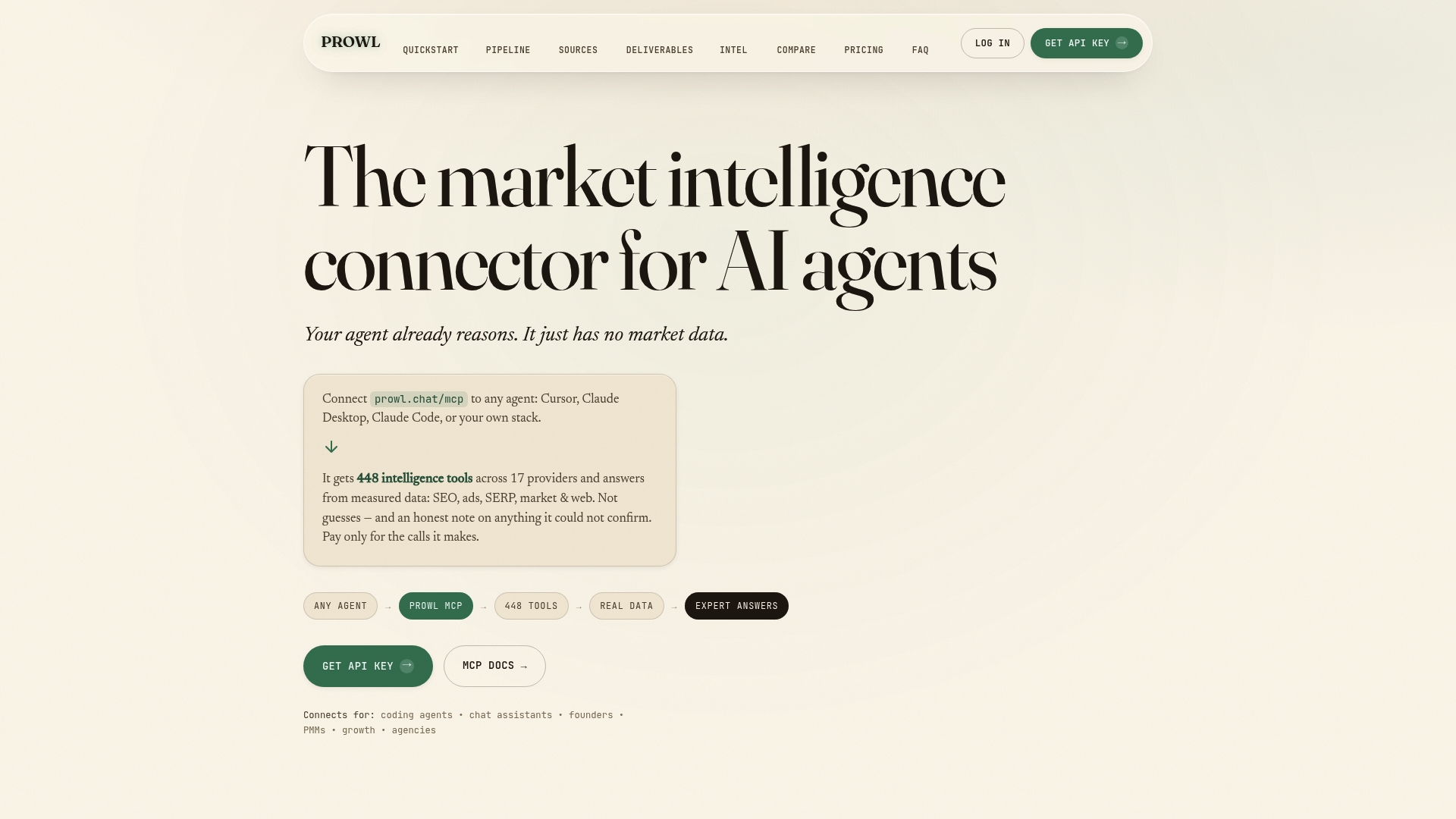
Getting started takes one setup step: connect your agent to the Prowl MCP and point it at your domain plus your competitor list. From there it pulls the backlink data, normalizes hostnames, scores each row against relevance and authority, and hands you a CSV ready for outreach assignment. Agencies running this monthly for multiple clients can see the full setup on the Prowl use cases page. If you want to see the platform itself before connecting an agent, start at Prowl.
Useful Resources for Backlink Gap Work
- How to Conduct a Competitor Backlink Analysis, a practical workflow reference
- Majestic’s Flow Metrics, for Trust Flow and Citation Flow scoring
- Backlink Gap Analyzer Overview, for tool-specific export behavior
- Shared backlink export fields checklist, for a ready spreadsheet template
Sources
Not every index sees the same web. Fresh crawlers catch recently built links fast; deeper historical indexes catch older resource pages that a newer crawler might miss entirely. Running both a fresh and a historical pull, then merging results, catches more of the real gap than either alone.
Export at minimum:
- How to Conduct a Competitor Backlink Analysis
- Majestic — backlink intelligence and Flow Metrics
- Backlink Gap Analyzer Overview - Knowledge Base
On the authority metric: Majestic’s Trust Flow and Citation Flow are widely used quality signals precisely because they separate trust-weighted link quality from raw link volume, which raw backlink counts alone don’t capture. Include a topical relevance score if your data source offers one.
API access processes faster at scale but takes setup time; UI exports are immediate but cap out quickly on large competitor sets. For a one-off analysis, UI exports are fine. For a recurring monthly process, an API pull into a shared spreadsheet saves real time.