
Brand sentiment analysis is the practice of measuring the emotional tone behind mentions of your brand, whether that’s a review, a tweet, or a call transcript, and converting that tone into a trackable score. The simplest version of that score is a ratio: positive mentions divided by total mentions. Before you buy a tool or hire an agency, do one thing first.
Map your top three to five data sources (social, reviews, support tickets, surveys) and compute a baseline this week. You cannot improve what you have not measured, and most brand teams skip this step and jump straight to dashboards.
- Pick your 3–5 loudest channels (where your customers actually talk about you)
- Pull the last 30 to 90 days of mentions from each
- Calculate positive mentions ÷ total mentions for a rough starting score
- Write that number down. It’s your baseline for every future comparison.
TL;DR:
- Mapping three to five key data sources and calculating a positive mentions ratio creates a baseline to measure future sentiment trends accurately.
- Combining social, review, survey, and support channel data into one framework improves early detection of product issues and crisis signals.
- Aspect-based analysis and regular calibration of models enhance the accuracy of sentiment insights and tie them to specific customer concerns.
- Automated tools like Prowl streamline real-time sentiment reporting, reducing setup time and enabling faster decision-making.
- Focusing on clearly defined objectives and proper source validation yields more actionable insights than relying solely on a single overall sentiment score.
Table of Contents
- What Brand Sentiment Measures and Why It Matters
- How Do You Build a Sentiment Measurement Framework?
- What Features Should You Look for in a Sentiment Tool?
- Is Your Sentiment Score Actually Good?
- What Mistakes Distort Sentiment Data?
- How Should Sentiment Data Drive Decisions?
- How Prowl Speeds Up Brand Sentiment Programs
- What Most Brand Teams Get Wrong About Sentiment Scores
- Get Sentiment Reports Without Building the Pipeline Yourself
- Key Takeaways
- Sources
What Brand Sentiment Measures and Why It Matters
Sentiment is not the same thing as awareness, and it’s not the same thing as Net Promoter Score. Awareness tells you how many people know your brand exists. NPS asks a narrow question about likelihood to recommend, usually captured at one moment through one channel. Sentiment analysis, by contrast, aggregates emotional tone across everything people say about you, unprompted, in their own words, across social posts, star reviews, and support calls.
That distinction matters because sentiment tends to move before the metrics finance actually watches. A dip in how people talk about your checkout experience often shows up weeks before churn numbers confirm it. Sprinklr’s research on brand sentiment measurement shows that aggregating social, review, survey, and contact-center data reveals not just tone but the specific drivers behind it, which is exactly the detail a pure NPS score can’t give you.
A few things sentiment tracking does that other metrics don’t:
- Flags emerging product complaints before they hit support ticket volume
- Surfaces which specific features or moments drive negative mentions, not just that negativity exists
- Gives PR and crisis teams an early warning system independent of sales data
- Connects marketing campaign language to how audiences actually respond, in real time
How Do You Build a Sentiment Measurement Framework?
A sentiment score without a process behind it is just a number nobody trusts. Here’s the operational sequence that turns raw mentions into something your CMO will actually act on.
- Define objectives and KPIs. Decide upfront whether you’re tracking crisis risk, campaign performance, or product feedback. Each goal changes what you measure and how often.
- Map sources and constraints. List every channel, note API access limits, language coverage, and data retention rules before you build anything.
- Ingest and normalize. Pull raw text into one pipeline and standardize formats (timestamps, language tags, source labels) so comparisons across channels actually mean something.
- Choose your analysis depth. Document-level sentiment (is this post positive or negative?) is fast but shallow. Aspect-based sentiment (what specifically do they like or hate?) and emotion detection (anger versus disappointment) cost more but drive better decisions. Chattermill’s analysis of AI sentiment tools found that aspect-based sentiment is what lets enterprise teams tie specific product issues to churn, rather than just knowing that overall mood dipped.
- Validate and calibrate. Pull a sample, have humans label it, and compare against your model’s output before you trust it at scale.
- Compute scores and trends. The base formula stays simple: positive mentions ÷ total mentions. For a more useful comparison across time periods and channels, normalize it: (positive − negative) ÷ total mentions, which gives you a score that can go negative and better reflects real swings in mood.
- Set alerts, reports, and ownership. Decide who gets pinged when sentiment drops below a threshold, and who owns the weekly or monthly report.
Statistic to know: YouGov’s work on sentiment tracking notes that modern NLP models can reach high classification accuracy on digital and social text, which is precisely why automated scoring has become viable at the volume most brands now generate.
Pro Tip: Run your normalized sentiment score alongside a 7-day rolling average, not just a daily snapshot. Daily sentiment swings wildly with volume; a rolling average filters the noise so you can see the actual trend line your team should react to.
Checkpoints worth building into this process: recalibrate your model every quarter as slang and product language shift, and re-run inter-annotator agreement checks any time you add a new channel or language.
What Features Should You Look for in a Sentiment Tool?
Choosing a vendor, or deciding to build your own pipeline, comes down to a short list of capabilities that actually separate a usable tool from a pretty dashboard nobody trusts.
- Multichannel ingestion with real language coverage. A tool that only handles English social posts leaves your review and support data on the table.
- Aspect-based analysis. You want to know that complaints cluster around “shipping speed,” not just that overall sentiment fell three points.
- Sarcasm and nuance handling. This remains the hardest technical problem in the category, and no tool solves it perfectly, so budget for human review regardless of what a vendor promises.
- Real-time alerts and anomaly detection. Brand24’s research on sentiment dashboards points to real-time alerting as the feature that most directly stops a small negative spike from becoming a full crisis.
- Integrations and export formats that match how your team actually reports, whether that’s Slack alerts or a CSV feed into your BI tool.
- A clear path from sentiment to KPI. The tool should let you connect sentiment trends to NPS, CSAT, and churn, not just display a mood score in isolation.
- Developer or API access if you need custom scoring logic. AWS’s overview of sentiment analysis notes that cloud NLP services now offer scalable APIs specifically for teams building their own pipelines rather than buying an off-the-shelf dashboard.
- Multimodal readiness. Gartner projects that a large share of generative AI solutions will handle multiple data types by 2027, so a tool that only reads text today may need an image or audio upgrade path sooner than you’d think.
Cost usually scales with mention volume and language count, so estimate your actual monthly mention volume before you commit to a tier.
Is Your Sentiment Score Actually Good?
A raw sentiment number means almost nothing without context. A 62% positive score sounds fine until you learn your closest competitor sits at 78%, or that your own score was 74% last quarter.
- Normalize before you compare. A channel with 200 mentions and one with 200,000 need different confidence treatment; don’t weight them equally in a single blended score.
- Track against your own history first. Your baseline from week one becomes the yardstick every future score gets measured against.
- Layer in peer benchmarks where you can get them, but treat competitor sentiment data as directional, not precise, since methodology varies between tools and vendors.
- Break scores down by topic, not just overall. Aspect-level benchmarking, tracking sentiment specifically around pricing, support, or a new feature, tells you where to act.
- Flag low-volume signals as uncertain. A single angry cluster of 15 mentions shouldn’t move your headline score the way 1,500 mentions would; show a confidence range, not just a number.
When you present this to stakeholders, a trend line paired with the top three topic drivers behind any move beats a single score every time. Executives remember “sentiment dropped four points because of shipping delays” far longer than they remember “sentiment is 61%.”
What Mistakes Distort Sentiment Data?
The most common failure in sentiment programs isn’t a bad model. It’s dirty input. Noise from irrelevant mentions, sarcasm, and competitor chatter mixed into your own brand’s data pollutes results long before any algorithm gets a chance to help.
- Sarcasm and irony routinely flip a model’s read on a post, especially in social replies and app store reviews.
- Sampling bias creeps in when you only pull from channels where your loudest, angriest customers post, skewing the whole score negative.
- Slang and regional language drift age a model fast; last year’s training data won’t catch this year’s phrasing.
- Validate with a real process: sample a batch of mentions, have a small team label them independently, measure inter-annotator agreement, then check a confusion matrix for where the model actually fails before you trust it at scale.
Pro Tip: Set a hard rule: any cluster of negative mentions above your normal daily volume gets routed to a human reviewer within hours, not queued for the weekly report. Automated scores catch volume; humans catch the specific complaint that’s about to go viral.
How Should Sentiment Data Drive Decisions?
Sentiment data that lives in a dashboard nobody checks is wasted infrastructure. Ownership needs to be explicit: PR typically owns crisis-threshold alerts, product owns aspect-level feedback loops, and marketing owns campaign-lift measurement, with CX often sitting across all three as the connective function.
- Set alert thresholds tied to a specific percentage drop or spike, not vague “keep an eye on it” instructions.
- Use sentiment for campaign lift by comparing tone before, during, and after a launch, not just clicks and conversions.
- Feed aspect-level negative clusters straight into product’s backlog review, with volume and trend attached.
- Run a standing biweekly review where marketing, product, and CX look at the same trend line together, so nobody’s reacting to a stale screenshot.
Impact-weighted sentiment, multiplying polarity by the estimated customer volume affected, gives finance teams a rough sense of revenue risk behind a negative spike, turning a soft metric into a number a CFO will actually read.
How Prowl Speeds Up Brand Sentiment Programs
Most of the delay in a sentiment program isn’t the analysis. It’s the setup: connecting a dozen APIs, exporting to five formats, reconciling channels by hand. Prowl removes that layer by connecting one MCP to 444 market intelligence tools, so an agent can pull social, review, and competitive data and generate a real-time report without stitching together separate platforms.
- One connection point instead of a dozen individual tool integrations
- Real-time analytics reports generated on demand, not batched weekly
- Output synthesized directly into PDFs, dashboards, or presentation decks
- Faster QA cycles because ingestion and comparison happen in the same workflow
That combination compresses the gap between “we noticed a sentiment dip” and “we know why,” which is where most brand teams currently lose days. Details on the full toolset are outlined at Prowl.
What Most Brand Teams Get Wrong About Sentiment Scores
The conventional advice treats sentiment as a single health metric, something you check like a stock price. That framing undersells what the data can actually do and oversells what one number means. A 3-point drop in overall sentiment tells you almost nothing actionable on its own. A 3-point drop concentrated in mentions of your support wait times tells product and CX exactly where to look.

Most programs also overinvest in model accuracy and underinvest in the boring part: source mapping, sampling discipline, and a real validation loop. A slightly less accurate model with clean, well-sampled input will outperform a state-of-the-art model fed noisy, unrepresentative data every time.
The single biggest priority for a team starting today isn’t picking the best tool on the market. It’s deciding, in writing, what decision each sentiment metric is supposed to inform, then building the pipeline backward from that decision. Score first, purpose later, is how most sentiment dashboards end up ignored by month three.
— Sergey
Get Sentiment Reports Without Building the Pipeline Yourself
Running the framework above by hand means juggling social APIs, review scrapers, survey exports, and a separate BI tool just to see one trend line. Prowl gives marketing teams and analysts a single connection point instead, one MCP linked to 444 intelligence tools that pull competitor, review, and social data into a real-time report without the manual stitching.
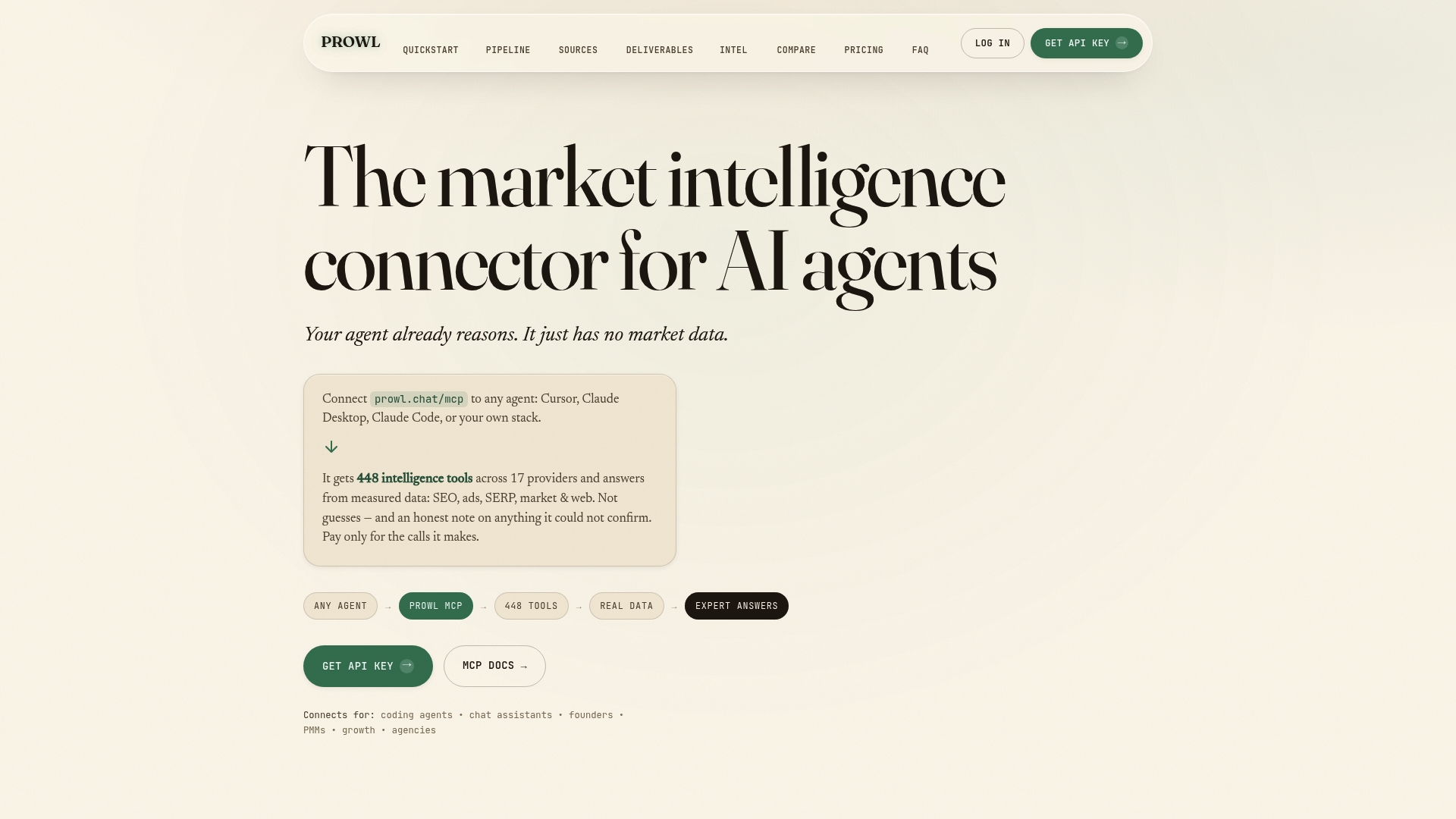
That matters most for teams who need an answer this week, not after a six-week vendor rollout. You can generate a sentiment or competitive report, export it as a dashboard, PDF, or deck, and hand it straight to stakeholders instead of building the tooling from scratch. If you’re evaluating how this fits your workflow, the use cases for market intelligence walk through specific report types teams run today. When you’re ready to connect it to your own agent or workflow, the setup guide for Prowl covers the API basics to get your first report running.
Key Takeaways
Brand sentiment analysis works best as a measurement framework tied to specific decisions, not a single score checked in isolation.
| Point | Details |
|---|---|
| Start with a baseline | Map your top 3–5 data sources and calculate positive ÷ total mentions this week. |
| Combine channels | Blend social, reviews, surveys, and support transcripts for a fuller sentiment picture. |
| Use aspect-based analysis | Break scores down by topic so teams know exactly what drove a shift. |
| Validate before trusting scale | Sample mentions, check inter-annotator agreement, and route negative clusters to human review. |
| Automate the pipeline | Prowl connects one MCP to 444 intelligence tools to generate real-time sentiment and competitive reports without manual setup. |
Sources
Sentiment analysis draws its power from breadth. A program built only on Twitter mentions will miss the customer who left a scathing three-star review on your app store listing, or the caller who told your support rep the new pricing page confused her. Sprinklr’s guidance on brand sentiment treats social, reviews, surveys, and contact-center interactions as a single connected dataset, not four separate reports.
- YouGov — sentiment tracking
- Sprinklr — How to Measure Brand Sentiment (With Real-World Insights)
- Chattermill — AI sentiment analysis tools for CX (2026)
- Gartner — generative AI multimodal prediction (press release)
Manual coding works when you need nuance on a small, high-stakes sample, like reading through 200 churn interviews by hand. Automated models scale across millions of mentions but need calibration. Most mature programs run a hybrid: automated scoring for volume, manual review for anything flagged as ambiguous or high-risk.