
A creative fatigue analysis answers one question: is this specific ad losing its pull because people have seen it too often, or is something else dragging results down? The reliable method is to compare each creative with its own baseline, track CTR, CPC, conversion rate, frequency and reach together, and check that the decline is concentrated in one ad before you blame fatigue. This guide walks through that process step by step, shows how to rule out look-alike causes, and covers what to do once you have a diagnosis.
TL;DR
- Creative fatigue is falling responsiveness (CTR or conversion rate) as people repeatedly see the same creative. It is measured per ad, not per account.
- No single metric proves it. Look for a pattern: CTR down, CPC or CPA up, frequency up while reach flattens, all against that ad’s own history.
- Frequency alone misleads, because platforms report it at the ad, ad set or campaign level rather than for the creative itself.
- Before you call it fatigue, rule out seasonality, offer changes, tracking breaks, landing page problems and auction pressure.
- Fix it by adding genuinely different concepts or reaching new audiences, then monitor on a schedule so you catch the next decline early.
Table of Contents
- What creative fatigue actually is
- The metrics that signal creative fatigue
- How to run a creative fatigue analysis, step by step
- Fatigue or something else? Rule out the look-alikes
- Fixing creative fatigue: what to change
- Build a monitoring routine
- Perspective: why fatigue analysis breaks down across tools
- Where Prowl fits in your analysis
- FAQ
- Sources
What creative fatigue actually is
Analytics at Meta defines creative fatigue as a decline in responsiveness, such as lower CTR or conversion rate, that results from users seeing the same creative elements again and again. The key word is creative. It is about the visual and messaging elements of one ad, not about the audience being used up.
That distinction matters for diagnosis. Ad fatigue is the broader umbrella: Amazon Ads describes it as covering both creative fatigue and audience fatigue. If a single ad is decaying while its siblings hold steady, you have a creative problem. If everything in an ad set sinks together, the audience, the offer or the market is the likelier culprit.
It also helps to know that wear-out is not universal. Academic work on 30 natural experiments on the Yahoo! Front Page found that four campaigns wore out after only one or two exposures, while ten showed little wear-out after as many as 50 impressions. A meta-analysis in the Journal of Advertising put maximum consumer attitude at roughly 10 exposures, and noted that the best frequency depends on context. The takeaway: there is no magic number that applies to every ad, so your analysis has to be built around each creative’s own behavior.

The metrics that signal creative fatigue
Build the analysis on a small set of metrics, read together and tracked over time by creative ID.
| Metric | What fatigue looks like | What it can also mean |
|---|---|---|
| CTR | Steady decline after a strong start | Weaker placement mix, seasonality |
| CPC | Rising as CTR falls | Auction competition |
| Conversion rate | Slipping on the same landing page | Site issue, offer change, tracking break |
| CPA | Climbing | Any of the above, plus budget changes |
| Frequency | Rising | Small audience, budget increase |
| Reach | Flattening while frequency rises | Audience too narrow |
Search Engine Land recommends tracking CTR, CPC and conversion rate over time, comparing each ad with its own historical benchmarks, accounting for seasonality and placement, and analyzing by creative ID. The same piece points out that when frequency rises but reach plateaus, the ad is repeatedly hitting the same people rather than finding new ones.
Why frequency alone is not enough
Frequency is the metric most people check first, and it is the easiest to misread. Meta’s analytics team says frequency is a poor signal for fatigue because it is reported at the ad, ad set or campaign level, not at the level of the creative. An ad set running five different concepts can show a frequency of 4 while each concept has been seen far fewer times.
So use frequency as a prompt to investigate, never as the verdict. Pair it with the response metrics: if frequency is climbing and CTR is not moving, the audience may still like the ad.
Know the normal decay curve
Every ad declines eventually. Search Engine Land notes that a strong ad typically follows a predictable curve, with engagement dropping about 20 to 30% week over week as it nears the end of its run, and that a faster fall usually means something else needs fixing. A high initial CTR followed by a gradual slide is usually the sign of a strong performer reaching the end of its life, not a failed one.
How to run a creative fatigue analysis, step by step
- Pull data at creative level. Export performance by creative ID, daily or weekly, for the full life of each ad. Account-level averages hide the very decay you are looking for.
- Set each ad’s baseline. Use its own peak or first stable week as the reference for CTR, CPC and conversion rate. Compare the ad with itself, not with a universal benchmark.
- Chart the trend. Plot CTR and CPA against cumulative impressions or days live. Look for a sustained slope, not a single bad day.
- Add frequency and reach. Check whether frequency is rising while reach flattens. That combination suggests the same people are seeing the ad repeatedly.
- Compare with siblings. Look at other ads in the same ad set, with the same audience and offer. If they hold steady and one decays, fatigue is the likely cause.
- Rule out other explanations. Run the checklist in the next section before deciding.
- Decide and log. Record the diagnosis, the action taken and the date, so the next review has context.
A small worked example: an ad launches at a 1.8% CTR. Three weeks later it sits at 1.1%, CPC has risen, frequency has moved from 1.4 to 3.2 and reach has barely grown. The two other ads in the ad set are flat at around 1.6%. That is a textbook case: decline isolated in one creative, with the audience-side signals pointing the same way. Retire or rework that ad, and leave the others alone.
If you want to see how agencies structure creative-level comparisons, our walkthrough on experiment-first ad creative analysis covers the workflow in more detail.
Fatigue or something else? Rule out the look-alikes
Declining CTR and rising CPA are symptoms, and creative fatigue is only one cause. Before you commit budget to new creative, treat fatigue as a hypothesis and check:
- Seasonality and promotions. A holiday spike or a finished sale changes response without any creative wearing out.
- Auction competition. More bidders raise CPC for every ad in the account at once.
- Offer and landing page. If conversion rate drops but CTR holds, look at the page, the price and the checkout, not the ad.
- Tracking. A broken pixel, a changed event or an attribution shift can mimic a collapse in performance.
- Stock and delivery. Out-of-stock products and delivery changes hit conversions directly.
- Budget changes. A sudden budget increase pushes delivery into weaker pockets of the audience.
The pattern is the clue. A decline across many ads at the same moment points to a broader problem. A decline concentrated in one ad, with its neighbors still performing, points to fatigue. When you do test replacements, keep the offer and landing page stable so you are measuring the creative and nothing else.
No single threshold settles this either. Context changes by objective, audience, platform, placement, format and spend, which is why a pattern of change against the ad’s own baseline is a better test than a fixed number copied from a blog post.
Fixing creative fatigue: what to change
Meta’s analytics team says advertisers can respond by adding new creative to fatigued ad sets or targeting new audiences. The same report found that refreshing creative in high-fatigue cases improved conversion rates by an average of 8%. Treat that as a directional figure from one platform’s analysis, not a promise for your account.
The quality of the refresh decides whether it works. Academic research on advertising wear-in and wear-out found an inverted U-shaped response for ads with low divergence and relevance, while highly divergent and relevant ads showed little wear-out. In practice, that argues for new concepts, not cosmetic edits.
Change the idea, not just the color
Swapping a button color or a headline word often produces an ad that the audience reads as the same one. Vary the angle: a different customer problem, a different proof point, a different format (static, short video, user-style testimonial), a different opening hook. Teams that only count assets can fool themselves, because ten files built on one idea behave like one ad.

Rotate and stagger
Launch new concepts before the current winner is fully spent. If you have to wait for a clear collapse, you have already paid for the decline. A rolling pipeline, where one or two new concepts enter testing each cycle, keeps the account supplied without emergency rebuilds.
Widen the audience when the creative is still strong
If the ad is performing but frequency is climbing and reach is flat, the creative may be fine and the pool too small. Adding fresh audiences extends the life of a good ad at no creative cost.
For teams working on the response side as well, a guide to conversion rate optimization tips can help you check that the page behind the ad is not the real bottleneck. And if you would rather hand production or media buying to specialists, paid advertising services can carry the creative refresh cycle for you.
Build a monitoring routine
A one-off analysis helps. A routine prevents most of the damage.
- Weekly: review CTR, CPC and CPA by creative ID against each ad’s baseline. Flag any ad down meaningfully for two consecutive weeks.
- On each flag: run the look-alike checklist, then compare with sibling ads.
- Monthly: review concept-level performance, not just ad-level, to see which angles are running out of road.
- Always: keep a short log of launches, refreshes and results, so you learn how long your own creatives last.
Over a few months, that log gives you something no blog can: the typical lifespan of your creatives, by platform and format. That is a far better trigger for refreshes than any borrowed rule of thumb.
It also helps to define your KPIs once and keep them consistent. Our notes on key performance indicators for ads outline the metrics most teams standardize on.
Perspective: why fatigue analysis breaks down across tools
We see the same failure again and again. The data needed for a fatigue diagnosis lives in several places: ad platform exports, analytics, competitor ad libraries, reviews, pricing pages. Each one tells a piece of the story, and stitching them together by hand is where the analysis stalls, or gets skipped.
Our view is that fatigue should be diagnosed as a cross-referenced pattern, not read off one dashboard number. A falling CTR means little until you have checked whether competitors changed their messaging, whether the market shifted, and whether the decline is isolated to one concept. That is why we built Prowl as a single connector that lets an AI agent or workflow reach 444 marketing intelligence tools through one API, so the agent can pull ad performance, competitive ad activity and market context in one pass.
We also care that every number can be traced to its source. A fatigue report is only worth acting on if you can see where each figure came from, and where coverage has gaps. Our approach is to make that visible, so your team spends its time deciding what to change, not chasing exports.
Prowl Team
Where Prowl fits in your analysis
If you run fatigue reviews across several clients or channels, the slow part is rarely the thinking. It is gathering and normalizing data. Prowl connects your agent or workflow to marketing intelligence tools through one endpoint, so you can generate reports on ad performance, competitor creative and market trends without setting up each integration yourself, and deliver them as interactive reports, PDFs, PPTX and other formats.
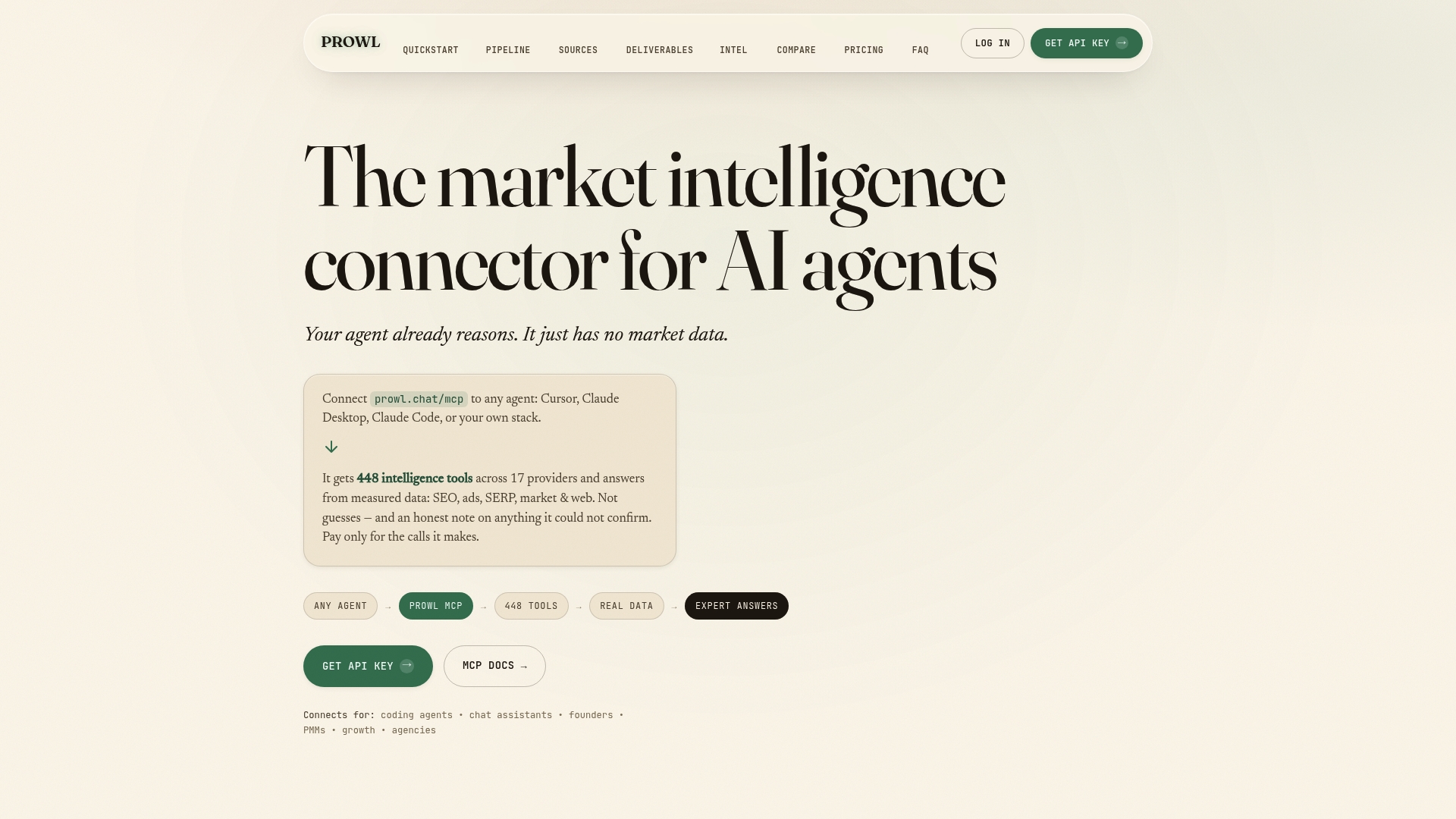
Plans are published on the Prowl pricing page: Exploit is $60 per month, Blackops is $120 per month and Syndicate is $240 per month, and there is a Recon plan as well. If you prefer pay-as-you-go, credits come in $10, $50 and $200 top-ups, one-off. You can see the full platform on the Prowl homepage.
Two related guides show the workflows in practice: ad performance analysis with one connector and analyzing competitor ads, which helps when you need fresh angles to replace a fatigued concept.
FAQ
What is creative fatigue?
Creative fatigue is a decline in how people respond to an ad, such as lower CTR or conversion rate, caused by seeing the same creative elements repeatedly. It applies to a specific creative, not the whole audience or account. Ad fatigue is the wider term that also includes audience fatigue.
How do you detect creative fatigue?
Track CTR, CPC, conversion rate, frequency and reach by creative ID and compare each ad with its own baseline. Look for CTR falling and CPC or CPA rising while frequency climbs and reach flattens. Then confirm that sibling ads with the same audience and offer are not declining too.
Is a high frequency always a sign of fatigue?
No. Frequency is reported at the ad, ad set or campaign level, so it does not show how often people saw one specific creative. Treat a high number as a reason to check response metrics, not as proof.
How often should I refresh ad creative?
There is no universal schedule, because wear-out varies by audience, format, platform and spend. Review performance weekly against each ad’s baseline, launch new concepts before the current winner is spent, and use your own log of creative lifespans to set the cadence.
Sources
- Creative Fatigue: How advertisers can improve performance by managing repeated exposures (Analytics at Meta)
- Your ads are dying: How to spot and stop creative fatigue (Search Engine Land)
- What is Ad Fatigue? How to Diagnose, Prevent, and Cure It (Amazon Ads)
- Worn-Out or Just Getting Started? The Impact of Repetition (AEA conference paper)
- Advertising Repetition: A Meta-Analysis on Effective Frequency (Journal of Advertising)
- The effects of creativity on advertising wear-in and wear-out (Journal of the Academy of Marketing Science)
- Conversion rate optimization tips: the digital marketer’s guide
- Paid advertising services