
Review mining is the practice of collecting customer reviews at scale and analyzing their text to find recurring themes, unmet needs, complaints and praise, so you can make product, marketing and positioning decisions from what customers actually say. Done well, it replaces guesswork about “what customers think” with counted, traceable evidence. Done badly, it produces a word cloud and a false sense of certainty. This guide covers what review mining reveals, how to prepare the data, which techniques fit which question, and how to check your findings before they reach a slide deck.
TL;DR
- Review mining turns unstructured review text into counted themes, sentiment and needs. Start from a decision, not from a pile of data.
- Reviews can surface needs that interviews miss: in one academic study, they held eight customer needs that interviews and focus groups did not.
- Clean and structure the data first (source, date, rating, product version, language, duplicates), then split reviews into single statements before grouping them.
- Pick the technique by question: sentiment for tone, aspect-based analysis for features, topic modeling for unknown themes.
- Reviews skew extreme and can include personal data, so validate findings and handle the text responsibly.
Table of Contents
- What review mining is and what it reveals
- Start with a decision, not a dataset
- Collecting and preparing review data
- Review mining techniques and what each one uncovers
- A practical review mining workflow
- Validating findings and avoiding false patterns
- Privacy and responsible use
- Our perspective
- Put review mining into a repeatable workflow
- Where review mining fits next
- FAQ
- Sources
What review mining is and what it reveals
A review is a free-text answer to a question nobody asked: “What was it like to use this?” Review mining collects thousands of those answers and sorts them into patterns. The sources vary: app stores, marketplaces, G2-style software directories, local listings, social posts and support tickets all work, as long as the text describes real experience with a product or service.
The case for doing it comes from research on product development. A study by Timoshenko and Hauser, summarized by Kellogg Insight, found that 97% of the customer needs identified in interviews and focus groups for oral-care products also appeared in Amazon reviews. The reviews also contained eight additional needs, nearly 10% of the total, that the interviews never surfaced.
Two reasons explain why. Timoshenko points out that reviews reach customers who would never join a focus group. And people tend to write a review right after using a product, while interview participants may have last used it a month or two earlier.
In practice, review mining answers questions like these:
- Product: Which missing feature is mentioned most often by people who gave three stars?
- Positioning: What words do customers use to describe the benefit, and are they different from the words on our homepage?
- Competitive: What do customers of an alternative praise and complain about, and where is the gap?
- Pricing: How often does “too expensive” appear, and next to which feature?
- Operations: Is a complaint tied to one product version, one location or one onboarding step?
The link between listening to customers and business results is a recurring theme in growth writing. One overview of customer feedback and revenue growth shows how feedback can be tied to the work your team ships. Review mining is the scalable version of that habit.
Start with a decision, not a dataset
The most common failure is mining “everything” and hoping a story appears. A 2026 workflow guide recommends writing down the basics before you collect a single review: who owns the research, what decision it informs, the product and customer scope, the time period, what you are comparing against, how much evidence counts as a pattern, and what output you will produce.
A useful brief fits in five lines:
- Decision: Should we prioritize a mobile redesign or faster onboarding next quarter?
- Scope: Our app and the three closest alternatives, US English reviews, last 12 months.
- Comparison: Our themes against theirs, and our themes this quarter against last.
- Threshold: A theme counts only if it appears in at least a set share of reviews, and across more than one source.
- Output: A one-page ranked list of themes with example quotes and counts.
The threshold matters more than it looks. Without it, one vivid complaint gets treated as a trend.
Collecting and preparing review data
Good analysis starts with a boring step: making the data consistent. The same guide suggests normalizing each review into a record with fields such as a review ID, original text, cleaned text, source, date, rating, product or version, customer segment, experience stage, language and a quality status. You will not need every field, but source, date, rating and version are close to essential, because they let you see whether a theme is rising or fading and whether it belongs to one release.

Know what bad data looks like
Research on automated processing of user feedback by Maalej lists the main reasons for poor feedback quality: missing, erroneous, inconsistent, ambiguous, incorrectly formatted and outdated values. The same paper recommends going beyond ordinary text cleaning. Annotate with sentiment scores, mask sensitive parts, assess quality and authenticity, add demographic data where you have it, and augment with context such as interaction traces.
A short preparation checklist:
- Deduplicate. Cross-posted or repeated reviews are not separate opinions.
- Separate products and markets. Do not blend two product lines or two countries into one pool.
- Flag low-quality text. One-word reviews, spam and off-topic posts go in a separate bucket, not the bin, so you can report how much you excluded.
- Keep the original text. Always store the raw review next to the cleaned one so every finding can be traced back.
- Mask personal details. Names, handles and any person mentioned in the text should be anonymized before sharing.
On authenticity: in the US, the FTC finalized a rule in August 2024 banning the sale or purchase of fake reviews, including AI-generated fake reviews. That does not clean the existing pile, so authenticity checks still belong in your preparation step.
Review mining techniques and what each one uncovers
A 2024 survey by Malik and Bilal reviewed 154 publications from 2013 to 2023 and describes the main families of methods: sentiment classification, opinion mining, aspect-based sentiment analysis, emotion analysis, topic modeling, summarization and deep learning. Here is how they map to real questions.
| Technique | Question it answers | Typical output | Watch out for |
|---|---|---|---|
| Sentiment classification | Are people mostly happy or unhappy? | Positive, neutral, negative share over time | Sarcasm and mixed experiences get mislabeled |
| Aspect-based sentiment | How do people feel about price, support, battery, onboarding? | Sentiment per feature | Needs a sensible list of aspects |
| Topic modeling | What are people talking about that we did not expect? | Clusters of related words and reviews | Clusters need human naming and checking |
| Emotion analysis | Is it frustration, confusion or delight? | Emotion tags | Finer labels, less reliable |
| Summarization | What is the gist of 5,000 reviews? | Short written summaries | Can smooth over minority views |
| Thematic coding | What recurring themes exist, and how often? | Codes with counts and quotes | Slow by hand, fast with an LLM and review |
The techniques combine well. A 2025 paper on cultural heritage reviews, for example, used topic modeling to find latent topics and a sentiment service to score the tone of each. That two-step pattern, find the topics first and then measure sentiment inside each, is a solid default for most teams.
Why aspect-level beats overall sentiment
An overall score hides the useful part. A four-star review that praises the product and complains about shipping carries two signals. Amazon’s machine learning team described why natural-language reviews are hard: text length varies, signal and noise sit together, and it is difficult to identify keywords, topics and entity-level sentiment.
The workaround is to split reviews into atomic statements before grouping them. The workflow guide above warns that otherwise a general “mixed experience” label can bury the detail you can act on. “Love the dashboard” and “export is broken” should land in different buckets, even when they come from one review.
If you want a deeper walkthrough of the sentiment layer, see our review sentiment analysis pipeline and the broader brand sentiment analysis framework.
A practical review mining workflow
Here is the sequence that works for most marketing, product and growth teams.
- Write the decision and scope. One paragraph, as above.
- Collect from several sources. One platform skews toward one type of reviewer. Pull from at least two or three.
- Normalize and deduplicate. Use the record fields listed earlier.
- Split into statements. One observation per row.
- Code themes. Read a sample, create short labels such as “slow sync” or “confusing pricing”, then let a model apply them to the rest. Review the labels the model invents.
- Attach sentiment per theme. Not per review.
- Count and compare. Share of reviews per theme, by source, by month, by product version, and against alternatives.
- Validate (next section).
- Report with evidence. Every number links back to example reviews.
Maalej describes a similar pipeline for user feedback in research terms: pre-processing, classification by development task or product feature, summarization and ranking, and matching feedback to the artifacts it concerns. The last step is the one many teams skip. A theme only becomes work when it is tied to a ticket, a landing page or a pricing test.
What AI changes
The slow part used to be reading. A 2025 study applied an LLM-based approach to 20,000 Yelp reviews of Starbucks stores. Human coders needed a median of six minutes per review, while the model needed two seconds per review and delivered comparable insights. The same study’s simulations suggested that improving sentiment on key service features could lift average revenue by 1 to 2% per store. Treat that as a modeled result for one chain, not a promise for your business, but it shows why teams link text analysis to money.
Speed is not the same as accuracy, though. Which brings us to validation.
Validating findings and avoiding false patterns
Review data is a biased sample. Kellogg’s summary notes that online reviews skew toward extremely positive or extremely negative ratings, so the needs of neutral customers can be underrepresented. Your findings describe people motivated to write, not every customer.
Five checks catch most problems:
- Representativeness. State plainly that reviewers are not all customers. Compare themes with support tickets, surveys or sales calls.
- Mixing. Make sure different products, versions or markets are not merged. The workflow guide lists this among common failures, along with counting duplicates as separate opinions.
- Sarcasm and mixed sentiment. Read a random sample of reviews tagged positive and negative and measure how often the label is wrong.
- Order and context effects. The 2025 LLM study suggests showing the model the full review for overall sentiment before splitting it into sentences, and presenting attributes in random order to reduce order bias and hallucination.
- Data quality. A student project on Trustpilot data at Aalborg University warns that poor data can lead clustering and summarization to produce misleading patterns, sending teams to solve the wrong problem.
A simple rule: never ship a theme that you cannot trace to at least a handful of real review quotes. Traceability is the cheapest defense against a plausible but wrong summary.
Privacy and responsible use
Reviews feel public, but public does not mean free of rules. The Dutch Data Protection Authority’s scraping guidelines state that publicly available scraped data is still subject to GDPR. That means a valid legal basis and notice to the people concerned, and purely commercial interest will not be treated as legitimate where it does not override individuals’ rights. If you analyze reviews from EU residents, that matters even if your company is in the US.
A 2023 iConference paper by Hu recommends that researchers look at the applicable international and regional frameworks, including the EU GDPR, China’s PIPL and the WIPO Copyright Treaty, when collecting reviews from global platforms. The same paper points to the user and reader duality: an anonymous reviewer may also be an identifiable person who can be harmed, for instance by doxing.
Practical habits that follow from this:
- Read each platform’s terms before collecting, and use official exports or APIs where they exist.
- Anonymize reviewer names and pseudonyms. The Aalborg project notes that review text can also name specific people and carry country and time details.
- Report themes and short anonymous excerpts, not profiles of individuals.
- Talk to your legal or privacy counsel before you build a recurring pipeline on EU or other non-US data.
Our perspective
We built Prowl on a simple belief: the hard part of review mining is no longer the reading, it is the wiring. Teams spend days connecting review sources, SEO data, ad data and pricing data, and then the analysis is stale by the time it is finished.
That is why we give an agent or workflow one connection to 442 marketing intelligence tools, instead of a separate integration for each source. Our approach is designed so that reviews can be read alongside the rest of the market picture: what customers say, what competitors charge, how ads are positioned, where the funnel leaks.
We also care about traceability. A theme is only worth acting on if every number can be followed back to its source, and a report should say plainly where coverage runs out. That is the standard we aim for when an agent produces a report in minutes rather than hours.
Review mining works best as one input to a cross-referenced view of the market, not as a standalone exercise. Pair it with funnel data, search demand and competitor moves, and the question changes from “what are people complaining about” to “what should we do first.”
Prowl Team
Put review mining into a repeatable workflow
If you run review mining more than once a quarter, the setup cost is what hurts. Prowl connects your AI agent or automated workflow to 442 market intelligence tools through one API, so review analysis can sit next to competitive, SEO, ad and pricing research, with output as interactive reports, PDFs, infographics, slides, video or audio.
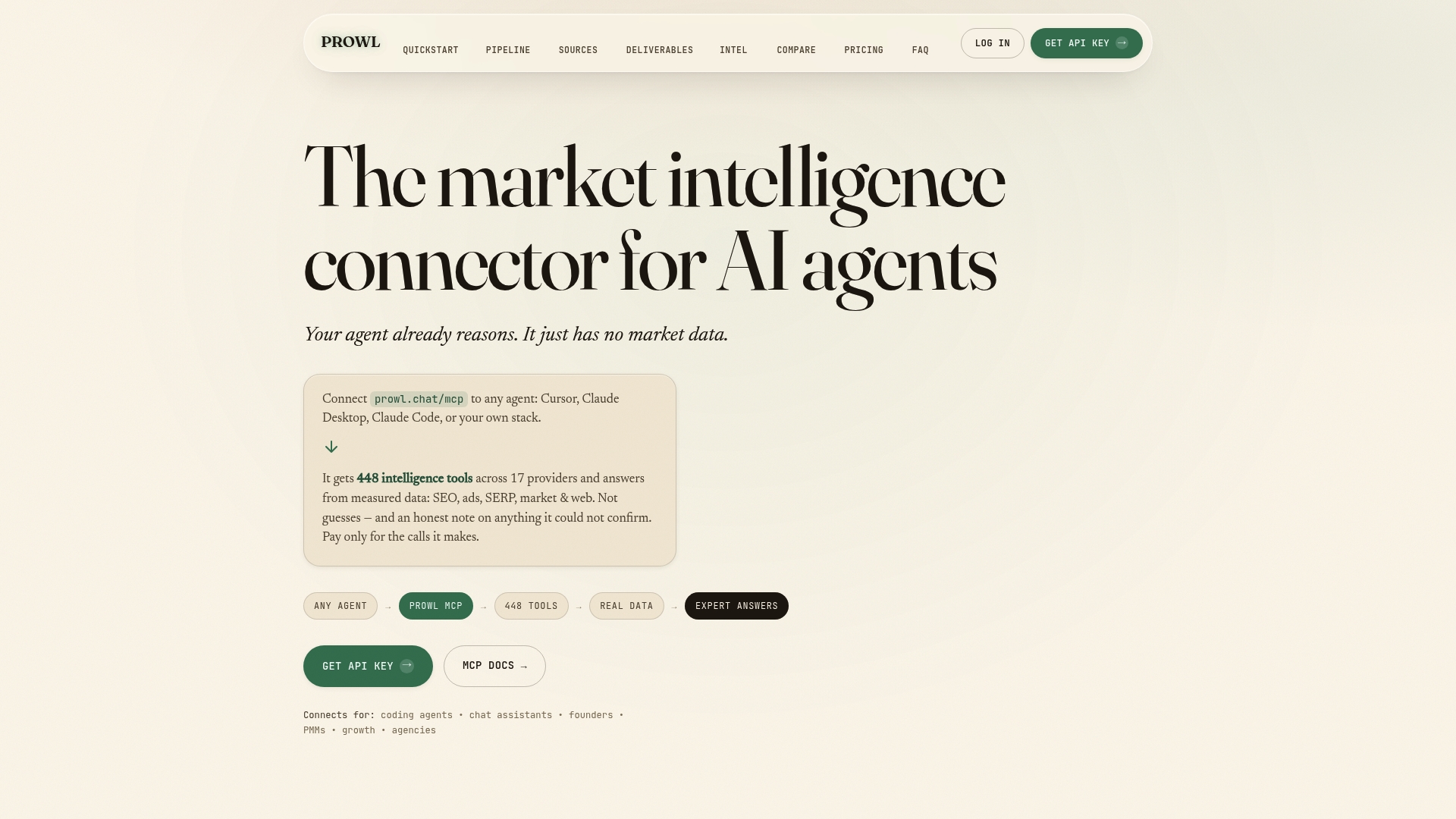
Pricing is published on the Prowl pricing page. Subscription plans are Exploit at $60 per month, Blackops at $120 per month and Syndicate at $240 per month, and Recon is also listed there. Pre-paid credits come in $10, $50 and $200 top-ups for pay-as-you-go use. You can also see the market research data use case or start from the Prowl homepage.
Where review mining fits next
Once themes are ranked, connect them to the rest of your analytics. A “checkout confusion” theme becomes more credible when automated funnel analysis shows the drop at the same step. A pricing complaint is easier to size when you compare it with the market. And a recurring praise phrase is raw material for ad creative research.
Product teams can go one step further and watch the same themes as early signals of fit and retention, as described in our guide to product market fit signals.
FAQ
What is the difference between review mining and sentiment analysis?
Sentiment analysis labels text as positive, negative or neutral. Review mining is the wider job: it collects reviews, extracts themes, features and needs, measures sentiment inside each, and turns the result into a decision. Sentiment is one tool inside it.
How many reviews do I need?
There is no universal number. Set an evidence threshold up front, such as a minimum share of reviews or a minimum count across at least two sources, and use it for every theme. Small datasets can still help you find language and ideas, but treat counts from them as directional.
Can AI do review mining without a human?
AI handles the volume well. A 2025 study found an LLM processed reviews in about two seconds each against a median of six minutes for human coders. People still need to define the question, review the theme labels, sample for errors such as sarcasm, and decide what to do with the result.
Is it legal to analyze public reviews?
It depends on the platform’s terms, the location of the reviewers and the data you keep. Regulators such as the Dutch Data Protection Authority treat scraped public data as still covered by GDPR. Check platform terms, anonymize reviewer details and ask your privacy counsel before building a recurring pipeline.
Sources
- How Companies Can Mine Online Reviews for Product Development, Kellogg Insight
- On the Automated Processing of User Feedback, arXiv
- From Reviews to Actionable Insights: An LLM-Based Approach, arXiv
- Natural language processing for analyzing online customer reviews, PMC
- An AI Framework for Unlocking Actionable Insights from Text, MDPI
- Get better insight from reviews using Amazon Comprehend, AWS
- Build an AI Review Mining Workflow for Customer Insights
- Leveraging Trustpilot Reviews Using AI and Qualitative Methods, Aalborg University
- Data Scraping: Guidelines from the Dutch Data Protection Authority, Lexology
- Research with User-Generated Book Review Data: Legal and Ethical Issues, iConference 2023
- FTC final rule banning fake reviews and testimonials
- Customer feedback and revenue growth