
AI search visibility is how often, how accurately and how prominently your brand is mentioned or cited in answers from tools like ChatGPT, Perplexity, Google AI Overviews and Google AI Mode. It is not a ranking position. It is a rate: across a fixed set of questions your buyers ask, in what share of answers do you appear, and in what role? Measure it as a trend over many prompts, not as a single screenshot, because the answers change from run to run.
This guide covers what the term means, how it differs from classic search visibility, the metrics worth tracking, a method you can repeat every month, and what you can do to improve the numbers.
TL;DR
- AI search visibility measures brand mentions and page citations inside AI-generated answers, not blue-link rankings.
- Track mention rate, citation rate, owned-domain citation rate, answer position and competitor share of voice.
- Answers are volatile, so use a fixed prompt set, repeat runs, and report trends rather than one-off checks.
- Zero-click behavior is the reason this matters: when the answer sits on the results page, fewer people click.
- Standard SEO fundamentals still apply: unique, useful content and a site that can be crawled and indexed.
Table of Contents
- What AI search visibility actually means
- Why zero-click search makes it urgent
- The metrics that matter
- Why a single check misleads you
- A repeatable tracking method
- How to improve your AI search visibility
- Where one data connection saves the most time
- Prowl for visibility and competitive reporting
- FAQ
- Sources
What AI search visibility actually means
Traditional search visibility asks where a page ranks for a keyword. You pick a query, check position, and estimate traffic from the click-through rate at that position. The unit is a URL on a results page.
AI search visibility asks a different question. AI visibility is the measure of how often, how accurately and how prominently a brand appears in responses from AI-powered search engines and assistants. The unit is a brand, product or domain inside a generated answer. There may be no list of ten results at all, just a paragraph, a few named options and a handful of source links.
Three differences follow from that:
- Position is fuzzy. You can be named first, named fourth, or cited without being named. Each is a different outcome.
- Queries are not fixed. Models such as ChatGPT and Gemini often rewrite the user’s question into new sub-queries for every answer, so a page’s chance of being cited depends heavily on the model’s own retrieval process rather than a fixed keyword ranking.
- The model’s prior knowledge matters. In controlled experiments, simply revealing a brand name to a language model can reorder its product recommendations even when the facts are identical. What the model already “knows” about you shapes visibility, not just what is on your page.
The practical upshot: you still need pages that deserve to be retrieved, but you also need your brand to show up consistently in the wider web content models learn from and retrieve.
Why zero-click search makes it urgent
Zero-click search is any search where the user does not click through because the results page already answered the question. AI-generated responses are a common cause, and experiences like AI Mode and ChatGPT cite sources instead of presenting a list of relevant pages.
The click data is stark. In a March 2025 analysis of U.S. Google users, those who saw an AI summary clicked a traditional result link in 8% of visits, versus 15% for those who did not. Clicks on the links inside the summary itself were rarer still, about 1% of visits to pages with a summary.

That changes what you report. If traffic alone is your scoreboard, you will see a decline without understanding why. If you also track whether your brand is in the answer, you can see influence that never produced a session. Zero-click tracking and AI search visibility are two views of the same shift: one measures what you lose in clicks, the other what you keep in presence.
The metrics that matter
Mentions and citations are not the same thing, and mixing them hides the real picture.
- A mention puts your brand name in the answer. It can place you in a buyer’s consideration set even if nobody clicks.
- A citation links to a specific page as a source. Owned citations show which pages on your site inform AI answers, which tells you what content is actually working.
You can be mentioned without being cited (the model knows you from elsewhere) or cited without being mentioned (your page informed an answer that named someone else). For a deeper look at telling the two apart, this walkthrough on tracking AI citations is worth a read.
A practical scorecard, based on the metrics that practitioners commonly track:
| Metric | What it answers | How to calculate |
|---|---|---|
| Mention rate | How often are we named? | Answers naming your brand ÷ total answers |
| Citation rate | How often is any page of ours linked? | Answers linking your domain ÷ total answers |
| Owned-domain citation rate | Which of our pages get used? | Citations to your domain, grouped by URL |
| Answer position | Are we first, or an afterthought? | Order of your brand among those named |
| Competitor share of voice | Who wins the questions we want? | Your mentions ÷ all brand mentions in the set |
Share of voice is the metric that executives grasp fastest. We cover the classic version in our guide to automating SEO share of voice tracking, and the same logic applies to AI answers: pick the competitive set, count appearances, compare.
Why a single check misleads you
AI answers are volatile. In one study, ChatGPT rewrote its queries on every answer, and between same-day runs the queries overlapped by only 2.7% and the cited pages by 15%. Tracking is also limited because answers vary across runs, model versions, locations and user contexts, and visible citations may not reveal every source the model used.
Two consequences:
- A single-run audit is unreliable. Practitioners recommend measuring visibility as a trend across prompt aggregates rather than a static data point.
- Be careful with causal claims. Researchers in the field argue that findings need replication across different models, industries and points in time before they can be treated as settled. Treat any “one trick to get cited” claim as a hypothesis.
A repeatable tracking method
Here is a process a small team can run monthly.
1. Build a prompt set
Write 30 to 60 prompts that mirror how your buyers actually ask. Mix three types: category questions (“best tools for X”), comparison questions (“A vs B”), and problem questions (“how do I fix Y”). Keep the wording fixed so results are comparable over time. This follows the approach of GEO research that tests responses with prompt sets under consistent conditions.
2. Choose platforms and settings
Pick the surfaces your audience uses: ChatGPT, Perplexity, Google AI Overviews, AI Mode, Gemini. Record the platform, date, location and whether the user was logged in. Without that context, a change in numbers has no explanation.
3. Run each prompt several times
Because of the volatility above, repeat each prompt multiple times per platform and report the share of runs where you appear, not yes or no.
4. Log mentions, citations and position
For each answer, record who was named, in what order, which URLs were cited, and whether the description of your brand was accurate. Inaccurate descriptions are findings too: they point to pages or third-party profiles that need fixing.
5. Compare against competitors and against your own traffic
Share of voice only means something relative to a set. Then compare against analytics: do pages that earn citations also earn referral visits? If you want a framework for the technical side, one useful lens is how generative engines retrieve and use content.
6. Report the trend, not the snapshot
Show a three-month line for each metric. One bad week is noise; a steady slide on a core topic is a signal.
How to improve your AI search visibility
The encouraging news is that the fundamentals have not been replaced. Google’s guidance for generative AI features points to unique, helpful, people-first content with a distinct point of view, and a clear technical structure so pages can be crawled, indexed and shown. In plain terms:
- Answer real questions directly. Lead each section with the answer, then support it. Models extract passages, and clear passages are easier to lift.
- Say something others do not. Original data, specific examples and a point of view give a model a reason to cite you over the ten pages that say the same thing.
- Keep the technical basics clean. Crawlable pages, sensible headings and structured data. This overview of AI SEO for smaller sites connects conventional technical SEO and structured content with AI search.
- Fill content gaps. Find the questions where competitors are cited and you are absent, then publish the missing page. Our piece on content gap analysis for keeping AI citations walks through the workflow.
- Build entity presence beyond your site. Because the model’s prior knowledge shifts recommendations, consistent descriptions of your brand across reputable third-party pages matter.
One caution on frameworks: layered “GEO stack” models are useful for structuring an audit, but they are individual proposals, not standards. Use them to organize questions, and let your own repeated measurements decide what to change.
Where one data connection saves the most time
The tracking method above sounds simple until you do it by hand: pulling keyword rankings, competitor positions, ad activity, reviews and AI answers from separate tools, then reconciling them in a spreadsheet. That is where most teams stall.
For agencies and in-house teams, a unified view helps. Our walkthrough of a unified search visibility analysis for agencies shows how to line up classic rankings with newer signals in one report, and our guide to real-time competitor analysis covers the alerting side. If you run research through an AI agent, market research data your agent can query keeps every figure traceable to its source.
Perspective
We built Prowl on a simple belief: strategy should rest on verified numbers, not assumptions. AI search visibility is a good test of that belief, because the temptation is to trust one screenshot of one answer.
Our approach is to let an agent do the repetitive work through a single connection. Prowl gives any AI agent or workflow access to 442 marketing intelligence tools through one API, so keyword data, competitor activity, ad performance and review analysis can be cross-referenced in one workflow instead of stitched together across separate integrations.
We also think reports should show their work. Every number should trace back to its source, and gaps in coverage should be stated plainly. For visibility work, that means you can see which claims rest on data and which are still open questions, and your team can present findings to a client or a board with confidence.
Prowl Team
Prowl for visibility and competitive reporting
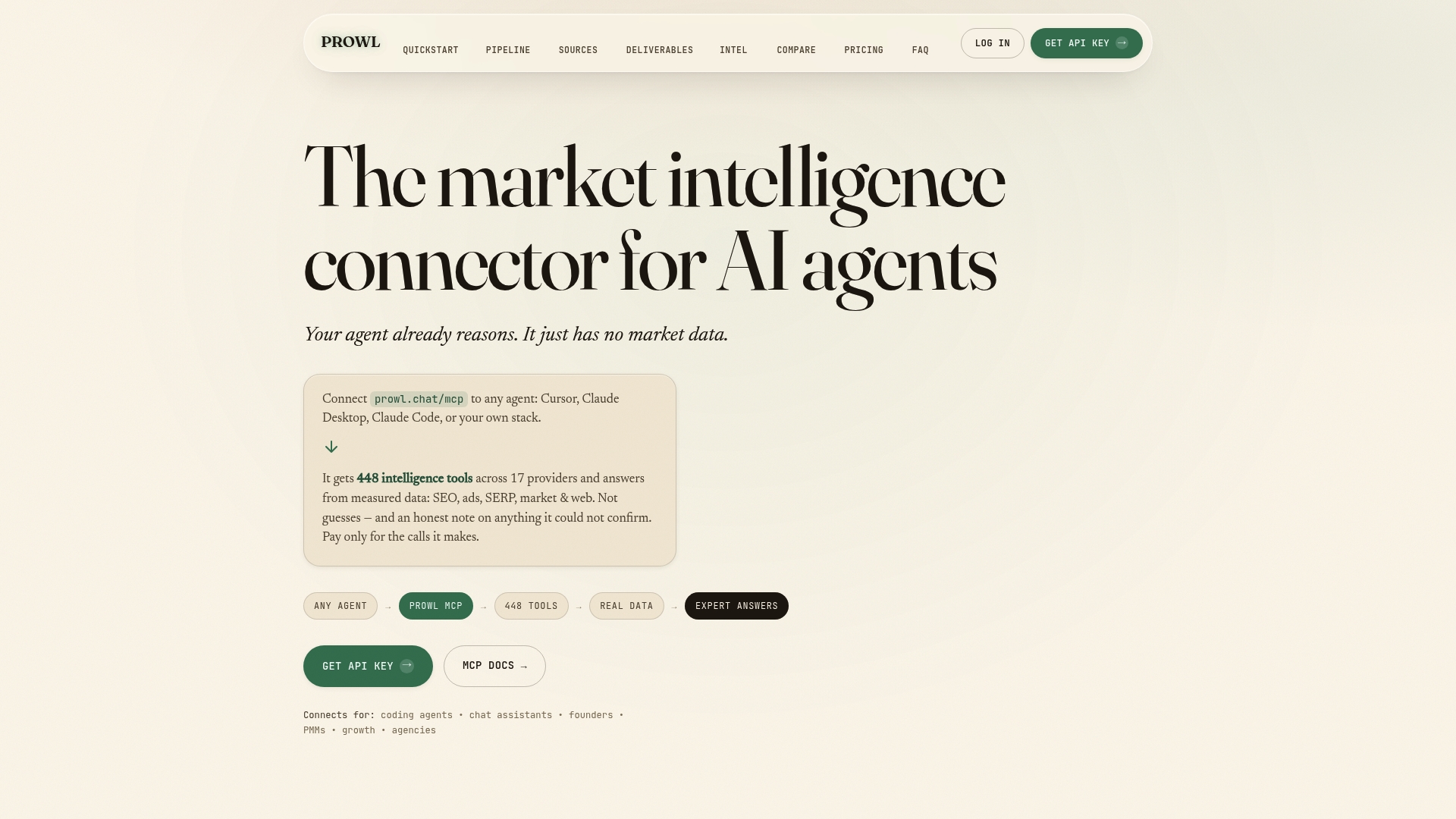
Prowl connects your agent to live market data across marketing sectors, and turns it into deliverables such as interactive reports, PDFs, PPTX decks, infographics, video and audio. It suits agencies, analysts, product managers, founders and growth teams who need synthesized, sourced reports quickly.
Pricing is flexible. Subscription plans on our pricing page include Exploit at $60 per month, Blackops at $120 per month and Syndicate at $240 per month, and Recon is also listed there. If you prefer metered usage, pre-paid credits come in $10, $50 and $200 packs. If you work in an editor, see our Cursor MCP server page, or start from the Prowl homepage.
FAQ
Is AI search visibility the same as SEO?
No, though they overlap. SEO targets page rankings that drive clicks, while AI search visibility targets brand mentions and citations inside generated answers. Google says SEO best practices remain relevant for generative AI features, so strong SEO is a sound base.
What is zero-click SEO?
It is the practice of working in a landscape where many searches end without a click because the results page answers the question. The goal shifts from only earning visits to also earning presence, through mentions, citations and accurate summaries of your brand in answers.
How do I track zero-click searches?
You cannot see every zero-click search directly, so combine signals: impressions and clicks in your search console, referral traffic from AI platforms, and a fixed prompt set that you rerun to log mentions and citations. Report the trend over several months rather than any single result.
How often should I measure AI visibility?
Monthly works for most teams, with each prompt run several times per platform. Because same-day runs can differ sharply, more frequent single checks add noise rather than insight. Increase frequency only around launches or major content changes.
Sources
- Google users are less likely to click on links when an AI summary appears (Pew Research Center)
- What Drives AI Citations? Content, Retrieval and Model
- Google’s guide to optimizing for generative AI features
- A Meta-Analysis Framework for Consolidating GEO Evidence
- GEO and AI visibility research
- What to track in AI Search: Brand Mentions, Citations, and more
- What Are Zero-Click Searches? And How Do They Impact SEO?
- AI Visibility vs Traditional SEO: 5 Key Differences
- AI Citation Tracking: How to Measure Where AI Cites You
- AI SEO: What Works for Small Businesses in 2026
- 5 Signs You Need GEO Optimization in Dubai