
AI agent orchestration is the control layer that decides which agent or tool does what, in what order, with which context, and what happens when a step fails. It turns one or more model-driven agents into a system you can run, audit and trust. This guide covers how it works, the main patterns, when multiple agents are worth the cost, and how to choose an approach for your workflow.
TL;DR
- Orchestration is the runtime logic around your agents: planning, routing, execution, state and recovery. It is more than a prompt chain.
- Most orchestrated systems follow one loop: plan, route, execute, observe, adapt.
- Five patterns cover most multi-agent designs: sequential, concurrent, group chat, handoff and Magentic.
- Start with a single agent and add more only when context overload, parallel work or specialization justifies the extra cost.
- Agents are only as good as the data and tools they can reach, so connect them to live, sourced inputs.
Table of Contents
- What AI agent orchestration means
- How orchestration works in practice
- The main multi-agent orchestration patterns
- When multiple agents beat a single agent
- What good orchestration tooling should provide
- Common failure modes and how to avoid them
- Measuring whether orchestration is working
- How to choose an approach for your workflow
- Our perspective
- Put your orchestrated agents on live market data
- FAQ
- Sources
What AI agent orchestration means
An agent on its own runs a loop: the model reasons, calls a tool, reads the result and repeats. Orchestration is the application logic and runtime control around that loop. Snowflake’s practical guide separates three things that often get blurred: the agent runtime, which executes the model-and-tool loop; workflow orchestration, which connects agentic and deterministic steps; and multi-agent orchestration, which coordinates execution, context or responsibility across more than one agent.
IBM describes the multi-agent case as coordinating specialized agents inside a unified system, where an orchestrator (a central agent or a framework) activates the right agent at the right time. The same page places this inside the broader practice of AI orchestration, which manages models, data pipelines and APIs, and notes that multi-agent orchestration adds communication, role allocation and conflict resolution.
Orchestration versus workflow automation
Traditional automation follows predetermined rules. Sim.ai’s explainer frames agent orchestration as an extension of that: model-driven decisions are allowed inside a workflow, such as classifying an issue, choosing a tool or planning subtasks, while state, tools, approvals and failure handling stay explicit. That bounded freedom is the point. You get flexibility where the work is ambiguous and control where the work is risky.
Three layers worth separating
Arize’s Laurie Voss argues in a June 2026 post that orchestration spans expression (frameworks and control flow), runtime (execution, recovery, durability) and observability (tracing, evaluation, debugging). Most debates, he observes, focus on only one. The runtime layer answers the practical question of what happens when a long-running agent loses a worker partway through. If you are evaluating tools, check all three layers, not just how pleasant the syntax is.
How orchestration works in practice
Underneath most orchestrated systems sits one control loop: plan, route, execute, observe, adapt. JetBrains describes the orchestrator as decomposing an objective into discrete tasks, setting execution order and dependencies, and routing each task by task type, agent capability, current load, access permissions and runtime conditions. It also maintains the task queue, intermediate outputs, memory references and execution history.
Here is the loop applied to a market-research request, such as a competitor teardown:
- Plan. Break the request into pieces: traffic estimates, ad activity, pricing changes, customer reviews.
- Route. Send each piece to the agent or tool best suited to it, with only the context it needs.
- Execute. Run independent pieces in parallel and dependent ones in order.
- Observe. Record outputs, errors and sources in shared state.
- Adapt. Retry, reroute or escalate to a human when a step fails or a result looks thin.
The quality of the final answer depends heavily on step 3. An agent that cannot reach live, verifiable data fills the gap with plausible guesses, and no orchestration layer fixes that after the fact. This is why tool access is a first-class concern, not an afterthought. Our guide to AI agent integrations covers how connected systems change what an agent can reliably do.
The main multi-agent orchestration patterns
Microsoft’s Azure Architecture Center identifies five patterns. The table below summarizes them with the situations the guide associates with each.
| Pattern | How it works | Fits when |
|---|---|---|
| Sequential | Agents run in a fixed order, each refining the last output | Stages have clear dependencies |
| Concurrent | Several agents analyze the same input at once | You need independent perspectives or low latency |
| Group chat | Agents discuss and converge in a shared thread | Consensus, brainstorming, maker-checker validation |
| Handoff | Control passes to whichever specialist is needed | The right expert only emerges during processing |
| Magentic | A manager builds and adjusts a task plan dynamically | Open-ended problems with no predetermined path |
The same Microsoft page also cites an AWS graduation path: start with a single agent, move to a router when routing accuracy drops, go hierarchical when queries need decomposition across domains, use a team of agents when iterative peer review improves quality, add a dynamic worker pool when the number of workers varies per task, and use a graph when you need explicit, auditable control flow with conditional branching.
A getorchestra.io guide makes a useful observation: most agent workflows are a mix of these same five shapes, and other frameworks map onto them under different names. Its advice is to choose the control-flow pattern first, then the framework that expresses it most plainly, then decide where it runs in production.
When multiple agents beat a single agent
More agents do not mean better results. Anthropic names three situations where multiple agents consistently outperform one: when context pollution degrades performance, when tasks can run in parallel, and when specialization improves tool selection or focus. Outside those cases, it says, coordination costs typically exceed the benefits. The same article states that multi-agent setups typically use 3 to 10 times more tokens than a single agent on equivalent tasks, because context is duplicated, agents exchange coordination messages and results are summarized at handoffs.
Research backs the caution. An MIT Media Lab study found that across model families from OpenAI, Google and Anthropic, adding agents did not reliably beat single-agent baselines. It identified a threshold near 45% single-agent success, above which adding agents is predicted to give zero or negative gains. The results varied sharply by task: on a finance benchmark, centralized coordination lifted mean performance from 34.9% to 63.1%, while on a planning benchmark every multi-agent architecture tested performed worse, with relative declines of 39 to 70%.

A separate arXiv paper shows theoretically that orchestration pays off only when there are performance or cost differences between agents to exploit.
For organizations, Microsoft’s Cloud Adoption Framework suggests starting with multiple agents only when specific criteria require separation: crossing security or compliance boundaries, several teams owning distinct knowledge areas, or planned growth beyond three to five distinct functions.
A practical rule of thumb
Build one capable agent with the right tools first. Split it when you can name the reason: its context window is overloaded, two subtasks are truly independent, or a specialist needs a narrower toolset. Research workflows often qualify, because pricing, advertising, reviews and search data are separate streams that can be gathered in parallel and then reconciled.
What good orchestration tooling should provide
Whatever you choose, judge it against capabilities, not brand. The n8n team lists five: state management, communication protocols, orchestration patterns (sequential, parallel or hierarchical), tool integration and error recovery through retries, rerouting or graceful degradation.
For production, add governance and limits:
- Hard limits. Snowflake’s guide says caps on model turns, tool calls, elapsed time, delegation depth and total compute belong in the runtime, and that termination should be an application condition, not left to the model’s judgment (Snowflake).
- Privilege tiers. Microsoft’s Agent Governance Toolkit proposes four privilege rings, from trusted orchestrators down to sandboxed agents used for testing, plus circuit breakers and replay debugging.
- Credential handling and audit trails. The Orchestra Runtime documentation describes injecting credentials at runtime so secrets are never exposed to the agent, with an audit trail of runs, sessions and turns.
Common failure modes and how to avoid them
The AWS Well-Architected Agentic AI Lens lists recurring problems: peer-to-peer coordination that causes deadlocks and inconsistent outcomes, hard-coded agent identifiers, untested fallback chains, and a control plane with in-memory state that becomes a single point of failure. Its remedies are a dedicated arbiter, capability-based routing, explicit fallback chains and a durable, redundant control plane.
A second AWS page on workflow design flags three performance anti-patterns: running steps sequentially when they could run in parallel, routing all data through the orchestrator so it becomes a bottleneck, and building dynamic graphs without cycle detection or maximum depth, which lets model-driven routing loop forever.
Perplexity’s November 2026 guide adds more: lossy handoffs between agents, fan-in that fires before all branches finish, nondeterministic shared-state updates and retry amplification in delegation loops.
Security deserves its own review
Orchestrated agents act on real systems, so permissions matter. A 2025 SailPoint survey, cited by OutSystems, found that 80% of respondents said their agents had already taken unintended actions and 39% said agents had accessed systems they were not authorized to use. Give each agent the narrowest tool access its job needs, and review how traffic from agents shows up in your systems. This guide to agent-driven traffic analytics is a good starting point for monitoring what agents touch.
Deloitte’s 2026 predictions advise defining ownership and accountability for orchestration, designing modular frameworks that can evolve, and stress-testing with real business messiness such as incomplete data and conflicting goals before scaling.
Measuring whether orchestration is working
Adding coordination is a hypothesis, and you should test it against a single-agent baseline on the same tasks. Track task success, cost per completed task, latency and the number of human interventions. If a second agent does not move at least one of those in the right direction, remove it.
If your agents’ work feeds search visibility or you want to see how different AI models respond to the same prompts, a multi-LLM audit tool lets you compare outputs across models in one pass, which is handy when you are deciding which model should sit in which role.
How to choose an approach for your workflow
- Write the task as a flow. Is it fixed, branching or open-ended? Fixed flows rarely need an autonomous manager.
- Pick the pattern. Use the table above. Choose the simplest pattern that reliably meets requirements.
- Pick the framework. Prefer the one that expresses your pattern plainly and gives you tracing and durable state.
- Decide where it runs. Production needs retries, checkpoints and audit logs, not just a notebook.
- Wire in data. Connect the tools and data sources each agent needs, with sources it can cite.
Practice leans toward restraint. One field guide, The Platform Product Manager, reports that in a 2025 study about two-thirds of production agents ran fewer than 10 steps before a human stepped in, and 16 of 20 case studies used fixed workflows instead of open-ended planning. Simple, bounded systems are what most teams actually ship.
Our perspective
Most orchestration conversations start with the framework. We think they should start with the inputs. An orchestrator can route, retry and reconcile perfectly and still produce a confident report built on stale or unsourced numbers.
That is why we built Prowl around a single connection. One MCP and one API give your agent or workflow access to 442 marketing-intelligence tools, so you do not wire up and maintain dozens of separate integrations before the first useful run. Our design goal is for orchestrated agents to cross-reference multiple providers in one workflow and produce reports in minutes rather than hours.
We also believe every number in a deliverable should trace back to its source, and that gaps in coverage should be stated plainly instead of papered over. For analysts, marketers, product managers and founders, that is what turns an orchestrated agent from a demo into something you can put in front of a client.
Prowl Team
Put your orchestrated agents on live market data
If you are building agent workflows for market research, SEO, ad performance, pricing or review analysis, Prowl gives them one endpoint to call. Plans are $60 per month for Exploit, $120 per month for Blackops and $240 per month for Syndicate. You can also top up pay-as-you-go credits at $10, $50 or $200, one-off. See current details on the Prowl pricing page.
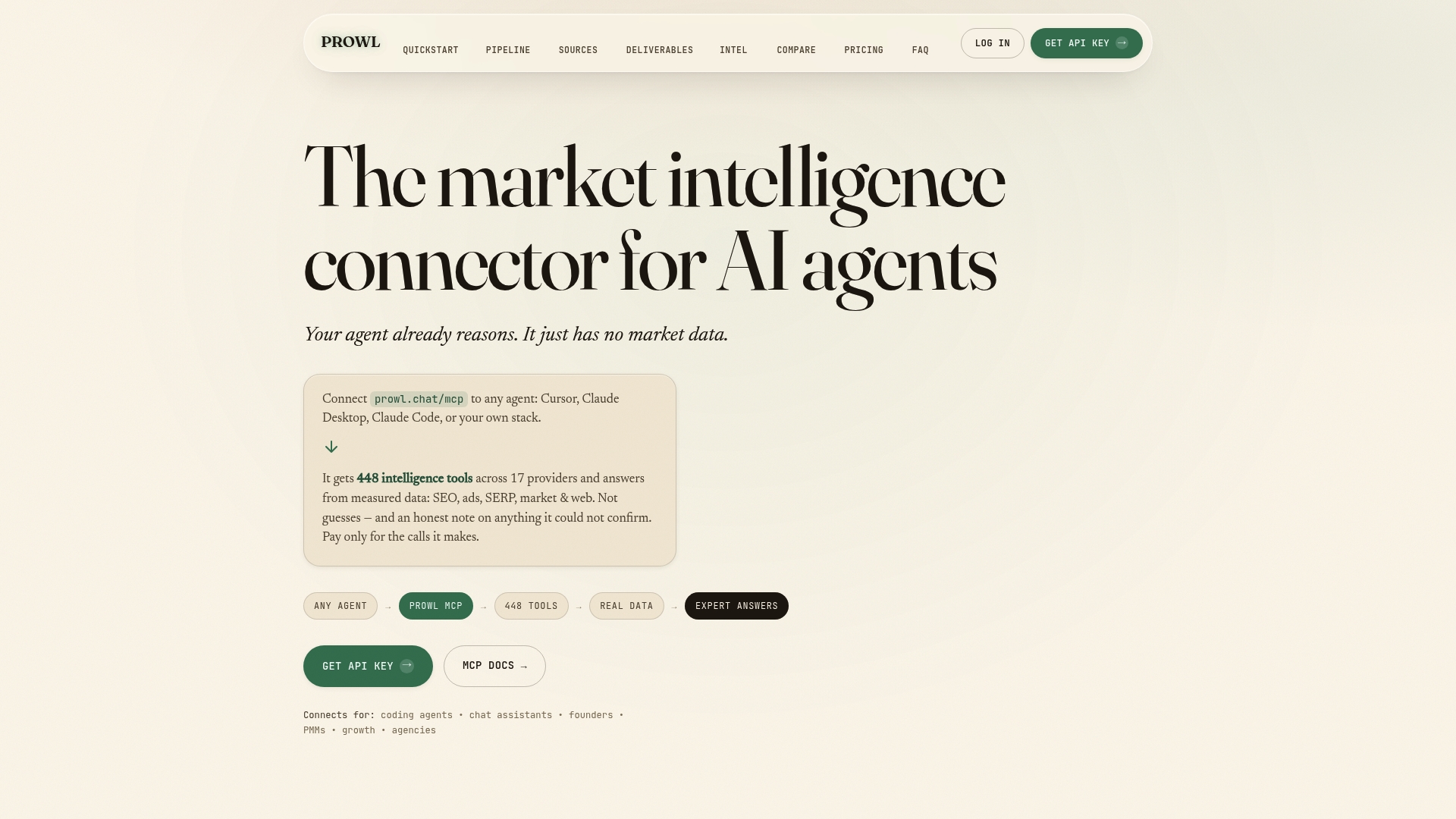
To see what agents can do with it, browse the use cases, read how analysts launch agent market research in a day, or check the REST API reference if you want to call tools from your own orchestrator.
FAQ
What is the framework used to orchestrate AI agents?
There is no single one. Teams use graph-based, role-based and conversation-based frameworks, plus managed cloud services. Choose the control-flow pattern first, then the framework that expresses it most plainly, then decide where it will run in production.
What is the best AI agent orchestrator?
The best one is the one that fits your pattern, your reliability needs and your team. Look for state management, tool integration, error recovery, tracing and enforceable limits. For a fixed, predictable flow, a simple sequential setup often beats a complex autonomous manager.
Do I need multiple agents?
Often not. Anthropic says multiple agents help mainly with context overload, parallel work and specialization, and that multi-agent setups can use 3 to 10 times more tokens. Start with one agent and split only for a named reason.
How do I orchestrate agents safely?
Bound everything: turns, tool calls, depth and time. Give each agent least-privilege access, keep audit logs, and add human approval before irreversible actions. Stress-test with incomplete data and conflicting goals before you scale.
Sources
- AI Agent Orchestration: A Practical Guide, Snowflake
- What Is Agent Orchestration? Frameworks and Runtimes, Arize
- What is AI Agent Orchestration?, IBM
- AI Agent Orchestration Frameworks Explained, Sim.ai
- AI Agent Orchestration Explained: How It Works, JetBrains
- AI Agent Orchestration Patterns, Azure Architecture Center
- AI Agent Orchestration: Tools, Frameworks & Best Practices, getorchestra.io
- When to use multi-agent systems, Anthropic
- When do AI agents benefit from collaboration?, MIT Media Lab
- When Should We Orchestrate Multiple Agents?, arXiv
- Single-agent or multiple-agent systems, Microsoft Cloud Adoption Framework
- AI Agent Orchestration Frameworks, n8n
- Modern Agent Architecture Overview, Agent Governance Toolkit
- Orchestra Runtime Overview
- Multi-agent orchestration, AWS Agentic AI Lens
- Design efficient workflow orchestration, AWS Agentic AI Lens
- AI Agent Orchestration: Failures, Approvals, and Retries, Perplexity
- AI Agent Orchestration: Frameworks, Patterns, Examples, OutSystems
- AI agent orchestration, Deloitte Insights
- AI agents: orchestration platforms, The Platform Product Manager
- Agent-Driven Traffic Analytics: A 2026 Implementation Guide
- Multi-LLM Audit