
AI agents can already produce reviewable, citation-linked market research briefs in minutes, not days. That trust is conditional: it holds only when someone defines the decision, the sources, and the verification rules before the agent runs. Treat agents as fast collectors and drafters, not final arbiters. NIST’s AI Risk Management Framework calls for exactly that kind of scoping and monitoring, and the first move for any team should be a low-risk pilot like weekly competitor monitoring, not a company-wide rollout.
TL;DR:
- Most AI market research agents are effective for discovery and extraction, but verification and judgment still require human oversight to prevent errors.
- Connecting multiple data sources individually causes delays; platforms like Prowl consolidate access, enabling faster pilot deployments within a day.
- The strongest initial workflows are competitor change monitoring and recurring intelligence summaries, as their results are easily verifiable and measurable.
- Proper setup involves clear decision scope, stable data connectors, and evidence-based output formats with source citations and confidence levels.
- Effective governance includes assigning agent ownership, authenticating sources, logging actions, and conducting ongoing performance and risk assessments.
Table of Contents
- What Are AI Agents and How Do They Work in Market Research?
- How Big Is the AI Agent Market Research Opportunity?
- Which Market-Research Workflows Should AI Agents Run First?
- How Do You Set Up an AI Agent Market Research Workflow?
- What Governance and Risk Controls Do Agentic Research Programs Need?
- How Do You Measure Whether an AI Research Agent Is Working?
- How Prowl Speeds Up Agentic Market Research
- What Analysts Actually Get Wrong About AI Agent Rollouts
- Get Started with Prowl Agent
- Sources
- FAQ
What Are AI Agents and How Do They Work in Market Research?
An AI agent for research is not one model doing everything. It’s a small pipeline of specialized functions that pass work to each other: a planner that breaks a research question into subtasks, a retriever that pulls raw data, an extractor that pulls structured facts out of that raw data, a synthesizer that turns facts into a narrative, and an actioner that delivers the output somewhere useful. Each piece maps to a distinct part of the market-research job.
The planner is where most projects succeed or fail. Give it “understand our competitor’s pricing” and it will wander. Give it “list every price change our top five competitors made in the last 90 days, with source URLs and dates,” and it produces something checkable. The retriever then goes after that scope. Microsoft’s market-research agent scenario describes exactly this kind of setup: agents pulling social signals, third-party research, sentiment data, and competitor moves, then handing structured findings to the next stage for reporting.
Extraction is where agents earn their keep on volume. A human analyst reading 40 competitor blog posts and 15 pricing pages in an afternoon is optimistic. An agent can do it in minutes and pull out specific fields (price, date, feature name, source) rather than a vague summary. Synthesis is the riskier step, because this is where an agent starts making claims about why something happened, not just what happened. That’s the layer that needs the most human review.
Data sources for these pipelines typically fall into a few buckets:
- Public web sources: company pages, pricing pages, press releases, regulatory filings
- Review and sentiment platforms: app store reviews, G2, Trustpilot, social mentions
- Licensed or paid data feeds: industry reports, SEO and ad intelligence tools, subscription databases
- Internal data: CRM records, sales call notes, support tickets, prior research archives
- Survey and primary research tools: panel providers, in-app surveys, structured interview transcripts
Connecting these sources one at a time, through separate APIs and separate authentication, is the part that eats weeks of engineering time before an agent produces a single useful brief. That’s the actual bottleneck in most agent deployments, not the model quality.
The last architectural point worth understanding is the split between discovery and verification. Agents are genuinely good at discovery: finding candidate facts across dozens of sources faster than any team could manually. They are not good, on their own, at verification. A model can hallucinate a plausible-sounding statistic or misdate a filing, and it will say it with the same confidence as a correct one. Verification means checking a claim against a primary source, an original filing, or a dated official page, not trusting a summary or the model’s own memory. Keep those two jobs conceptually and procedurally separate, and route anything the synthesizer produces back through a verification pass before it reaches a decision-maker.
How Big Is the AI Agent Market Research Opportunity?
Market-size numbers for AI agents vary wildly across research firms, and that variance is not noise. It comes from real methodological differences: some firms count only standalone agent platforms, others fold in every AI feature with agent-like behavior, and forecast horizons stretch anywhere from three to ten years out. Any professional report you rely on should state its publisher, its publication date, its scope, and its methodology. If it doesn’t, treat the headline figure as marketing, not data.
Adoption numbers tell a clearer, more useful story than sizing forecasts do.
By the numbers: McKinsey’s State of AI research finds that 62% of organizations report experimenting with AI agents in at least one business function, but only 23% report having scaled an agent workflow into production. Most companies are still in the pilot stage, and enterprise-wide financial impact remains rare.
That gap between experimentation and scaling matters directly for research teams. It means the tooling and the appetite exist, but most organizations haven’t yet built the governance and measurement discipline to trust agent output at scale. Getting there faster than your competitors is a real edge, but only if you skip the mistake of treating a pilot as if it were already a production system.
Part of scoping any agent program correctly is deciding when always-on monitoring beats periodic research, and vice versa:
- Always-on monitoring fits fast-moving categories: pricing wars, product launches, review sentiment shifts, competitor hiring signals. An agent watching continuously catches a change within hours.
- Periodic primary research (surveys, structured interviews, focus groups) fits questions that need human nuance: willingness to pay, brand perception shifts, unmet needs. Agents can help draft and synthesize these, but they shouldn’t replace the human collection step.
- Hybrid cadence works best for most teams: continuous monitoring feeding a structured, human-reviewed digest weekly or biweekly, with primary research run quarterly or around major decisions.
Which Market-Research Workflows Should AI Agents Run First?
Not every research task is equally suited to agent automation. Some are close to fully automatable today; others need heavy human involvement no matter how good the underlying model gets. Ranked roughly by how safe and measurable they are to hand to an agent first:
- Competitor-change monitoring. Outputs a dated log of pricing, product, and messaging changes across a defined competitor set. Sources: competitor websites, app stores, press pages. Cadence: daily or weekly. Supports go/no-go pricing and positioning decisions.
- Recurring intelligence digest. A weekly or biweekly summary combining competitor moves, review sentiment shifts, and relevant news. Sources: web, review platforms, news feeds. Supports leadership briefings and sales enablement.
- Industry trend detection. Flags emerging keywords, funding announcements, and regulatory shifts across a sector. Sources: news, patent filings, funding databases. Cadence: weekly. Supports roadmap and strategy planning.
- Company or prospect deep-dive. Compiles a structured profile of a target account or partner: funding history, leadership changes, tech stack signals, public statements. Sources: company site, LinkedIn signals, press releases. Run on demand. Supports sales and partnership decisions.
- TAM/SAM/SOM sizing. Pulls published market estimates, filters by scope and geography, and builds a sourced range rather than a single number. Sources: industry reports, government statistics, competitor disclosures. Run quarterly or per major planning cycle. Supports investment and resourcing decisions.
- Survey and question drafting plus synthesis. Drafts survey instruments based on a research question, then synthesizes open-text responses into themes. Sources: internal survey tools, prior research archives. Run per study. Supports product and messaging decisions.
- Pricing and packaging change tracking. A narrower version of competitor monitoring focused specifically on tiered pricing pages and promotional changes. Cadence: weekly. Supports pricing committee decisions.
- Review and sentiment synthesis. Aggregates and categorizes customer reviews and social mentions by theme and sentiment trend. Sources: app stores, review sites, social listening feeds. Cadence: biweekly. Supports product and support prioritization.
Pro Tip: Start with competitor-change monitoring and the recurring intelligence digest. Both have a known, checkable ground truth (a price either changed or it didn’t), which makes them the easiest workflows to measure for accuracy before you trust an agent with anything higher stakes, like market sizing or strategic recommendations.
The pattern across all eight: the workflows agents handle best have a verifiable, dated, structured answer. The ones that need the most human oversight are the ones asking “why” or “how much will this be worth,” where judgment and context matter more than raw retrieval speed.
How Do You Set Up an AI Agent Market Research Workflow?
A working agent deployment starts with a decision spec, not a tool selection. Write down, before anything else, the exact decision this research needs to support, the geography and timeframe it covers, the customer or market segments involved, the named competitor set, and what counts as acceptable evidence. Skipping this step is the single most common reason agent projects produce vague, unusable output. Underspecified research questions, not model limitations, cause most operational failures in agentic research programs.
Once the decision spec is written, pipeline setup follows a fairly consistent pattern:
- Connect data sources through stable connectors rather than one-off scrapers that break on layout changes.
- Normalize incoming data into a consistent schema so a price from one source and a price from another can actually be compared.
- Set a retrieval window (last 7, 30, or 90 days) that matches how fast your category moves.
- Build deduplication rules so the same press release picked up by five outlets doesn’t count as five separate signals.
The output format matters as much as the pipeline. Professional-grade agent output should read less like an essay and more like an evidence ledger, as Microsoft’s research assistant scenario recommends: every claim carries its own source and its own confidence level, rather than one narrative paragraph asserting a dozen unlinked facts.
| Field | Purpose |
|---|---|
| Claim | The specific fact or statement being reported |
| Value | The number, date, or category tied to the claim |
| Source URL | Direct link to the original document or page |
| Publication date | When the source itself was published |
| Retrieval date | When the agent pulled the data (freshness matters) |
| Geography | Market or region the claim applies to |
| Confidence | High, medium, or low, based on source reliability |
| Conflicts | Any contradicting data found elsewhere, noted rather than hidden |
That “conflicts” field is the one most teams skip and shouldn’t. When two sources disagree on a competitor’s headcount or funding round, an agent that quietly picks one is less useful than one that flags the disagreement and lets a human resolve it.
Verification rules should specify which claims require a second, independent source before they’re treated as fact, and which categories of output (anything shaping a pricing decision or investor-facing figure) require human sign-off before distribution. That human approval gate isn’t bureaucratic overhead. It’s the difference between an agent that assists analysts and one that quietly becomes the analyst, with no one checking its work.
Track a few pilot metrics from week one: how often citations actually resolve to real, correct sources; how often a human analyst has to correct a factual claim; and how long it takes from question to delivered brief. Those three numbers, tracked over four to six weeks, tell you whether to expand the pilot or fix the pipeline first.

What Governance and Risk Controls Do Agentic Research Programs Need?
Treat every research agent the way you’d treat a new hire with system access: it needs a defined role, a defined set of permitted actions, and someone accountable for what it does. The World Economic Forum’s “Know Your Agent” framework argues that identity, permissions, and continuous monitoring are prerequisites for trusting any agentic system, not optional extras layered on after deployment.
WEF projects a substantial economic opportunity from AI agents, but pairs that projection with a clear warning: without identity verification, defined permissions, and ongoing accountability, agent adoption opens the door to fraud and misuse rather than reliable output.
Translating that into something a research team can actually implement looks like this:
- Know Your Agent onboarding. Every agent gets a named owner, a documented scope of what it’s allowed to query and touch, and a review date, the same way a new employee gets an onboarding checklist and a manager.
- Identity and permissions. Agents should authenticate distinctly from human users, with access scoped to only the sources and systems the specific workflow requires.
- Logging and accountability. Every query, every source touched, and every output generated should be logged with a timestamp, so any claim can be traced back to exactly how the agent arrived at it.
- Provenance checks. Before a fact enters a final report, confirm it traces to a primary source rather than a secondary summary or an aggregator that may itself have gotten it wrong.
- Timestamping everything. Publication date and retrieval date are different things, and conflating them is how stale data ends up presented as current.
- Supplier and vendor risk assessment. If a third-party tool or connector feeds your agent pipeline, evaluate its own data practices and reliability, not just its feature list.
- An incident playbook. Decide in advance what happens when an agent produces a materially wrong output that reaches a decision-maker, including who gets notified and how the error gets corrected in circulation.
NIST’s AI Risk Management Framework frames this work as four ongoing functions: map the context and risks, measure performance and trustworthiness, manage the risks that measurement reveals, and govern the whole process with clear accountability. Its companion ARIA guidance pushes further, calling for red teaming and structured user testing on top of model benchmarks. Regulatory bodies are increasingly asking for exactly this kind of documentation trail, a trend covered in more depth in this compliance guide to AI agent audits, worth a read if your organization operates in a regulated sector.
None of this needs to slow a research team down. It needs to happen once, as infrastructure, and then run quietly in the background of every subsequent pilot.
How Do You Measure Whether an AI Research Agent Is Working?
Five numbers tell you almost everything about whether an agent pilot is working: citation validity rate (the percentage of cited sources that actually say what the agent claims they say), precision and recall against a known set of facts, analyst correction rate (how often a human has to fix something before it ships), time-to-insight, and cost per brief compared to the equivalent manual process.
The evaluation method that works best borrows directly from how NIST’s ARIA program approaches agent testing: build a small set of gold-standard events with a known, verifiable answer, then measure the agent against it before touching anything ambiguous.
- Pick 10 to 20 gold-standard events. These are facts you already know the answer to: a competitor’s confirmed price change, a documented funding round, a known product launch date.
- Run the agent against those events blind. Don’t tell it the answer. Score it on whether it found the fact, cited it correctly, and got the date and value right.
- Run the same tasks with your existing human process in parallel, for a real A/B comparison on time and cost, not just accuracy.
- Calculate correction rate by tracking how many outputs an analyst had to edit for factual accuracy before they were usable.
- Repeat the cycle on a rolling basis (NIST calls this TEVV: test, evaluation, verification, and validation) rather than treating one evaluation as final.
A realistic pilot timeline runs 8 to 12 weeks. Weeks one and two: set up the decision spec, connectors, and gold-standard event set. Weeks three through six: run the agent on real weekly cycles, tracking all five metrics. Weeks seven and eight: compare against the parallel human process and calculate cost per brief. If correction rate isn’t improving by week eight, the problem is almost always the decision spec or the source connectors, not the model itself.
How Prowl Speeds Up Agentic Market Research
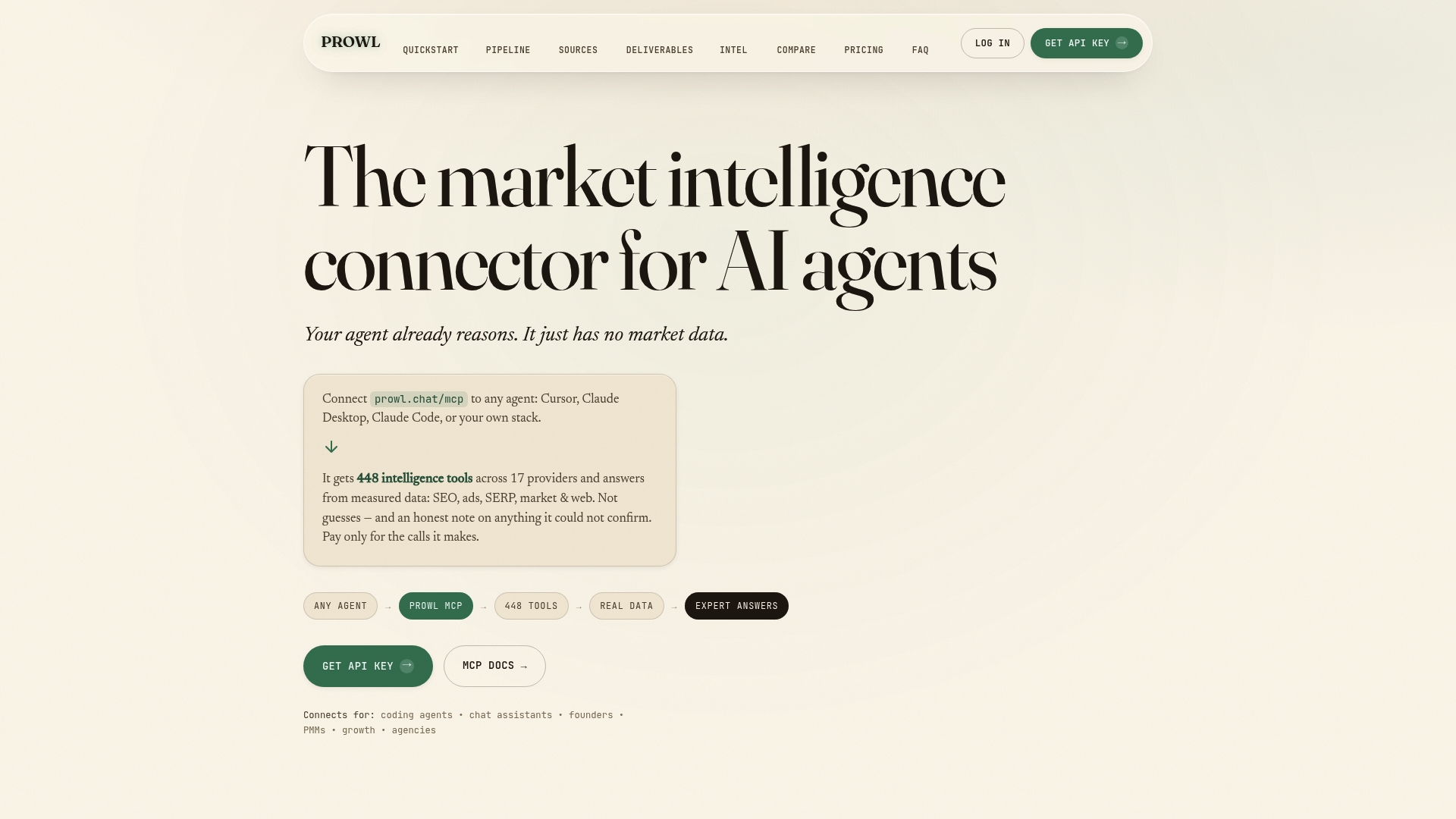
Most of the delay in standing up an agent research pipeline has nothing to do with the model. It’s the weeks spent wiring individual connectors: one API for SEO data, another for ad performance, another for review scraping, another for competitor tracking, each with its own authentication and its own quirks. Prowl Agent collapses that setup into a single connection: one MCP (market intelligence connector) that gives any agent access to 448 market-intelligence tools at once.
That single-connector model changes what a pilot looks like in practice. Instead of spending a sprint on integration work before a single report ships, a team can point an agent at Prowl’s MCP and start pulling cross-referenced data (SEO rankings, ad performance, competitor pricing, review sentiment) the same day.
A few pilots suit this setup particularly well:
- Weekly competitor monitoring digest, pulling pricing, SEO, and review changes into one dated report each Monday.
- A market-sizing brief, cross-referencing multiple public estimates into a scoped range rather than a single unsourced number.
- A recurring trend digest, tracking keyword and sentiment shifts across a defined competitor set over a rolling window.
Each of these maps directly to the workflows covered earlier in this piece, just without the integration overhead that normally delays a first working pilot by weeks. Detailed use-case walkthroughs, including sample report structures for these exact workflows, are available on Prowl’s use cases page.
What Analysts Actually Get Wrong About AI Agent Rollouts
The failure mode I see most often has nothing to do with model quality. It’s an underspecified research question handed to an agent with the vague hope it will figure out the important part on its own. “Research our competitors” produces noise. “List every pricing change from these five named competitors in the last 90 days, with dated sources” produces something you can act on. That gap in specificity is where most agentic research projects quietly die, usually blamed afterward on “the AI wasn’t good enough.”
The second mistake is treating always-on monitoring as a replacement for structured primary research rather than a complement to it. An agent can tell you a competitor changed their pricing page. It cannot tell you why your own customers would tolerate a price increase, or what unmet need is driving churn. Those questions still need a human asking another human, and no amount of agent sophistication changes that.
The third habit worth building early, before it becomes a crisis, is documenting assumptions and keeping a named human accountable for every conclusion that reaches a decision-maker. An agent that drafts a brief is a tool. A person who reads it, checks the citations, and signs off on it is the one actually doing the research. Lose sight of that distinction and you haven’t automated market research. You’ve just automated the guessing.
— Sergey
Get Started with Prowl Agent
Running your first agentic market research pilot doesn’t require months of integration work. Connect an agent to Prowl’s MCP, point it at a defined competitor set, and run a sample competitor-monitoring digest within a day, not a quarter. That’s the practical advantage over building individual connectors yourself: one setup step instead of a dozen.
Prowl Agent offers four plans: Recon (price available on request), Exploit at $60 per month, Blackops at $120 per month, and Syndicate at $240 per month, along with one-off credit packs starting at $10. For a team testing a first pilot workflow, starting on Exploit or a $10 credit pack keeps the risk low while you validate citation accuracy and correction rate over a few weekly cycles. If you’re working inside Claude or Cursor, dedicated MCP server setups are available for Claude and Cursor specifically. Head to the getting-started guide to connect your first agent and generate a sample report today.
Sources
Typical sources include competitor websites, pricing pages, review platforms, news and press releases, regulatory filings, and licensed data feeds like SEO and ad intelligence tools. Connecting all of these individually is usually the slowest part of setup, which is why single-connector platforms like Prowl Agent exist to consolidate access.
- Market landscape research agent — Microsoft Adoption
- NIST AI Risk Management Framework
- The state of AI in 2025: Agents, innovation, and transformation — McKinsey
- AI agents could be worth $236 billion by 2034 – if we ensure they are the good kind | World Economic Forum
FAQ
Can AI Agents Replace Human Market Researchers?
No. Agents handle discovery, extraction, and drafting well, but verification, judgment calls, and interpreting why something is happening still need a human analyst. The safest model treats agents as fast collectors that feed a human-reviewed process, not a replacement for one.
How Accurate Are AI Agents for Competitive Intelligence?
Accuracy depends entirely on scope and verification rules, not the model alone. Teams that test agents against known gold-standard events and require source-linked citations, as NIST’s ARIA guidance recommends, see far higher reliability than teams that trust unverified summaries.
How Much Does Prowl Agent Cost for Market Research?
Prowl Agent’s plans start with Recon, priced on request, and go up to Exploit at $60 per month, Blackops at $120 per month, and Syndicate at $240 per month. One-off credit packs are also available starting at $10 for teams that prefer pay-as-you-go usage over a subscription.
What Is the Biggest Risk in AI Agent Market Research?
The biggest risk is trusting agent output without governance: no source verification, no logging, and no human approval gate before a claim reaches a decision-maker. The WEF’s “Know Your Agent” framework treats identity, permissions, and continuous monitoring as the baseline controls that prevent this.