
White label analytics means an API-driven market-intelligence pipeline that pulls data from connected sources, applies your branding, and ships client-ready reports on a schedule, not a dashboard you skin with a logo. If you’re an agency owner, analyst, or growth lead deciding how to build or buy this capability in 2026, the recommendation is direct: adopt an API-driven report-generation pipeline built on structured JSON ingestion, not a manual export-and-format workflow, and not an embedded BI widget bolted onto someone else’s app.
The fastest path to proving this out is a pilot. Connect three to five client accounts to a metered API plan or a small credit balance. Run one templated report through a full cycle, and measure whether it holds up under real client scrutiny before you scale it across your book.
Four things separate a pipeline that survives contact with real clients from one that collapses after the second billing cycle:
- API ingestion first. Data has to arrive as structured JSON, not scraped screenshots or manual CSV pulls.
- Metric governance. One dictionary of definitions (what counts as a “conversion,” which currency, which time zone) applied across every client.
- Templated branding. Reports built as parameterized templates, not one-off files someone edits by hand each month.
- Scheduled delivery. Reports go out on a calendar, with an approval step, not whenever someone remembers to hit send.
The rest of this guide walks through each of those four pieces in the order you’ll actually build them.
Key Takeaways
Reliable white label analytics comes from treating reporting as a governed production pipeline, ingest, govern, template, deliver, rather than a monthly design exercise.
| Point | Details |
|---|---|
| Ingestion comes first | Build the API connector and metric governance layer before investing in template design. |
| Pilot before scaling | Test three to five clients on one template and measure delivery consistency before full rollout. |
| Governance prevents churn | Version metric definitions and templates so changes are auditable months later. |
| Vendor evaluation matters | Confirm supported outputs, rate limits, SLAs, and billing model (credits vs. subscription) in writing. |
| Prowl maps to the checklist | Prowl connects 444 intelligence tools through one API with metered credits and subscription billing for report output. |
Table of Contents
- What Does “White Label Analytics” Mean Here?
- Why Do Agencies Invest in API-First White Label Analytics?
- What Are the Core Components of a White-Label Analytics Platform?
- What Mistakes Do Agencies Make With White Label Reporting?
- How Do You Evaluate a White Label Analytics Vendor?
- What’s a Realistic Implementation Timeline?
- How Does Prowl Fit the API-First Checklist?
- How Do Developers Get Started With MCP Integration?
- What Separates Stable Pipelines From Brittle Ones?
- Get Your White Label Reporting Pipeline Running
- Useful Resources for Your Next Steps
- Frequently Asked Questions
- Sources
What Does “White Label Analytics” Mean Here?
In this guide, white label analytics is an API-driven market-intelligence and report-generation service: it connects to data sources, applies governed metric logic, and outputs branded reports your agency or team can hand to clients as its own. That’s a different animal from embedded analytics or in-app business intelligence SDKs, which live inside somebody else’s software product and render dashboards your end users see natively inside that app. If you’re evaluating an SDK to embed charts into your own SaaS product, this guide isn’t it. If you’re building or buying a system that turns raw platform data into a polished, branded PDF or interactive report for a client, keep reading.
The distinction matters because the buying criteria are completely different. Embedded BI is a front-end engineering decision about your own product’s user experience. API-first white label analytics is an operations decision about production reliability, metric consistency, and delivery cadence across dozens or hundreds of client accounts.
Here’s what this guide actually covers in terms of outputs:
- Programmatic layer: structured JSON responses that feed downstream systems, dashboards, or AI agents directly.
- Client-facing layer: PDF and PPTX exports, interactive shareable links, and increasingly, video or audio summary formats for executive stakeholders who won’t open a 40-page deck.
- Narrative layer: AI-drafted executive summaries that a human account manager edits before anything goes out the door.
Why Do Agencies Invest in API-First White Label Analytics?
The business case comes down to four things: automated time savings, dependable branded output, delivery you can set your watch to, and a service line you can actually sell as a line item. Agencies that build this well turn reporting from a cost center into a retention tool and, in some cases, a standalone revenue stream billed separately from media management or SEO work.
The metrics that matter here aren’t vanity numbers. Track report delivery consistency (did the report go out on the day it was promised, every time), client retention rate tied to accounts on automated reporting versus manual, hours reclaimed per account each month, and speed to insight, meaning how long between a data anomaly occurring and a human noticing it.
One documented agency case shows what’s realistically on the table: a workflow using scheduled connectors, a template engine, and a delivery layer cut monthly reporting time dramatically, reclaiming over a hundred hours per month across a full reporting cycle. That’s not a marginal efficiency gain. That’s the difference between one person’s entire month and a single afternoon.

Separately, vendor analysis on the true cost of manual reporting found that pre-built templates alone can save agencies significant hours per month, though custom or non-standard platforms often still require one-time or annual connector costs to fully automate. Time savings from templates and time savings from full pipeline automation aren’t the same number, and vendors sometimes blur the two.
What Are the Core Components of a White-Label Analytics Platform?
Five layers make up a functioning pipeline, and skipping any one of them is where projects quietly fail months after launch.
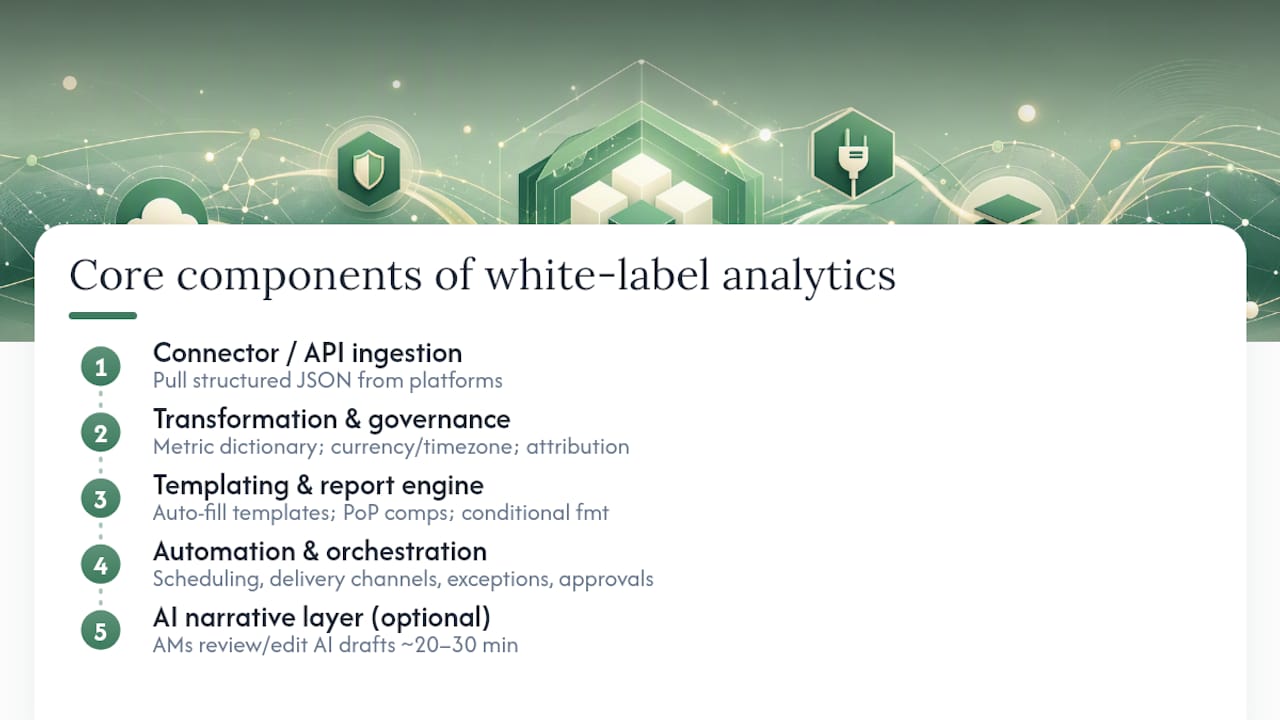
The connector or API ingestion layer pulls raw data from ad platforms, CRMs, SEO tools, and review sites, and it needs to return structured JSON, not a static export. This is the foundation everything else depends on.
The transformation and governance layer sits right on top of it. This is where you define your metric dictionary (what “qualified lead” means across every client, standardized currency and time zone handling, and consistent attribution rules), so numbers mean the same thing whether a report goes to a client in Singapore or Sao Paulo. This governed approach, with definitions and conversions standardized at ingest, is where most reconciliation failures actually originate.
Next comes the templating and report engine. Templates should populate placeholders, calculate period-over-period comparisons automatically, and apply conditional formatting so the same template scales across dozens of client accounts without hard-coded content for each one. Version your templates the same way you’d version code.
The automation and orchestration layer handles scheduling, delivery channels, exception handling when a data source fails to refresh, and an approval workflow so nothing ships without a human sign-off.
Finally, an optional AI narrative layer can draft executive summaries and commentary automatically. Agencies using this pattern report account managers spending roughly 20 to 30 minutes reviewing and editing AI-drafted narratives rather than writing them from scratch, shifting AM time toward strategic commentary instead of copywriting.
What Mistakes Do Agencies Make With White Label Reporting?
The single most common mistake is spending the first month on template design and the last week on data ingestion. That’s backward. A beautiful PDF built on a shaky connector breaks the first time a platform changes its API schema, and it breaks silently, which is worse.
- Prioritizing visual polish over ingestion. Templates are the easy, satisfying part. Governed data pipelines are the part that actually determines whether reports arrive correctly at 6 a.m. every month.
- Skipping the metric dictionary. Without one, “conversions” means something different on client A’s report than client B’s, and nobody notices until a client compares numbers with their own platform dashboard.
- Triggering delivery on connector refresh. Reports should go out through a controlled approval and close process, using client mapping records and template versioning, not the instant raw data lands.
- Under-sizing rate limits. Nobody estimates usage until the month-end reporting rush hits every client at once and the API throttles requests mid-cycle.
Pro Tip: Build a reconciliation and exception path before you build your first template. A report that fails loudly and gets caught internally costs you nothing. A report that fails quietly and reaches the client costs you the account.
How Do You Evaluate a White Label Analytics Vendor?
Ask technical questions before commercial ones. What APIs and connectors are natively supported, and in what output formats? A vendor should hand you sample JSON payloads on request, not a sales deck. Confirm rate limits in writing, and ask what happens during your peak reporting week when every client account refreshes at once.
On the operational side, ask about onboarding time from contract signature to first live report, SLA commitments for data freshness, whether approval workflows and audit logs exist, and whether report delivery is idempotent (meaning a retry doesn’t send the same client report twice).
Commercially, understand whether you’re buying credits, a metered subscription, or both, how overage is billed, and what the refund or credit rollover policy looks like when a month runs light.
Security and compliance checks matter more than most agencies budget time for: ask about encryption in transit and at rest, data retention periods, PII handling practices, and whether the vendor addresses relevant frameworks like GDPR for EU client data or HIPAA where health-adjacent data enters the pipeline. This is general guidance, not legal advice. Confirm exact compliance obligations with your own counsel or compliance officer for your specific client contracts.
Red flags worth walking away from: opaque, sales-call-only pricing, no evidence the vendor can show you an actual API request and response, and vendors whose entire pitch is visual design with no mention of a governed ingestion layer underneath it.
What’s a Realistic Implementation Timeline?
Most agencies can move from pilot to stable production in roughly two to three months if scope stays tight.
- Discovery (1 to 2 weeks). Pick three to five pilot clients, define exactly which KPIs and templates matter for this round, and confirm API availability for every data source those clients use.
- Mapping and schema design (2 to 3 weeks). Build your metric dictionary, client mapping records, and normalization rules for currency and time zone.
- Template creation and QA (2 to 3 weeks). Build parameterized templates, test placeholder population and conditional formatting, and run a full dry cycle against sample data.
- Pilot run and reconciliation (about 1 month). Run one live billing cycle end to end, reconcile every number against source platforms, and log every exception the pipeline throws.
- Scale and governance (ongoing). Expand client coverage, formalize your approval workflow, and treat metric definitions and templates as versioned assets going forward.
Budget for connector costs (third-party or custom-built for niche platforms), development time for mapping and QA, estimated credit consumption based on report volume, and any subscription fees. Non-standard platforms, proprietary CRMs especially, often require a custom API integration layer rather than a pre-built connector, so budget extra discovery time for those accounts. Assign clear ownership early: someone owns the mapping records, someone approves drafts before delivery, and someone monitors exceptions daily during the pilot.
How Does Prowl Fit the API-First Checklist?
Prowl connects any AI agent or workflow to 444 marketing intelligence tools through a single API, which covers the ingestion breadth most agencies otherwise stitch together from a dozen separate vendor accounts.
| Checklist Item | How Prowl Addresses It |
|---|---|
| API ingestion | Single API surface across 444 integrated intelligence tools spanning SEO, ad performance, and competitor data |
| Report formats | Interactive reports, PDF, PPTX, infographics, video, and audio outputs |
| Branded templating | Report generation designed for agency and analyst branding needs |
| Billing model | Pre-paid credits plus monthly subscription plans, metered by usage |
| AI-agent integration | Built for connection into existing agent workflows via the Prowl MCP |
For agencies weighing build-versus-buy, Prowl takes the ingestion orchestration and report generation layer off your plate entirely: you’re not maintaining 15 separate API integrations or writing your own template engine from scratch. What it doesn’t do is replace your metric governance decisions. You still define which numbers matter to which client. The use-case library shows how agencies apply this across SEO audits, competitor tracking, and pricing research without standing up individual tool subscriptions for each.
How Do Developers Get Started With MCP Integration?
Before writing a line of integration code, gather your API keys, set up separate staging and production environments, pull sample JSON payloads from the vendor, and understand the rate-limit ceiling you’re working within.
A typical high-level workflow runs: authenticate against the API, request a source data extract, normalize that extract through your metric dictionary, render it into your branded template, then schedule delivery through your orchestration layer. Each step should log a reference ID so you can trace any report back to its exact source request later.
- Use idempotent delivery references so a retry never double-sends a client report.
- Store every source request reference for audit purposes, especially if a client disputes a number months later.
- Build retry and backoff logic for API calls rather than letting a single failed request break the whole cycle.
- Test both staging and production environments separately before any client-facing rollout.
Pro Tip: Version your attribution model the same way you version your templates. When you change how a conversion gets counted, old reports built under the previous definition should stay locked to that definition, not silently recalculate.
Normalizing time zones and currency at the point of ingestion, not later in the template layer, eliminates a large share of the reconciliation headaches that surface weeks after a report has already gone to a client. The getting-started guide walks through this authentication and request sequence in more detail for teams building against the Prowl MCP specifically.
What Separates Stable Pipelines From Brittle Ones?
Every agency that’s run automated reporting for more than a year converges on the same handful of operating principles, and none of them are about design.
Governance has to be versioned and auditable, full stop. If you change how you define a metric, that change needs a timestamp and a reason attached to it, because six months from now someone will ask why last March’s numbers don’t match this March’s methodology. Treat that as infrastructure, not a footnote.
Branding belongs in parameterized templates, never in one-off manual edits. The moment someone opens a report file and manually adjusts a color or a header for “just this one client,” you’ve created a maintenance liability that compounds every month it goes unfixed.
The deepest principle, though, is designing for exceptions before you design for the happy path. A pipeline that only handles the case where every API call succeeds and every number reconciles cleanly isn’t a production pipeline, it’s a demo. Build the exception path first: what happens when a connector times out, when a metric definition conflicts, when a client’s account gets suspended mid-cycle. Agencies that skip this step don’t find out until a broken report reaches a client’s inbox, and by then the damage to trust is already done.
Get Your White Label Reporting Pipeline Running
Building your own connector layer across dozens of data sources, writing a template engine, and handling orchestration in-house takes months most agencies don’t have to spare. Prowl gives you that entire stack through one API: 444 integrated intelligence tools, output in whatever format your client needs, from interactive links to PPTX to video summaries, and billing that scales with actual usage instead of locking you into a flat annual contract.

A sensible pilot looks like this: connect three client accounts, run them through one pre-built report template, and measure whether delivery lands consistently on schedule before you commit further budget. Prowl’s pay-as-you-go credits mean you can test that pilot without a long-term subscription commitment, and the getting-started guide walks through connecting your first agent in under an hour. If it holds up across three clients, scaling to thirty is a configuration problem, not a rebuild.
Useful Resources for Your Next Steps
Start with the Prowl product page to see the full scope of connected tools and output formats, then browse the use-case library for examples closer to your specific client mix, whether that’s SEO auditing, ad performance tracking, or competitor pricing research.
For implementation reading beyond this guide, the breakdown of how agencies automate client reporting walks through the scheduled-trigger and human-review-checkpoint pattern in more technical detail, and the analysis on manual reporting’s true cost is worth reading before you finalize a build-versus-buy budget.
Once you’ve picked a direction, the fastest way to know if it works is to run the pilot: three to five clients, one template, one full billing cycle, and a clear look at whether delivery landed on time and reconciled cleanly against source platforms.
Frequently Asked Questions
Is white label analytics the same as embedded BI or in-app dashboards? No. White label analytics, as covered here, is an API-driven service that generates branded client-ready reports outside your product. Embedded BI or in-app SDKs render dashboards inside someone else’s software product for that product’s own end users, which is a separate buying decision entirely.
Do I need coding experience to implement an API-driven reporting pipeline? Some technical capacity helps, particularly for authentication and template mapping, but platforms built for agencies typically handle the connector and orchestration complexity so your team focuses on metric definitions and client-specific templates rather than writing integration code from scratch.
Should I choose credits or a subscription for a white label analytics platform? It depends on report volume. Credits suit agencies with variable or seasonal reporting needs, while a subscription often makes more sense once you’ve got a predictable, high volume of monthly reports across a stable client base.
How long does it take to see results from switching to automated reporting? A tight pilot, three to five clients on one template, typically shows whether delivery consistency and time savings hold up within one full billing cycle, roughly a month once mapping and template QA are complete.
Sources
- Stop Manual Reporting in Marketing Agency 2026 | US Tech Automations
- Automate Marketing Agency Client Reporting (2026) | AutoCore AI
- The True Cost of Manual Reporting for Marketing Agencies | Data Clare