
Review sentiment analysis is the process of assigning a polarity score, usually positive, negative, or neutral, to a piece of customer review text, often broken down further by product aspect (battery life, shipping speed, customer service). The recommended pipeline for production work is collect, clean, extract aspects, model, evaluate, and monitor, in that order, and skipping the aspect-extraction step is the single most common reason teams end up with sentiment scores nobody trusts.
At scale, the best-performing setups tend to be aspect-aware transformer fine-tunes, or a hybrid that pairs a lexicon-based first pass with a transformer for ambiguous cases. A comprehensive survey of sentiment analysis methods found that fine-tuned smaller models remain competitive with large language models on many benchmarks, which matters if you’re budgeting compute rather than chasing leaderboard bragging rights.
Here’s what the pipeline actually looks like in practice:
- Collect: pull reviews from marketplaces, app stores, support tickets, and social mentions, with full metadata (rating, timestamp, verified purchase flag).
- Clean: strip HTML, normalize encoding, deduplicate, detect language, and flag likely fake reviews before they poison your labels.
- Extract aspects: segment sentences and identify what’s being talked about (price, durability, support) before scoring sentiment.
- Model: choose lexicon, classical ML, transformer, or LLM based on data volume, latency needs, and budget.
- Evaluate: check per-aspect F1 and macro F1, not just overall accuracy, since review data is almost always class-imbalanced toward positive.
- Monitor: watch for prediction drift as products change, seasons shift, and new slang enters the review corpus.
Fast fact: one applied study on product reviews reported near 99% accuracy on its own dataset by adding sentence-type identification and fake-review filtering before sentiment scoring, a reminder that preprocessing decisions often move the needle more than model architecture choices.
Key Takeaways
Review sentiment analysis works best as an aspect-level triage system feeding human theme coding, not as a standalone verdict on customer happiness.
| Point | Details |
|---|---|
| Follow the full pipeline | Collect, clean, extract aspects, model, evaluate, and monitor, in that order, or aspect insights get lost. |
| Fix preprocessing first | Deduplication, fake-review filtering, and sentence segmentation often improve accuracy more than swapping models. |
| Match model to data volume | Use lexicon baselines with no labeled data, classical ML for thousands of labels, transformer fine-tunes for production scale. |
| Evaluate per aspect, not overall | Macro F1 and per-aspect F1 expose the minority-class blind spots that raw accuracy hides. |
| Use Prowl to cut reporting time | Prowl connects review and competitor data through 444 tools in one workflow, reducing time-to-report for sentiment programs. |
Table of Contents
- When Should You Run Sentiment Analysis on Reviews?
- How Do You Clean and Normalize Review Text?
- Which Modeling Approach Fits Your Review Data?
- How Do You Evaluate Review Sentiment Models Fairly?
- What Are the Biggest Pitfalls in Review Sentiment Analysis?
- How Do You Build a Runnable Review Sentiment Pipeline?
- How Prowl Speeds Up Review Sentiment Workflows
- How Do You Keep a Sentiment Model Reliable in Production?
- What Datasets and Libraries Should You Start With?
- Sentiment Scores Are a Filter, Not a Verdict
- Get Your Review Sentiment Pipeline Running This Week
- Frequently Asked Questions
- Sources
When Should You Run Sentiment Analysis on Reviews?
Sentiment analysis on reviews answers two very different kinds of questions, and conflating them is where most programs go wrong. The first kind is triage: which reviews need a human to look at them today? The second kind is decision-making: should we change the packaging, retrain support staff, or deprioritize a feature? Sentiment scores are excellent at the first job and mediocre at the second when used alone.
Triage use cases reward speed. Decision-making use cases reward precision and context, because a shift from 3.6 to 3.4 average stars tells you almost nothing about why without aspect-level breakdowns and theme coding underneath.
Common practical applications include:
- Product roadmap input: aspect-level sentiment trends over time reveal which features are becoming liabilities before churn data catches up.
- Support prioritization: routing angry, high-severity reviews to senior agents rather than treating every ticket as equal.
- Competitor tracking: comparing sentiment trajectories across your reviews and a competitor’s to spot where you’re gaining or losing ground on specific attributes.
- Fraud and quality signals: sudden sentiment spikes tied to a specific SKU often flag a defect batch before returns data confirms it.
Pro Tip: Don’t report a single sentiment average to leadership. Report the top three themes driving negative sentiment, ranked by frequency times severity times customer segment value, and let sentiment scoring do the sorting behind the scenes rather than the storytelling up front. Practitioner guidance on customer feedback analysis backs this ranking approach directly, and it’s the difference between a dashboard nobody reads and a report that changes a roadmap meeting.
How Do You Clean and Normalize Review Text?
Review text is some of the messiest natural language you’ll work with: emojis standing in for entire sentences, HTML fragments leaking through from web forms, inconsistent capitalization, and a healthy dose of typos from mobile keyboards. Cleaning it well is less about a fixed checklist and more about deciding what noise actually carries signal.
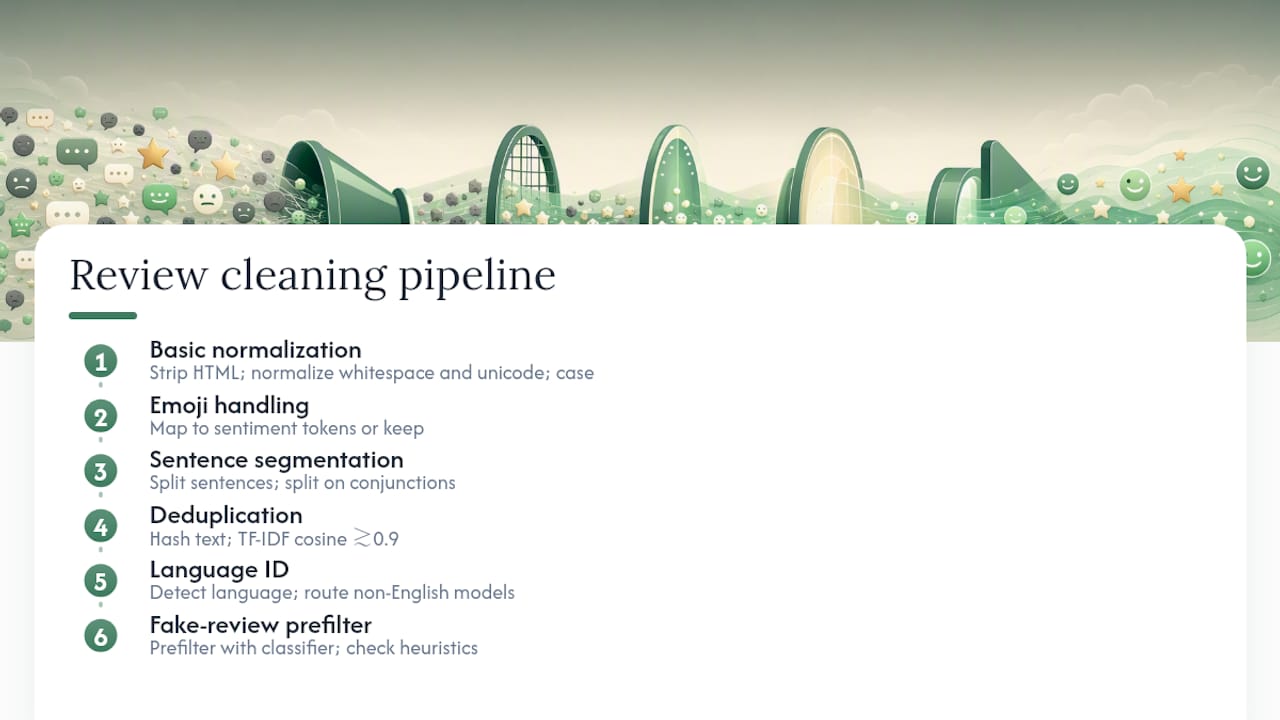
Start with the basics. Strip HTML tags and entities (&, ) that leak in from form submissions. Normalize whitespace and unicode variants, since a smart quote or a non-breaking space can silently break tokenizers. Lowercase text for classical ML pipelines, but preserve case for transformer models, which use capitalization as a feature.
Emojis deserve a decision, not a default deletion. A 🙄 or 😡 at the end of an otherwise neutral sentence often carries the actual sentiment, and stripping it blind can flip your label. Map common emojis to sentiment tokens or keep them in the input for transformer models, which handle them natively through subword tokenization; only strip them for lexicon-based bag-of-words approaches where they add noise without a mapping table.
Sentence segmentation is where aspect-based work actually begins. A review that reads “The camera is great but the battery dies in two hours” carries opposite sentiment for two different aspects in one sentence, and a document-level sentiment score will average them into a meaningless neutral. Segment by sentence, and where sentences are compound, split on coordinating conjunctions (“but,” “however,” “although”) before running aspect extraction.
Deduplication catches more than you’d expect. Copy-pasted reviews, review-farm templates, and reposts across marketplaces inflate your dataset with near-duplicate text that skews class balance and inflates apparent agreement. A simple approach: hash normalized text and flag exact matches, then use a similarity threshold (cosine similarity on TF-IDF vectors above roughly 0.9) to catch near-duplicates with minor edits.
Language detection should run before, not after, sentiment scoring. Running an English sentiment model on Portuguese text produces confident, wrong answers rather than a helpful error, so gate the pipeline with a language identifier (fastText’s language ID model is a common, fast choice) and route non-English text to a multilingual model or a dedicated pipeline per language.
Fake-review prefiltering closes the loop on data quality. One study on product reviews found that combining sentence-type identification with fake-review classification meaningfully improved downstream sentiment accuracy, because incentivized or bot-written reviews carry distorted sentiment distributions that pull your model’s decision boundary in the wrong direction. Heuristics worth checking: reviewer account age, review velocity (dozens of five-star reviews posted within minutes of each other), and generic templated phrasing repeated across unrelated products.
Which Modeling Approach Fits Your Review Data?
Lexicon-based, classical machine learning, deep learning, and transformer or LLM approaches each solve a different slice of the review sentiment problem, and the right choice depends on your labeled data volume, latency budget, and how much you need per-aspect granularity rather than an overall polarity score.
Lexicon-based methods (VADER, SentiWordNet, TextBlob’s pattern-based scorer) remain genuinely useful, not just as a teaching example. They require zero training data, run in milliseconds, and produce interpretable scores you can explain to a non-technical stakeholder in one sentence: “this word list scored the review negative because of these three words.” A survey of sentiment analysis methods confirms lexicon tools still serve as fast, interpretable baselines, particularly useful for early-stage triage or when you have no labeled data yet to train anything else.
Classical ML (TF-IDF features feeding logistic regression or a linear SVM) is the right call when you have a few thousand labeled reviews and a tight compute budget. These models train in seconds on a laptop, are easy to debug through feature weights, and often outperform naive lexicon approaches by a meaningful margin once you have even a modest labeled set. They struggle with negation and context the way any bag-of-words representation does, since “not good” and “good” share the token “good.”
Deep learning and transformer fine-tuning (BERT, RoBERTa, DeBERTa variants fine-tuned on your domain) is where most production-grade review sentiment systems land today. Fine-tuning on even 5,000 to 10,000 labeled examples from your own review domain typically outperforms a generic pretrained model by a wide margin, because review language has its own register: “meh,” “returned it,” “five stars but,” phrases that generic sentiment corpora underrepresent. Practical tips: freeze the lower transformer layers if your labeled set is small, use class weighting to handle the usual positive-review skew, and validate on a held-out set stratified by product category, not just a random split.
Prompting and few-shot LLM approaches (GPT-family models, Claude, open models like Llama fine-tunes) shine when you need to stand up a sentiment classifier fast, with no labeled data, or when you need free-text explanations alongside the label (“negative, because the reviewer complained about a two-week shipping delay”). The tradeoff is cost and latency at scale: running every incoming review through an API call adds up fast compared to a fine-tuned model you host yourself, and the same survey found that fine-tuned smaller models remain competitive with LLMs on many established benchmarks, which argues for reserving LLM calls for ambiguous cases a cheaper model flags rather than routing every review through them.
Aspect-based sentiment analysis (ABSA) architectures split into three broad families. Span-extraction models identify the exact phrase referring to an aspect (“the battery”) and pair it with a sentiment label. Sequence-tagging approaches treat aspect extraction like named-entity recognition, tagging each token as belonging to an aspect category or not. Joint models train aspect extraction and sentiment classification together in a single network, sharing representations so the model learns that certain phrasing patterns predict both the aspect and its polarity simultaneously. ABSA remains, per that same survey, one of the more active research frontiers, and it’s the approach that actually answers “what specifically are customers unhappy about,” rather than just “are they unhappy.”
| Approach | Data needed | Latency | Interpretability | Best fit |
|---|---|---|---|---|
| Lexicon-based | None | Milliseconds | High | Fast triage, no-label cold start |
| Classical ML (TF-IDF + LR/SVM) | Hundreds to thousands of labels | Milliseconds | Medium | Constrained budgets, quick baselines |
| Transformer fine-tune | Thousands of labels | Tens of milliseconds | Low to medium | Production accuracy at scale |
| LLM prompting/few-shot | None to few examples | Seconds, API-dependent | Medium (with rationale) | Ambiguous cases, rapid prototyping |
How Do You Evaluate Review Sentiment Models Fairly?
Accuracy alone lies to you on review data, because most review corpora skew heavily positive, and a model that predicts “positive” every time can hit 70% to 80% accuracy while being useless for the negative reviews that actually matter for support prioritization. Macro F1, which averages performance evenly across classes regardless of how many examples each class has, is the metric that actually exposes a model ignoring your minority class.
For aspect-based work, report per-aspect F1 separately rather than one blended number. A model might nail “price” sentiment at 0.89 F1 while missing “customer service” sentiment entirely at 0.41 F1, and a single averaged score hides that gap completely. Calibration checks matter too: if your model outputs a probability of 0.95 positive, does that review actually turn out positive 95% of the time when you sample and manually check? Miscalibrated confidence scores mislead any downstream system that thresholds on them.
Benchmark datasets give you a starting point, not a finish line. IMDb and SST (Stanford Sentiment Treebank) are movie-review and general-text polarity benchmarks widely used in academic comparisons, while SemEval’s ABSA task sets are the standard for aspect-level evaluation. The same survey on sentiment methods notes these benchmarks have real domain gaps for actual product reviews, since movie reviews and Twitter-length opinion snippets don’t capture the specific phrasing, product jargon, and mixed-aspect sentences you’ll see in e-commerce or app store data. Treat benchmark performance as a sanity check on your architecture choice, not a promise about your production accuracy.
Practical validation should always segment by dimension:
- By product category: a model tuned on electronics reviews often underperforms on fashion or grocery reviews, where sentiment language differs.
- By language: multilingual models rarely perform evenly, and a model that’s 91% accurate in English might be 76% in Portuguese without you knowing it.
- By rating band: check whether your model confuses 2-star and 3-star reviews, a common failure mode since both often contain mixed sentiment.
Confusion matrices and manual error sampling round out the picture. Pull 50 misclassified examples and read them; you’ll usually find a pattern (sarcasm, negation, a specific product line) faster than any aggregate metric will tell you.
| Dataset | Best for | Domain gap for product reviews |
|---|---|---|
| IMDb | Document-level polarity, long-form text | Movie-review vocabulary, not e-commerce phrasing |
| SST | Sentence-level polarity, general text | Short, curated sentences, less noisy than real reviews |
| SemEval ABSA | Aspect-level sentiment and extraction | Limited product categories, smaller scale than production data |
What Are the Biggest Pitfalls in Review Sentiment Analysis?
Sarcasm is the challenge every practitioner underestimates until it shows up in production. “Great, another broken zipper after one wash” scores positive on any naive lexicon or classical model because of the word “great,” and no amount of feature engineering fully solves this without dedicated training examples. A 2021 review of sentiment and emotion detection literature identifies sarcasm and implicit sentiment as recurring, largely unsolved challenges across the field, not something specific to any one dataset or model family. Practical mitigation: ensemble a sarcasm-specific classifier alongside your main sentiment model, and route flagged cases to human review rather than trusting an automated score.

Negation trips up bag-of-words models constantly. “Not bad” and “bad” share a token, and a simple TF-IDF model has no mechanism to invert meaning based on word order. Targeted token replacement, where you detect negation words and merge them with the following token (“not_good” instead of “not” and “good” as separate features), is a cheap fix for classical ML. Transformer models handle negation far better natively through attention, since they process word order and context, which is one reason fine-tuned transformers outperform bag-of-words approaches on real review text.
Domain drift happens quietly and constantly. A model trained on last year’s reviews starts degrading the moment your product line changes, a new slang term enters common usage, or a competitor’s marketing shifts what customers compare you against. The same 2021 review flags domain transfer as a persistent challenge, and the practical answer is scheduled retraining, not a one-time deployment.
Multilingual review corpora raise a real architectural decision: translate everything into English and run one model, or maintain native-language models per market? Translation introduces its own error and often flattens nuance (idioms, regional slang), while native models require more labeled data per language. For high-volume markets, native models usually win on accuracy; for long-tail languages with sparse data, translation plus a single multilingual model is the more practical tradeoff.
Fake and incentivized reviews distort sentiment distributions before you even get to modeling. Sudden bursts of five-star reviews with generic phrasing, unverified purchase flags, and reviewer accounts with no other activity are the classic heuristics, and the BeDi-DC and Log-Squish CNN research demonstrates that filtering these out before sentiment scoring measurably improves downstream accuracy.
Pro Tip: Build a small “hard cases” test set of sarcastic, negated, and mixed-sentiment reviews, hand-labeled by your own team. Rerun it against every model version before deployment. It catches regressions that a random validation split, dominated by easy positive reviews, will completely miss.
How Do You Build a Runnable Review Sentiment Pipeline?
A working pipeline needs five stages, and where you invest engineering time depends entirely on your data volume and accuracy requirements, not on copying whatever the biggest tech company published last quarter.
- Ingestion: build connectors to your review sources with metadata capture built in from day one, since retrofitting metadata onto historical data is far harder than capturing it up front.
- Annotation: define a label schema (positive, negative, neutral, plus an aspect taxonomy specific to your product category) before you label a single review, and calculate inter-annotator agreement (Cohen’s kappa above 0.7 is a reasonable bar) on a shared sample before scaling up annotation.
- Preprocessing: apply the cleaning, deduplication, and fake-review filtering steps as a standing pipeline stage, not a one-off script you run before training and forget about.
- Modeling: pick your approach based on labeled data volume and latency needs, starting with a baseline you can ship in a week.
- Aggregation: roll per-review, per-aspect scores up into business metrics, theme counts, trend lines, segment comparisons, that a non-technical stakeholder can actually act on.
Your annotation plan deserves more thought than most teams give it. A workable schema might tag each sentence with an aspect label (price, shipping, quality, support) and a sentiment polarity per aspect, sampled to cover a mix of star ratings and product categories rather than a convenient recent slice. Aim for at least 200 to 300 doubly-annotated examples early on to measure agreement before you scale annotation to thousands of reviews with a single labeler, since discovering low agreement after the fact means relabeling everything.
Three recipes cover most real-world starting points:
Start with the lexicon-plus-logistic-regression baseline when you have no labeled data and need something running by Friday: score reviews with VADER, use those scores as a rough label, and train a TF-IDF logistic regression model on the result as a fast, explainable first cut. Move to a transformer fine-tune once you’ve accumulated a few thousand hand-labeled reviews and need production-grade accuracy, particularly for aspect-level breakdowns. Reach for LLM prompting or few-shot approaches when you need a rationale alongside the label, when the domain shifts too fast for retraining cadence to keep up, or when data volume is too low to fine-tune anything reliably.
Pick the recipe that matches where you actually are, not the one that sounds most sophisticated in a planning meeting.
How Prowl Speeds Up Review Sentiment Workflows
Building the ingestion and reporting layers around a sentiment model is often the slower half of the project, not the modeling itself. This is where a market intelligence connector like Prowl fits into a data science team’s workflow: it connects any AI agent to 444 intelligence tools through one API, so pulling review data, competitor comparisons, and market context doesn’t require standing up a separate integration for every source.
A practical workflow looks like this: connect Prowl to your review sources and competitor data through its MCP layer, run your aspect-based sentiment model against the extracted text, then have Prowl synthesize the output into an interactive report, PDF, or dashboard without hand-building the aggregation layer from scratch. For teams already stretched thin on engineering time, that synthesis step is usually the part that gets skipped, and skipping it is exactly why so many sentiment projects produce a model but never a report anyone reads.
Relevant capabilities for review sentiment work include:
- Real-time analytics reports pulled from live connectors rather than static exports.
- Rapid synthesis across SEO, competitor, and review data in one workflow.
- Output formats (interactive reports, PDFs, infographics) suited to different stakeholders, from engineering to leadership.
How Do You Keep a Sentiment Model Reliable in Production?
Batch versus real-time inference is the first operational decision, and it comes down to how fast you need an answer. Batch scoring, running once nightly or hourly against newly ingested reviews, works fine for roadmap and trend reporting, and it’s far cheaper computationally than real-time scoring on every review as it lands. Real-time inference earns its higher cost only when you’re routing urgent complaints to support agents within minutes, where the latency itself is the value.
Monitoring needs to track three separate signals: prediction drift (is the distribution of predicted sentiment shifting over time in a way that doesn’t match your rating data?), label drift (has the actual meaning of “positive” shifted as language or products change?), and volume shifts (a sudden spike or drop in review count often signals a data pipeline problem before it signals anything about customer sentiment). Set thresholds that trigger an alert, for example, a 10-point swing in weekly positive-review percentage that isn’t explained by a known product launch or promotion.
Retraining triggers should be scheduled and event-driven, not purely calendar-based. Human-in-the-loop resampling, periodically pulling a random batch of predictions for manual review, catches drift a metric alone might miss, an approach practitioner guidance on feedback analysis recommends alongside scheduled retraining cadences. Roll out new model versions behind a shadow deployment first, scoring in parallel with the production model, before fully switching traffic.
Pro Tip: Log every prediction with a confidence score and the model version that produced it. When something breaks three months from now, that log is the only way you’ll reconstruct which model version, and which product line, caused the drift.
What Datasets and Libraries Should You Start With?
For polarity benchmarking, IMDb and SST remain the standard academic starting points, while SemEval’s ABSA datasets are the go-to for aspect-level work, though remember their domain gap against real product reviews.
For tooling, NLTK and spaCy handle tokenization, sentence segmentation, and language detection well as preprocessing layers. VADER and TextBlob are quick lexicon-based baselines for early prototyping or low-resource triage. scikit-learn covers the classical ML route (TF-IDF, logistic regression, SVMs) efficiently for smaller labeled sets. Hugging Face Transformers is the standard library for fine-tuning BERT-family models and for accessing pretrained sentiment and ABSA checkpoints without building from scratch.
For deeper method-level reading, the comprehensive survey on sentiment methods and benchmarks covers the field from lexicons through LLMs, and the review on sentiment and emotion detection is a solid reference for challenge-specific literature, particularly sarcasm and annotation ambiguity.
Sentiment Scores Are a Filter, Not a Verdict
The biggest mistake teams make with review sentiment analysis is treating the score itself as the insight. It isn’t. It’s a sorting mechanism that tells you which of ten thousand reviews deserve a human’s attention today, and confusing that filter for a business conclusion is how companies end up making roadmap decisions off a number that moved half a point for reasons nobody investigated.
Account-level counts beat raw averages almost every time. If 40 customers mention slow shipping this month versus 15 last month, that’s a signal worth acting on. A 0.2-point shift in an averaged sentiment score across ten thousand reviews tells you almost nothing about which specific problem to fix, because it collapses ten different complaints into one meaningless composite.
Closing the loop matters more than most technical teams want to admit. If sentiment analysis flags a shipping complaint theme and your team fixes the carrier issue, tell the customers who complained, in their language, that it’s fixed. That single habit does more for retention than another quarter spent tuning F1 scores. Small teams should start with lexicon triage and manual theme reading; larger teams with real data volume should invest in aspect-based fine-tuning and automated theme clustering, but neither substitutes for someone actually reading the worst reviews every week.
Get Your Review Sentiment Pipeline Running This Week
Everything above assumes you’re building or maintaining your own connectors, annotation tooling, and reporting layer, which is real engineering time even after you’ve picked the right model. Prowl exists for teams who want the intelligence layer without owning that plumbing: it connects any AI agent to 444 market-intelligence tools through a single API, so review data collection, competitor sentiment comparisons, and reporting run through one workflow instead of five separate integrations.
For a review sentiment program specifically, that means:
- Pulling review and rating data alongside competitor and market context in one connected workflow.
- Generating real-time analytics reports without wiring together separate scraping, storage, and visualization tools.
- Producing output in the format your stakeholders actually want, whether that’s an interactive report for your data team or a PDF for leadership.
A good pilot to validate ROI quickly: pick one product line, run a two-week comparison between your current manual review process and a Prowl-connected workflow, and measure time-to-report rather than trying to prove model accuracy improvements on week one. If your team wants to see how this fits an existing agent setup, the use case library walks through comparable analytics workflows, and the getting-started guide covers connecting Prowl to your AI agent directly.
Frequently Asked Questions
What is the difference between sentiment analysis and opinion mining for reviews? The terms are largely interchangeable in practice, though opinion mining sometimes emphasizes extracting the specific target and opinion holder, while sentiment analysis focuses more narrowly on polarity classification. Most production review pipelines blend both, extracting the aspect (the opinion target) alongside the sentiment (the polarity) in a single ABSA step.
Do I need a transformer model, or is a lexicon-based approach enough? It depends on your accuracy requirements and labeled data volume. A lexicon-based approach like VADER works fine for fast triage or when you have zero labeled data, while a fine-tuned transformer is worth the investment once you need aspect-level accuracy at production scale and have a few thousand labeled examples to train on.
How do I handle reviews in multiple languages? Detect language first with a fast identifier, then either route each language to a native model or translate everything into one language and run a single model, depending on how much labeled data you have per language and how much nuance you’re willing to lose in translation.
What’s the biggest reason review sentiment models fail in production? Domain drift and skipped preprocessing, not model architecture. A model that isn’t retrained as product lines and language change will degrade quietly, and one trained on unfiltered fake reviews will misclassify a meaningful share of legitimate ones from the start.
Can I trust an average sentiment score to guide product decisions? Not on its own. Use sentiment scoring to triage which reviews deserve human reading, then track theme frequency and severity by segment rather than a single blended average, which tends to obscure the specific problem worth fixing.
Sources
Review sentiment analysis lives or dies on what you feed it. The usual sources are e-commerce marketplaces (Amazon, Walmart, Etsy), app stores (Apple App Store, Google Play), dedicated review platforms (Trustpilot, G2, Yelp), and first-party channels like support tickets and post-purchase surveys. Each source has a different bias profile: app store reviews skew toward extreme opinions, support tickets skew toward problems, and post-purchase surveys skew toward whoever bothered to respond.
Metadata matters as much as the text itself. Here’s the minimum you should capture on every record:
- From Lexicons to Large Language Models: A Comprehensive Survey of Sentiment Analysis Methods, Benchmarks, and Emerging Frontiers
- Sentence type identification-based product review sentiment analysis using BeDi-DC and Log-Squish CNN
- A review on sentiment analysis and emotion detection from text
- Customer Feedback Analysis: Methods, Framework & Examples (2026)
Sampling bias is the quiet killer of review sentiment programs. If you only pull the most recent 500 reviews per product because that’s what the API returns by default, you’ll systematically miss older complaints that got buried, and you’ll overweight products that happen to be trending. Build your sample across time windows and rating buckets, not just recency, and stratify by product category if your catalog spans wildly different item types.
On the scraping and licensing side, most marketplaces publish terms of service that restrict automated collection, and several offer official APIs (Amazon’s Product Advertising API, Google Play Console exports) specifically to avoid the legal gray zone of scraping. Rate limits aren’t just a technical annoyance, they’re often the boundary of what a platform considers acceptable use, and exceeding them repeatedly risks the API key or account getting suspended.
Pro Tip: Before you write a single line of scraping code, check whether your target platform has a review export or partner API. It’s almost always faster to negotiate access than to build and maintain a scraper against a site that changes its markup every quarter.