
For most teams that need fast, automated, agent-driven reporting, an MCP-style aggregator like Prowl is the strongest starting point. It hands one API access to hundreds of intelligence tools at once, which matters more in 2026 than raw data volume because the bottleneck for most teams is no longer data access. It’s synthesis speed.
That said, the “right” platform depends heavily on what you’re actually trying to do. A sales team chasing intent signals needs something different than a corp-dev analyst scouting acquisition targets. Here’s the shortlist:
- MCP-style aggregator (recommended): Best when you want one connector feeding automated, agent-driven reports across SEO, ads, competitors, and pricing without stitching together five subscriptions.
- Traffic & audience intelligence: Best for marketing teams that need web traffic estimates, audience overlap, and digital market share.
- Sales & contact intelligence: Best for revenue teams that need firmographic and contact-level data to fuel outbound and account scoring.
- Analyst-grade enterprise intelligence: Best for investment, risk, and private-market research where curated datasets and named analysts matter more than speed.
Before you sign anything, run this checklist:
- Ask for a live sandbox with real (not sample) data.
- Confirm API access and export formats in writing, not just in the sales deck.
- Check G2 reviews for support responsiveness, not just feature ratings.
- Request a data provenance breakdown: what’s scraped, what’s licensed, what’s first-party.
Key Takeaways
Most teams evaluating market intelligence platforms in 2026 get better, faster results from MCP-style aggregation than from stitching together multiple single-purpose tools.
| Point | Details |
|---|---|
| Match category to use case | Pick traffic, sales, aggregator, or enterprise categories based on your primary job, not feature counts. |
| Verify data provenance | Ask vendors which data is first-party, licensed, or scraped, and how often each refreshes. |
| Test the API before buying | Sandbox access with real data reveals integration friction a sales demo won’t show. |
| Budget by usage pattern | Metered credit pricing fits bursty research needs better than flat seat licensing for most lean teams. |
| Consider Prowl for aggregation | Prowl’s single API to 444 intelligence tools suits teams that want automated, agent-driven reporting without per-tool setup. |
Table of Contents
- What Are Market Intelligence Platforms and Why Do They Matter?
- How Do Leading Market Intelligence Platform Categories Compare?
- Which Platform Category Fits Your Specific Use Case?
- How Should You Evaluate and Choose a Vendor?
- What Will a Market Intelligence Platform Actually Cost?
- How This Guide Evaluated Platform Categories
- Why Prowl Fits the MCP-Style Intelligence Category
- Which Solution Fits Your Buyer Scenario?
- Market Intelligence Platforms for Decision-Makers: How to Pick
- Get Started With Prowl’s Market Intelligence Connector
- Frequently Asked Questions About Market Intelligence Platforms
- Sources
What Are Market Intelligence Platforms and Why Do They Matter?
A market intelligence platform pulls together external signals, competitor moves, pricing shifts, customer sentiment, traffic trends, hiring patterns, and turns them into something a team can act on without a research department. That’s the practical definition. The more useful question for 2026 buyers isn’t “what is it” but “which architecture fits how my team actually works.”
Two architectures dominate the category right now. The first is the traditional standalone platform: one vendor, one dataset, one dashboard, usually built around a specific niche like SEO or B2B contact data. The second, newer and faster-growing, is the MCP-style aggregator, where a market intelligence connector routes requests across dozens or hundreds of specialized tools through a single interface. AI-driven platforms that query live sources and return enriched results in minutes rather than weeks are becoming the norm rather than the exception, according to Lessie AI’s analysis of B2B research tools.
That shift matters because the old model assumed a human analyst would sit between the data and the decision. The new model assumes an AI agent does that first pass, and the human reviews a finished report instead of raw spreadsheets. If your team already works with AI agents or automated workflows, that distinction should weigh heavily on which category you pick.
How Do Leading Market Intelligence Platform Categories Compare?
Rather than rank individual products head-to-head (feature checklists change monthly and rarely reflect real usage), it helps to compare the categories that dominate 2026 buying decisions: what each is genuinely good at, and where it falls short.
| Category | Best for | Data sources & coverage | Core features | AI/NLP capabilities | Integrations & API | Pricing shape | Time-to-value | Support & SLAs |
|---|---|---|---|---|---|---|---|---|
| MCP-style aggregator | Agent-driven reporting across many domains at once | Aggregates hundreds of specialized tools (SEO, ads, competitor, review, pricing data) through one connector | Automated report generation, multi-format output, cross-tool synthesis | Strong, built for agent workflows and real-time synthesis | Single API, broad tool access, agent-native | Usage-based credits or metered subscription | Fast, often hours to first report | Varies by plan; self-serve plus paid support tiers |
| Traffic & audience intelligence | Digital marketing and competitive web analysis | Web traffic estimates, keyword data, ad intelligence, audience overlap | Traffic trend dashboards, keyword gap analysis, ad spend tracking | Moderate, mostly pattern detection and estimation | Broad but single-purpose APIs | Seat-based subscription tiers | Fast for basic use, slower for custom reporting | Standard tiered support |
| Sales & contact intelligence | Outbound sales, account-based marketing | Firmographic, technographic, and contact-level databases | Contact enrichment, intent signals, org charts | Moderate, focused on scoring and enrichment | Strong CRM integrations | Seat-based plus data credit add-ons | Moderate, depends on list building needs | Dedicated account management on higher tiers |
| Analyst-grade enterprise intelligence | Investment research, risk, and private-market analysis | Curated financial filings, private-market data, analyst commentary | Deep datasets, custom research requests, analyst access | Lower emphasis on automation, higher on curation | Enterprise API access, often custom | Enterprise licensing, negotiated | Slower, weeks to months for full onboarding | White-glove support, formal SLAs |
A few things jump out when you lay it out this way. Enterprise-grade providers like S&P Global’s Market Intelligence unit lean hard on curated datasets and analyst expertise rather than automation speed. That’s the right trade-off for investment and risk teams who need defensible, auditable sourcing. It’s the wrong trade-off for a five-person growth team that needs a competitor pricing snapshot by Friday.
Traffic intelligence tools and sales intelligence tools solve narrower problems well but rarely talk to each other out of the box. If your team needs SEO data one week and contact enrichment the next, you either buy both and manually stitch the outputs, or route both requests through an aggregator that already speaks to both systems.
- If speed and automation matter most, the MCP-style aggregator wins on time-to-value.
- If your primary need is web traffic benchmarking, a dedicated traffic intelligence tool is still the faster path for that single job.
- If you’re doing due diligence on a private company, nothing replaces curated enterprise data with named analyst backing.
- If your team already runs on AI agents or automated workflows, single-API access removes the integration tax entirely.
Which Platform Category Fits Your Specific Use Case?
Zooming into each category gets you closer to an actual shortlist. Here’s what to expect from each, including where Prowl sits.
MCP-style aggregators: the case for one connector
An MCP, or market intelligence connector, is a routing layer that lets an AI agent or workflow call dozens of specialized data tools through a single request instead of separate logins, separate APIs, and separate billing relationships. Prowl runs 444 intelligence tools behind one connection, covering SEO performance, ad tracking, competitor analysis, review mining, and pricing research, and returns finished deliverables (interactive reports, PDFs, PPTX decks, even video or audio summaries) instead of raw exports someone has to format later.
That matters practically. A marketing agency running quarterly competitor audits for a dozen clients doesn’t need twelve separate subscriptions to twelve niche tools. It needs one system that an agent can query repeatedly, with consistent output formatting, billed by actual usage rather than a flat seat fee per analyst.
Key features: automated report generation, multi-domain tool access, agent-native workflows, metered credit billing, multi-format deliverables, real-time data pulls.
Pros: fastest time-to-value of any category here; no per-tool onboarding; scales with usage rather than headcount; well suited to agencies and lean analyst teams.
Cons: less depth in any single vertical than a dedicated specialist tool; newer category, so enterprise procurement teams may need more education before approval.
Pricing shape: pay-as-you-go credits or metered monthly subscriptions, which tends to favor teams with variable or bursty research needs over predictable flat-fee enterprise contracts.
Traffic and audience intelligence tools
These platforms answer one question well: how is a competitor or market performing online, in terms of visitors, keywords, and ad spend. They’re built on large-scale web crawling and estimation models, and tools like Scrapy illustrate the kind of open-source scraping infrastructure that underpins a lot of this category’s raw data collection, even when the commercial platform layers proprietary estimation on top.
Key features: traffic estimation, keyword gap analysis, ad intelligence, audience demographic overlap, historical trend tracking.
Pros: deep, mature datasets for digital marketing specifically; strong for SEO and paid media benchmarking.
Cons: narrow scope outside of web and search behavior; doesn’t cover financial, product, or hiring signals.
Pricing shape: tiered subscriptions based on seats and query volume, generally predictable but can get expensive at scale.
Sales and contact intelligence platforms
Built for revenue teams, these platforms specialize in firmographic and contact-level data: who works where, what tech stack a company runs, and which accounts are showing buying signals.
Key features: contact enrichment, intent data, org chart mapping, CRM-native workflows, technographic filters.
Pros: best-in-class for outbound prospecting and account scoring; strong CRM integrations reduce workflow friction.
Cons: limited usefulness outside sales and marketing use cases; data can go stale quickly without frequent refresh cycles.
Pricing shape: seat-based licensing plus data credit packs, which can create unpredictable overage costs for high-volume outbound teams.
Analyst-grade enterprise intelligence
This is the category for high-stakes financial, risk, and private-market decisions, where curated data and a named analyst’s judgment carry real weight. Providers here emphasize data catalogs, discovery tools, and analyst commentary layered over proprietary datasets, an approach S&P Global has built its entire enterprise offering around.
Key features: curated financial and private-market datasets, custom research requests, compliance-grade audit trails, dedicated analyst access.
Pros: unmatched depth for regulated or high-dollar decisions; defensible sourcing for board-level and investor-facing work.
Cons: slow onboarding, often measured in weeks; pricing generally requires enterprise negotiation rather than self-serve signup.
Pricing shape: enterprise licensing, typically annual contracts with custom scoping.
Some buyers, particularly those researching emerging or regional markets, will still need something none of these categories fully cover: a bespoke research engagement. Newer regional intelligence services, like the founder and startup ecosystem product recently launched to help VCs and corporates track Africa’s startup landscape, show that pilot and retainer-based intelligence still has a place when off-the-shelf platforms don’t cover a specific geography or sector deeply enough.
How Should You Evaluate and Choose a Vendor?
Most RFPs fail not because teams pick the wrong vendor, but because they never wrote down what “right” meant before the demos started. Fix that first.
- Define your primary use case before you take a single call. GTM teams should weight integrations and freshness heavily; product strategy teams should weight breadth of competitor coverage; corp dev should weight data provenance and audit trails; agencies should weight speed and multi-client scalability.
- Score data provenance explicitly. Ask each vendor: which data is first-party, which is licensed, which is scraped, and how often is each refreshed? A vendor who can’t answer this cleanly is a red flag regardless of how polished the dashboard looks.
- Test the API, not just the UI. Request sandbox access with real data and have an engineer, not just a marketer, evaluate the documentation and response times.
- Confirm export flexibility. Can output feed your BI stack or data warehouse directly, or does everything live trapped in a proprietary dashboard?
- Get onboarding timelines in writing. “A few weeks” from a salesperson can quietly become three months once contracts and data mapping start.
- Check support SLAs against your actual risk tolerance. A missed alert during a competitor’s product launch is a different kind of failure than a slow support ticket on a dashboard question.
Questions worth asking directly in a demo: How fresh is this specific data source, not the platform average? What happens to my export rights if we cancel? Is there a sandbox with production-grade data, or only curated demo data? What’s the actual SLA for critical alerts versus general support tickets?
Red flags that should stop a deal in its tracks: vendors who won’t name their underlying data sources, platforms with no API or only a limited read-only export, and sales teams who can’t produce a single reference customer in your industry.
What Will a Market Intelligence Platform Actually Cost?
Pricing models fall into four rough buckets, and each shapes your total cost differently.
- Seat-based licensing: predictable, scales with headcount rather than usage. Works well for teams with stable analyst counts.
- Credits or API-call metering: scales with actual usage. Better for teams with bursty, project-based research needs rather than constant daily querying.
- Usage metering by data volume: common in enterprise contracts, tied to how much data you pull or how many entities you track.
- Flat enterprise licensing: negotiated annually, usually bundled with dedicated support and custom data feeds.
Cost drivers worth watching: data refresh frequency (real-time costs more than daily or weekly), number of API calls, custom integration work, and whether professional services are bundled or billed separately.
Here’s a rough first-year estimate for a mid-size marketing team of five running weekly competitor reports plus ad hoc research: a metered, credit-based aggregator model might land in the low five figures annually for moderate usage, assuming a few hundred report generations per year plus occasional deep-dive queries. A seat-based traffic intelligence tool for the same team, licensed per analyst, often lands in a similar range but with less flexibility if usage spikes mid-year. The gap widens fast if you need enterprise-grade curated data, where annual licensing frequently starts well above that range regardless of actual usage volume.
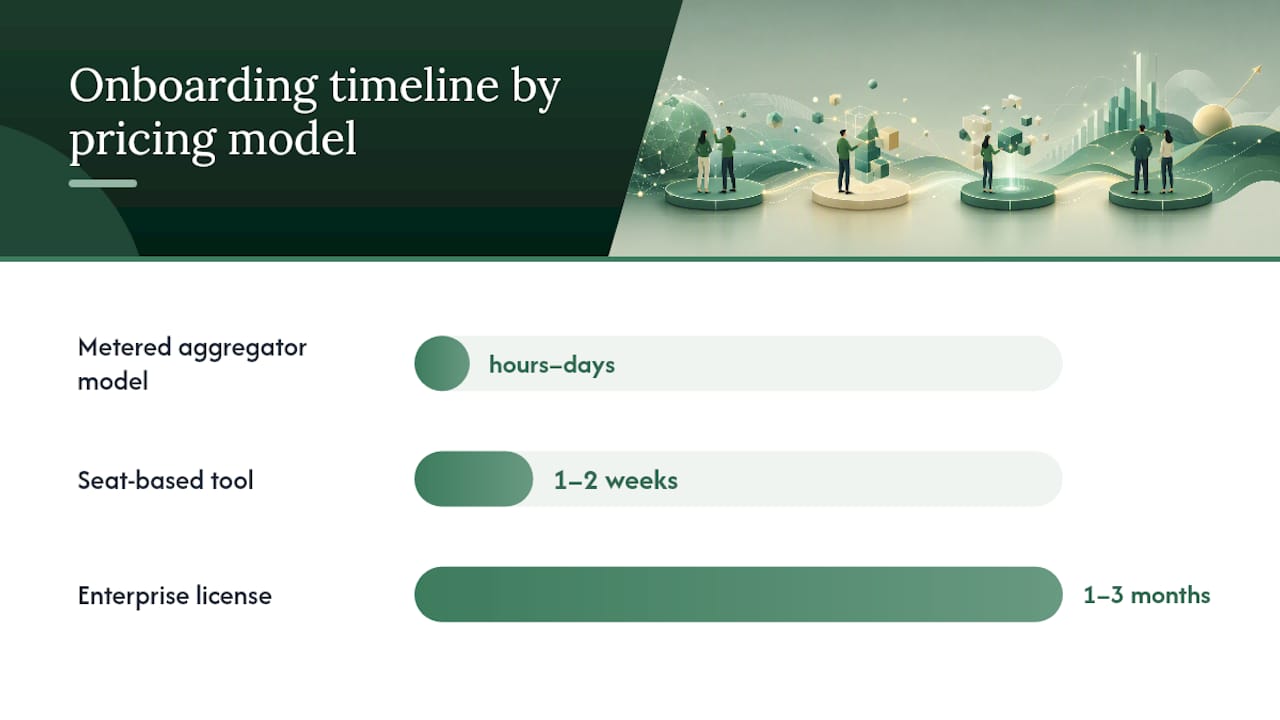
Onboarding timelines track roughly with pricing complexity: metered aggregator models often reach first value in hours to days, seat-based tools in one to two weeks, and enterprise-licensed platforms in one to three months once data mapping and compliance review are complete.
How This Guide Evaluated Platform Categories
This comparison weighted eight dimensions: primary use case fit, data source breadth, core feature depth, AI and NLP maturity, integration and API access, pricing transparency, time-to-value, and support quality. These mirror the criteria Gartner’s analyst frameworks use when evaluating intelligence platforms for enterprise buyers.
Evidence came from three angles: analyst research and vendor evaluation criteria, aggregated user feedback from marketplaces like G2, which surfaces real usability and support signals, and Gartner’s own peer-review listings for the competitive and market intelligence category specifically.
Weighting shifts by buyer type. A GTM team should weight time-to-value and integrations highest. Product strategy teams should weight data breadth and NLP maturity. Corp dev and investment teams should weight provenance and analyst-grade curation above speed. No single ranking fits every scenario, which is exactly why category fit matters more than a universal “best platform” claim.
Why Prowl Fits the MCP-Style Intelligence Category
Prowl’s core idea is simple: one API, 444 intelligence tools, and an agent that does the querying, comparing, and synthesizing instead of a human doing it manually across a dozen browser tabs. Real-time analytics reports come out the other end covering SEO performance, ad tracking, competitor moves, review sentiment, and pricing trends, formatted as interactive reports, PDFs, decks, or even video and audio summaries depending on what a team needs to hand off.

The practical use cases stack up fast: agencies generating standardized client reports at scale without hiring more analysts, growth teams automating weekly competitive monitoring instead of manually checking competitor sites, and corp-dev teams scouting acquisition signals across scattered sources without building a custom data pipeline from scratch.
Onboarding runs faster than most enterprise platforms because there’s no per-tool setup. Teams connect once through the MCP integration and start generating reports immediately, rather than negotiating separate contracts and API keys for every specialized tool they’d otherwise need.
| Point | Details |
|---|---|
| One connector, many tools | Prowl routes agent requests through 444 intelligence tools via a single API. |
| Faster reporting | Automated, agent-driven reports remove the manual formatting step most teams still do by hand. |
| Flexible output | Deliverables include interactive reports, PDFs, PPTX, infographics, video, and audio. |
Which Solution Fits Your Buyer Scenario?
- Small growth teams: an MCP-style aggregator wins on cost and speed. You don’t have headcount to run five separate tools, and metered billing matches unpredictable research bursts.
- Enterprise product organizations: a blend works best. Use an aggregator for fast competitive scans and pair it with a traffic intelligence tool for deep SEO benchmarking where dataset depth matters more.
- Agencies: the aggregator model is close to a mandatory fit. Multi-client reporting at scale demands standardized output and usage-based cost, not per-seat licensing across a dozen tools.
- Investors and corp dev: lean on analyst-grade enterprise intelligence for due diligence, but use an aggregator for the early-stage scouting and signal-gathering that precedes formal diligence.
The deciding factor shifts by scenario: cost and speed for lean teams, data depth for enterprise product work, scalability for agencies, and provenance for high-stakes financial decisions.
Market Intelligence Platforms for Decision-Makers: How to Pick
The conventional advice in this category still treats platform selection like a features checklist exercise: count the data sources, count the dashboard widgets, pick the biggest number. That approach made sense five years ago. It doesn’t anymore, because the real differentiator in 2026 isn’t how much data a platform touches. It’s how fast that data becomes a finished decision.
What’s underrated is integration architecture. Buyers obsess over dataset size and almost ignore how painful it is to actually connect five specialized tools to five different workflows. That friction compounds every quarter you keep the setup.
What I’d prioritize first: pick the category that matches your actual workflow shape, not your industry’s typical vendor list. A lean team running agent-driven workflows gains more from one connector to hundreds of tools than from one deep, narrow dataset it has to manually query every week. Depth still matters for regulated, high-stakes decisions. For everything else, speed to insight is the metric that actually moves outcomes.
Get Started With Prowl’s Market Intelligence Connector
Prowl gives you one connection point instead of a stack of subscriptions. Where the categories above each solve one piece of the puzzle, traffic here, contacts there, curated datasets somewhere else, Prowl routes an agent through all 444 of those tools at once and hands back a finished report instead of raw exports you’d otherwise have to assemble by hand.
That matters most if you’re already running AI agents or automated workflows and don’t want to build custom connectors for every new data source you need. Pay-as-you-go credits mean you’re not locked into a seat count that doesn’t match how research actually happens, in bursts, around launches, pitches, and competitive moves.
See how teams are already using it on the use cases page, or connect your first agent through the getting started guide and generate a real report before your next meeting.
Frequently Asked Questions About Market Intelligence Platforms
What’s the difference between market intelligence and competitive intelligence platforms? Market intelligence covers broader trends, industry shifts, customer sentiment, pricing patterns, across an entire sector. Competitive intelligence narrows that focus specifically to named rivals. Most modern platforms, including MCP-style aggregators, cover both under one system.
Do I need a data analytics platform in addition to a market intelligence platform? Usually not as a separate purchase if your intelligence platform exports cleanly to your existing BI stack or data warehouse. The distinction matters more when a platform locks output inside a proprietary dashboard with no export path.
How long does it typically take to see value from a new platform? It depends heavily on category. Metered aggregator models often deliver a first usable report within hours or days. Enterprise-licensed, analyst-grade platforms typically take one to three months for full onboarding and data mapping.
Are cloud-based platforms safer than on-premises deployments for sensitive market data? Most vendors now default to cloud deployment with SOC 2 or ISO certifications covering data handling. On-premises options still exist for organizations with strict regulatory requirements, but they slow onboarding and increase maintenance overhead considerably.
What red flags suggest a vendor’s data quality can’t be trusted? Vagueness about data sources, refusal to provide sandbox access with real data, and an inability to name specific refresh frequencies for individual data types are the clearest warning signs during evaluation.
Sources
For vendor due diligence, Gartner’s peer-review listings and G2’s user ratings give two independent views of real-world performance. For technical validation of data collection claims, Scrapy’s documentation shows what serious web-scraping infrastructure actually involves, useful context when a vendor claims proprietary “real-time” crawling. For market sizing context, the retail intelligence market forecast illustrates how fast AI-driven intelligence spending is growing across adjacent verticals.