
Keyword gap analysis is the process of comparing your site’s ranking keywords against 3 to 5 competitors to surface terms they rank for and you don’t. The payoff is a list of competitor-validated topics instead of guesswork. Begin by exporting your Google Search Console query data and identifying your main competitors before using third-party tools.
TL;DR:
- Prioritize fixing gaps on pages you already rank for by improving on-page SEO and internal linking to achieve faster gains.
- Focus on creating new pages only when three or more related keywords show up as gaps without a current home page.
- Use a scoring formula that combines search volume, click-through rate improvement, and keyword intent to identify the most valuable gaps to pursue first.
- Avoid technical issues and filtered branded terms to prevent false gaps, and always cross-check with Google Search Console impressions.
- Automate the workflow with AI-powered tools to manage multiple sites efficiently and generate actionable reports faster.
Table of Contents
- What Is Keyword Gap Analysis vs. Content Gap Analysis?
- Why Bother? The Real Payoff of a Keyword Gap Analysis
- How Do You Run a Keyword Gap Analysis Step by Step?
- How Do You Prioritize Which Gaps to Fix First?
- Turning Gaps Into Actions: Update, Create, or Redesign?
- What Mistakes Should You Avoid?
- How Prowl Speeds Up the Whole Workflow
- How Do You Measure Whether It Worked?
- A Practitioner’s Checklist and What I’d Do Differently
- When It’s Time to Automate the Gap Analysis Itself
- Where to Go Next for Templates and Tools
- Sources
What Is Keyword Gap Analysis vs. Content Gap Analysis?
Keyword gap analysis compares ranking data. You compare your keywords with those of competitors to identify missing or underperforming terms. It’s a data exercise, and the output is a spreadsheet of terms with volume, position, and URL.
Content gap analysis is broader. It looks at missing topics, formats, and depth across the buyer journey, not just individual keywords. A content gap might mean you have no comparison page at all, while a keyword gap might mean your existing comparison page just doesn’t mention one specific term a competitor targets.
The distinction matters for what you build next:
- A keyword gap on an existing page usually gets solved with a paragraph, a new H2, or an FAQ entry.
- A content gap, where no page covers the topic, needs a new pillar or cluster page.
- Overlapping gaps across five or six related keywords are your signal that you need a new page, not a patch job.
Confuse the two and you’ll spend a week writing a 3,000-word guide when a two-sentence addition would have closed the gap just as well.
Why Bother? The Real Payoff of a Keyword Gap Analysis
The fastest wins come from pages you already have. Terms where you rank between position 5 and 20 often just need better on-page targeting or a stronger internal link, and that kind of optimization tends to move faster than publishing new pages from scratch.
The slower, bigger win is topical. When three competitors all rank for a term you’ve never touched, that’s market validation you didn’t have to pay for. Benefits stack up fast:
- Near-win pages get a ranking lift without new content production.
- Competitor-validated topics reduce the risk of writing content nobody searches for.
- Gap data feeds directly into a content roadmap instead of a random editorial calendar.
- Funnel-stage gaps often reveal missing consideration or decision content, which tends to convert better than top-of-funnel traffic alone.
How Do You Run a Keyword Gap Analysis Step by Step?
This is the part most guides skip past. Here’s the actual sequence, in order, from picking competitors to scheduling the next audit.
- Pick your battleground keywords and competitors. Choose 3 to 5 sites that compete with you in search results, not just business rivals. A local bakery’s real SERP competitor might be a national recipe blog, not the bakery down the street.
- Export your data. Pull Google Search Console queries and landing pages filtered by performance metrics over a suitable recent period, a rank tracker CSV for tracked terms, GA4 landing page performance, and a fresh crawl of your own site plus competitor URLs.
- Pull competitor keyword exports from a third-party keyword tool for each of your chosen competitors, matching the same date range where possible.
- Normalize and merge. Standardize columns across every export (keyword, URL, position, volume, clicks, impressions, date) into one sheet before you do anything else.
- Classify by intent. Tag each term as informational, commercial, or transactional, and strip out branded queries for your brand and theirs.
- Find the gaps. Split terms into competitor-only (they rank, you don’t) and shared gaps (you both rank, but they outrank you or capture more clicks).
- Cluster and map. Group related keywords into topics, then map each cluster to an existing page or flag it as a new-page candidate.
- Decide and prioritize. For each cluster, decide update vs. create, score it, and slot it into your content roadmap. Set a monitoring date.
Following a reproducible workflow like this one keeps the process from turning into a one-off spreadsheet that nobody revisits after month one.
Before you cluster, sanity-check intent by looking at the actual SERP. If the top 10 results for a term are all comparison listicles and yours would be a glossary entry, the format mismatch will cap your ranking potential no matter how well the page is written.
Pro Tip: Keep a “competitor-only, high volume, low competition” filter as your first pass. Those terms usually convert into your fastest wins because three separate market signals already agree the demand is real.
How Do You Prioritize Which Gaps to Fix First?
A workable scoring formula: Opportunity Score = Search Volume × (Target CTR − Current CTR) × Intent Weight. Assign intent weights qualitatively based on the type of keyword intent, with higher weights for transactional and lower for informational, and let the math surface which gaps carry real revenue potential versus which just look big on paper.
Effort is the other half of the equation. Estimate it honestly:
- Writing time for a single paragraph addition vs. a full new page.
- Design or template changes needed (new comparison table, new schema).
- Whether the gap needs backlinks to have any realistic shot at ranking.
| Impact | Effort | — |
|---|---|---|
| High | Low | Update this week |
| High | High | Schedule for month 1–2 |
| Low | Low | Batch into a content sprint |
| Low | High | Deprioritize or drop |
Sort your full gap list into this matrix before you write a single word. It turns a 200-row spreadsheet into four honest buckets, and the top left one is where your next two weeks of work should go.
Turning Gaps Into Actions: Update, Create, or Redesign?
Not every gap needs a new page. Most don’t.
- Add a paragraph or FAQ entry when the gap is one keyword variant on a page that already ranks for the parent topic.
- Create a cluster page when three or more related gap keywords share no home page at all.
- Redesign the template when the SERP consistently shows a format (comparison table, calculator, video) that your current template structurally can’t support.
Internal linking is where a lot of teams drop the ball. Once you build or update a page, link to it from the pillar page and from at least two related cluster pages, using descriptive anchor text that matches the gap keyword’s intent, not generic “click here” links. Building out topic clusters this way, rather than leaving gap data as a flat keyword list, is what actually prevents two of your own pages from competing against each other in search results.
Pro Tip: Before publishing any update, check whether an existing page already targets a closely related term. Cannibalization from your own gap-filling content is more common than teams expect.
Before publishing updates, ensure intent alignment, avoid internal cannibalization, add relevant internal links, update metadata, and record changes for tracking.
What Mistakes Should You Avoid?
Branded queries are the most common source of false gaps. If a competitor ranks for their own brand name plus a modifier, that’s not a real opportunity for you. Filter those out before you cluster anything.
Other recurring mistakes worth flagging:
- Relying on one keyword tool’s volume figure without cross-checking against GSC impressions.
- Chasing a keyword whose SERP intent doesn’t match the page type you’re planning to build.
- Publishing content updates while a technical blocker (noindex tag, broken canonical, slow load time) prevents Google from even crediting the change.
- Treating gap analysis as a one-time project instead of a recurring quarterly audit.
Fix the technical issues first. No amount of content quality overcomes a page Google can’t properly crawl or index.
How Prowl Speeds Up the Whole Workflow
Running the process above by hand across five data sources takes real hours, mostly spent copying, renaming columns, and reconciling mismatched formats. A platform can connect an AI agent to many market intelligence tools through one API, so a single agent-run workflow can pull competitor keyword footprints, rank data, and site crawl signals into one aggregated dataset, then cluster the output into topics automatically.
For teams already stretched thin, that changes what a gap analysis costs in practice:
- One workflow request replaces manual exports from four or five separate tools.
- Clustering and mapping happen inside the same output instead of a second manual pass in a spreadsheet.
- Reports can be delivered as an interactive dashboard, PDF, or slide deck, so the roadmap is ready to hand to stakeholders without reformatting.
How Do You Measure Whether It Worked?
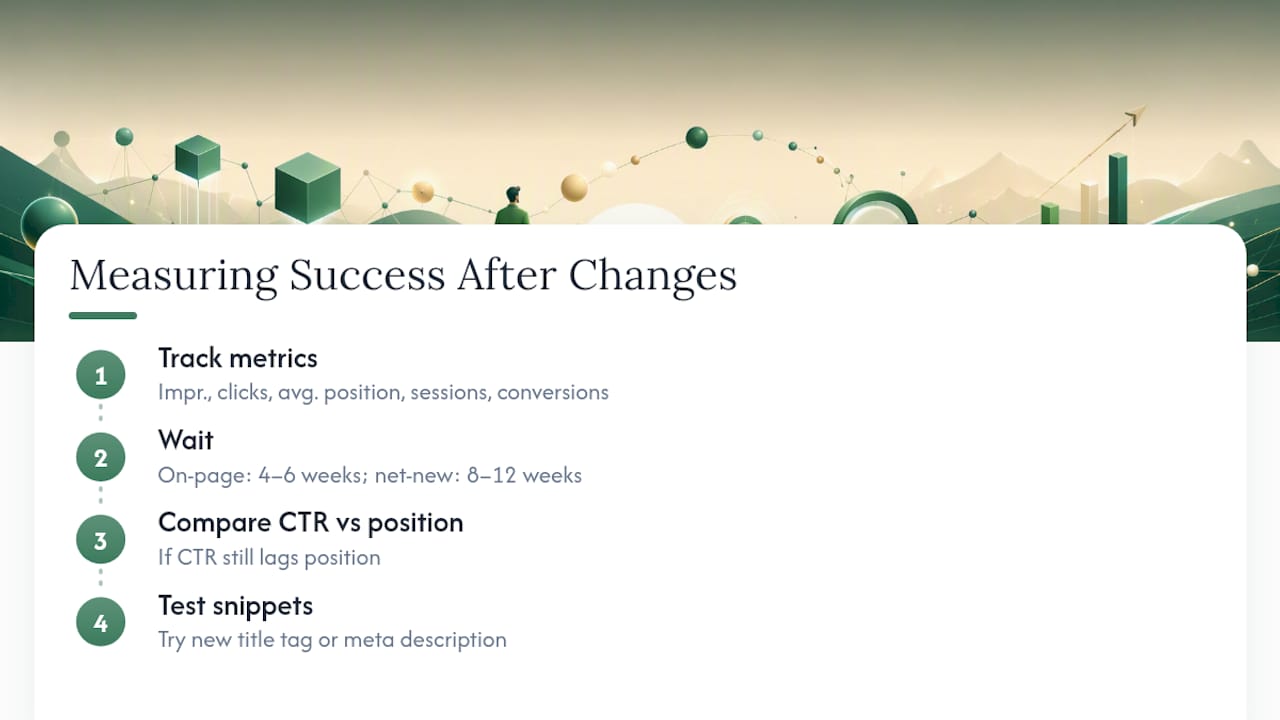
Track impressions, clicks, average position, organic sessions, and conversions for every page you touch. Give on-page updates 4 to 6 weeks to show movement in GSC and give net-new pages 8 to 12 weeks before judging them. If a page’s CTR still lags its position after that window, test a new title tag or meta description before assuming the content itself failed.
A Practitioner’s Checklist and What I’d Do Differently
Run this order on your first pass: pick competitors, export GSC, merge with one keyword tool, filter branded terms, score with the formula above, ship the top five. Three lessons from watching this go wrong: get one stakeholder to agree on the scoring weights before you present results, ship a near-win optimization first to build trust in the process, and never present a raw keyword list. Show the cluster and the recommended action, or nobody outside SEO will know what to do with it.
— Sergey
When It’s Time to Automate the Gap Analysis Itself
Running this process quarterly by hand works fine for one site. It gets painful fast once you’re managing gap analysis across multiple client accounts or a site with thousands of ranking keywords, where the manual export and merge step alone can eat a full day per site.

Prowl is built for exactly that scaling problem. Instead of stitching together exports from GSC, a keyword tool, a rank tracker, and a crawler by hand, one agent workflow through Prowl’s 444 intelligence tools pulls and clusters that data in a fraction of the time. Agencies running gap analysis across multiple client sites, or in-house teams juggling it alongside a dozen other reporting tasks, are the clearest fit. Browse the use cases page to see how teams structure recurring reports, then head to getting started to connect Prowl to your workflow and run your first automated gap report this week.
Where to Go Next for Templates and Tools
- Content Gap Analysis: The Complete Guide, for first-page audit techniques and identifying freshness and thoroughness gaps.
- SEO Gap Analysis Guide: Find Keywords & Fix Gaps, for pairing keyword data with technical and backlink diagnostics.
- 5-Step Content Gap Analysis Guide, for mapping content to buyer-journey stages.
- How to Do Keyword Gap Analysis: Step-by-Step Guide, for CSV export fields and the CTR-weighted scoring formula.
- Free SEO Competitor Analysis Tool, for a quick competitor keyword pull.
- Content Strategy Services for SEO, AEO & GEO, for help mapping gap output into an editorial plan.
Sources
Five sources, minimum: Google Search Console, one third-party keyword research tool, a rank tracker, a site crawler, and Google Analytics 4. Skip any one of these and you’re working with a partial picture.
Here’s what to actually pull from each:
- Content Gap Analysis: The Complete Guide
- SEO Gap Analysis Guide: Find Keywords & Fix Gaps | Rankpeak
- 5-Step Content Gap Analysis: How to Identify and Fill the Gaps
- How to Do Keyword Gap Analysis: Step-by-Step Guide
Third-party volume numbers are notoriously unreliable for long-tail terms. Some tools assign identical volume figures to phrases that are actually worded differently, which inflates apparent demand. Treat GSC impressions as ground truth and use third-party volume only for relative scale and for discovering terms you don’t already have GSC data on.