
A content gap analysis compares what your audience is actually searching for against what you’ve published, then ranks the difference by how much it’s worth fixing. Run correctly, it produces a prioritized backlog of pages to create, rewrite, or merge, weighted by both search visibility and whether AI answer engines will cite you at all. The 2026 version of this exercise has to score for both.
TL;DR:
- A comprehensive content gap analysis must identify missing topics, intent mismatches, and media format gaps, not just keyword opportunities.
- It should evaluate which pages are cited by AI tools and prioritize fixing high-impact, high-value gaps first.
- Running the analysis involves normalizing data, mapping keywords to pages, and assessing AI citation potential before planning fixes.
- Prioritize gaps based on winnability and business value, focusing on high ward-winning and high-value opportunities, then prune low-impact pages.
- Automating data collection and regular review of top-priority pages help maintain momentum and measure progress effectively.
Table of Contents
- What Content Gap Analysis Means for SEO and AI Visibility in 2026
- Types of Content Gaps and How to Fix Each One
- How Do You Run a Content Gap Analysis Step by Step?
- How Do You Prioritize Which Gaps to Fix First?
- Which Tools and Templates Do You Need to Run This?
- How Do You Audit a Large Site Without Getting Stuck?
- How Do You Measure Whether the Gaps Actually Closed?
- What I’d Tell Anyone Starting Their First Content Gap Analysis
- Run Your Next Content Gap Analysis Without the Manual Export Chain
- Sources
What Content Gap Analysis Means for SEO and AI Visibility in 2026
Most marketers still think of a content gap analysis as a keyword exercise: pull the terms a competitor ranks for that you don’t, then write pages to match. That’s the 2018 version of the job, and it’s incomplete. A complete content gap analysis also has to account for intent mismatch, thin coverage on pages that technically rank, and formats you haven’t attempted at all.
The bigger shift is what “visibility” means now. Ranking on page one used to be the finish line. It isn’t anymore. AI answer engines pull from a different pool of signals than traditional rankings, and a page can sit at position 3 on Google while never once getting cited by an AI overview or a Perplexity answer. That’s a gap too, and most audits still miss it entirely.
A properly scoped analysis in 2026 should aim for a few concrete outcomes:
- A ranked list of missing topics, not just a raw keyword export
- Existing pages flagged for rewrite, consolidation, or removal
- A clear read on which pages get cited by AI tools and which get ignored
- A backlog with owners and effort estimates attached, not a spreadsheet nobody opens again
Skip the AI-citation check and you’ll optimize for a search landscape that’s already shrinking in relative importance. Skip the prioritization step and you’ll end up with 400 rows of “content ideas” that never turn into published pages.
Types of Content Gaps and How to Fix Each One
Not every gap gets the same treatment. Lumping them together is how teams end up rewriting pages that needed deletion, or writing new articles when the real fix was consolidating three thin ones into one strong page. Gap analysis typically surfaces five distinct categories, each with its own signal and its own fix.
- Topic gaps. A subject your audience searches for that you haven’t covered at all. Signal: zero ranking pages for a keyword cluster a competitor owns. Fix: create net-new content.
- Intent gaps. You cover the topic, but the page answers the wrong question. Signal: you rank on page two for a commercial query with a page written like a blog post. Fix: rewrite to match the searcher’s actual intent, not just the keyword.
- Quality and depth gaps. The page exists and targets the right intent, but it’s thin, outdated, or shallow next to what’s ranking above it. Signal: high impressions, low click-through, or a ranking position that’s stuck in the teens. Fix: expand, add specifics, update data.
- Format and media gaps. The content is solid text, but the query wants a video, calculator, comparison table, or downloadable template. Signal: SERP features you’re not represented in. Fix: rebuild the format, not necessarily the words.
- Originality and information-gain gaps. The page restates what ten other sites already say, with no new data, framework, or first-hand angle. This is the one classic audits skip entirely, and it’s now the one that determines whether AI answer engines cite you instead of a competitor saying the same generic thing with better SEO.
A page can carry more than one gap at once. A thin blog post that also happens to answer the wrong intent needs a full rebuild, not a light edit. Tag each finding with its gap type before you touch a single word, because the type dictates the fix.
How Do You Run a Content Gap Analysis Step by Step?
This is the pipeline. Run it in order, and don’t skip the normalization step just because it feels tedious. It’s the difference between a clean backlog and a spreadsheet full of duplicate rows.
- Define scope and business objective. Pick a domain section, product category, or funnel stage. “Improve the whole site” isn’t a scope. “Close gaps in our mid-funnel comparison content for the enterprise segment” is.
- Export your data. Pull competitor keyword gaps from a keyword-gap tool, then export your own Search Console query data, GA4 landing page performance, and a full crawl (Screaming Frog or similar) for every URL in scope.
- Normalize before you join anything. Lowercase every URL, strip UTM and tracking parameters, standardize on one protocol, and decide once whether trailing slashes stay or go. Skipping this step creates false duplicates that silently inflate your page count and corrupt every pivot table downstream.
- Cluster keywords to pages and map intent. Group ranking keywords by topic and assign each cluster to the page (existing or theoretical) that should own it. Tag intent as informational, commercial, or transactional for each cluster.
- Audit existing pages against a consistent rubric. Score every page in scope on the same dimensions: word count relative to top-ranking pages, publish/update date, presence of original data, internal links pointing in, and current ranking position.
- Assign a fix by gap type. Use the taxonomy from the previous section. Write a one-line brief for each: what changes, why, and what “done” looks like.
- Run the AI-citation check. Query ChatGPT, Perplexity, and Google’s AI Overviews with the target questions your priority pages should answer. Note whether your domain shows up, whose content does, and what those cited pages have that yours doesn’t. That’s almost always original data, a named framework, or a first-person account.
- Size and assign. T-shirt size each brief (S/M/L) by estimated effort, assign an owner, and set a target date. A brief with no owner is a wish, not a task.
Pro Tip: Run the AI-citation check on your top 20 priority pages before you write anything new. If three competitors are getting cited for the same query with content no better than yours, the deciding factor is almost always a data point or example they have and you don’t. Add that first.
A brief template that actually gets used needs these fields: target page or new URL, gap type, target keyword and cluster, current ranking position, intent, recommended fix, effort size, owner, and due date. Anything less and the brief becomes another thing someone has to interpret before they can act on it.
How Do You Prioritize Which Gaps to Fix First?
Score everything on two axes: winnability and business value. A gap that’s easy to win but drives no revenue isn’t worth a sprint. A high-value gap you can’t realistically rank for in the next year isn’t worth chasing yet either.
Winnability depends on keyword difficulty relative to your domain authority, how entrenched the current top results are, and your realistic time horizon. A site with modest domain authority competing for a term dominated by five major publishers should treat that keyword as a multi-year play, not a quarterly goal.
Business value depends on intent and how close the query sits to a conversion. A commercial-intent term with modest search volume is often worth more than a high-volume informational term that never converts.
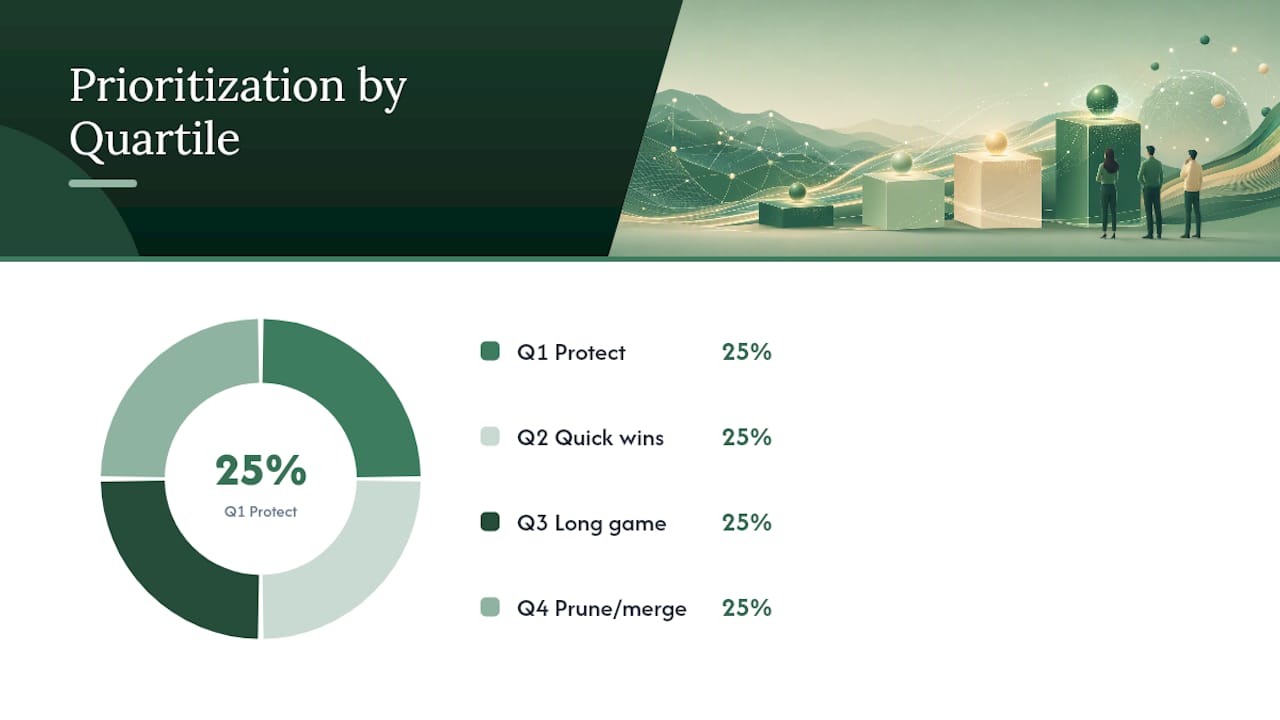
Converting both scores to percentiles and sorting into quartiles turns a messy spreadsheet into a repeatable decision model:
- Q1, high winnability and high value: protect and defend. These are your existing strong pages. Refresh them on a fixed schedule and don’t let a competitor out-execute you here.
- Q2, high winnability, lower value: quick wins. Fast to fix, useful for building topical authority even if the direct revenue impact is small.
- Q3, lower winnability, high value: the long game. Worth a content brief now, but budget for a 6 to 12 month runway, not a sprint.
- Q4, lower winnability, lower value: prune or consolidate. If three thin Q4 pages target overlapping queries, merge them into one page and redirect the rest.
Chasing Q3 and Q4 terms first is the single most common reason gap analyses stall before they produce any measurable result.
Which Tools and Templates Do You Need to Run This?
You don’t need a specialized platform to run a competent analysis. You need consistent exports and a spreadsheet structure that supports pivoting without manual cleanup.
The tool categories that matter: a keyword-gap tool (Ahrefs, Semrush, or similar) for competitor comparison, Google Search Console for your own query and impression data, GA4 for landing page performance, a crawler like Screaming Frog for a full inventory of existing URLs, and an AI-visibility tracker or manual prompt testing for the citation check.
The minimal export needs exactly these columns to make the pivot and clustering steps work without rebuilding the sheet halfway through: canonical URL, target keyword, ranking keywords, impressions, clicks, last updated date, owner, and primary intent. Miss the “last updated” column and you’ll have no way to separate a genuinely thin page from one that’s simply overdue for a refresh.
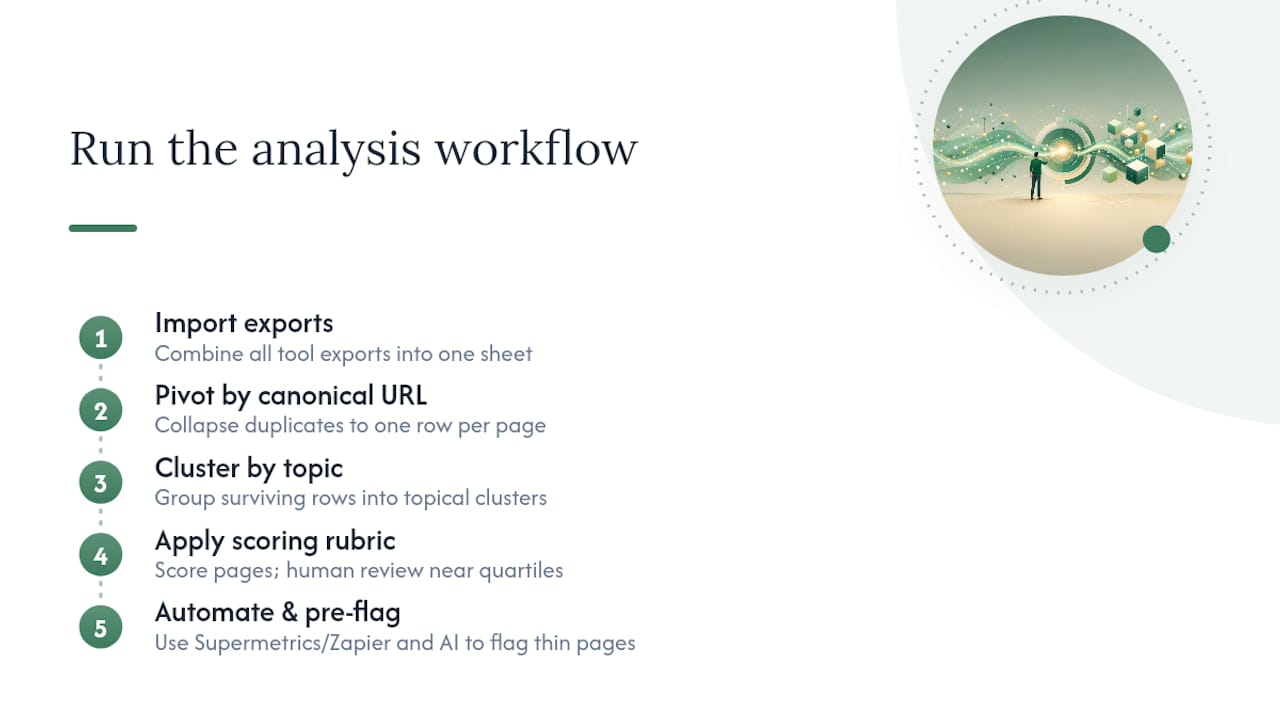
The workflow itself is short: import every export into one sheet, pivot by canonical URL to collapse duplicates, cluster the surviving rows by topic, then apply the scoring rubric. Automation tools like Supermetrics or Zapier can handle the repeat pulls automatically, and a lightweight AI summarization pass can flag obviously thin pages before a human ever opens them, though a person should still make the final call on anything scored near a quartile boundary.
How Do You Audit a Large Site Without Getting Stuck?
Auditing 3,000 URLs at once is how these projects die. The fix is sequencing: start with your highest-traffic subfolders, move to pages ranking positions 5 through 20 (the ones one good push away from page one), and sweep low-traffic pages last, once you’ve built momentum and a working rhythm.
Governance rules keep the data honest as you scale:
- Normalize canonical URLs the same way every time, before any join happens.
- Give every row an owner and a “last reviewed” date, or it never gets touched again.
- Use the same scoring rubric across every batch. Switching criteria mid-project makes the backlog impossible to compare.
This is where a market-intelligence connector earns its place in the workflow. Prowl connects an AI agent to 444 intelligence tools through one interface, which means the keyword-gap pull, the crawl data, and the competitor comparison can run as one automated pass instead of three manual exports stitched together by hand. That collapses hours of joining spreadsheets into a single generated report.
Pro Tip: Run the full phased audit once a quarter, but check your top 50 priority pages for AI-citation drift every month. AI answer engines update their preferred sources faster than Google’s core algorithm changes rankings.
How Do You Measure Whether the Gaps Actually Closed?
Track outcomes on a fixed cadence, or the backlog becomes busywork with no feedback loop.
Primary KPIs: search impressions, clicks, ranking position movement, whether AI tools now cite the page, and downstream conversions.
Secondary signals: click-through rate against impressions, time on page, and whether internal link equity to the page increased after you added new links pointing to it.
- Check rankings and impressions every 2 weeks for the first two months after publishing or updating a page.
- Run the AI-citation check monthly for your highest-priority pages.
- Call a gap “closed” when the page holds a stable position and shows a clear traffic or citation lift for at least one full reporting cycle, not just a one-week spike.
What I’d Tell Anyone Starting Their First Content Gap Analysis
Most audits fail from paralysis, not bad analysis. Teams chase keywords they’ll never rank for and ignore the AI-citation check entirely. Work in small batches, score everything the same way every time, and automate the joins so the rubric gets applied consistently instead of by whoever’s least tired that Friday.
— Sergey
Run Your Next Content Gap Analysis Without the Manual Export Chain
The workflow above works with spreadsheets and patience, but the joining, normalizing, and re-exporting is where most of the time actually goes. Prowl gives any AI agent direct access to 444 marketing intelligence tools through one connection, so the keyword-gap pull, the crawl data, and the competitor comparison generate as a single report instead of three separate exports you stitch together by hand.

Two concrete examples: a competitor keyword-gap comparison that used to mean exporting from three separate tools and reconciling the columns manually now runs as one automated join. A quarterly content audit report that took a day of spreadsheet work can generate live, with the scoring rubric already applied. Check the use cases for SEO and competitor analysis to see the report types available, or go straight to connecting your AI agent and run your first automated gap report this week.
Sources
For deeper reading, see Backlinko’s content gap guide, Semrush’s step-by-step framework, and this technical SEO checklist for B2B sites for audit-adjacent fixes.
- Content Gap Analysis: The Complete Guide - Backlinko
- How to Audit Website Content at Scale | Morrison
- How to Do a Content Audit: Complete Step-by-Step Guide (2026)