
Automated competitor analysis is an always-on, agent-driven pipeline that discovers, tracks, and prioritizes competitor signals so your team acts on what matters instead of chasing screenshots. Most organizations get to value fastest by pairing lightweight discovery agents with an MCP-style connector that centralizes enrichment, scoring, and reporting in one place. That combination solves the two problems that sink most competitive intelligence programs: missing competitors you didn’t know existed, and drowning in alerts nobody reads.
The practical benefit is real-time, prioritized insight instead of a quarterly slide deck nobody opens until the deal is already lost. AI agents can search, extract structured data, and refresh competitive intelligence continuously, which changes the cadence from “we’ll check next quarter” to “we knew about the price change three hours after it went live.”
If you’re setting this up for the first time, start here:
- Deploy discovery agents that scan search clusters, job boards, and filings for emerging rivals.
- Connect an MCP-style connector to centralize extraction, normalization, and delivery.
- Score signals by revenue relevance before routing alerts to sales or product teams.
Pro Tip: Don’t automate everything at once. Pick three signal types (pricing, product launches, hiring) and get those pipelines reliable before adding a fourth.
Table of Contents
- What Is Automated Competitor Analysis, and When Do You Need It?
- Building the Pipeline: Discovery, Extraction, Normalization, Monitoring, Synthesis
- How Do You Find Competitors You Don’t Know About Yet?
- Which Signals Should You Monitor First?
- Should You Build Your Own Pipeline or Buy One?
- How Do You Roll Out Automated Competitor Analysis in 90 Days?
- How an MCP-Style Connector Shortens Time to Insight
- Data Privacy and Ethics in Automated Competitor Analysis
- Common Pitfalls That Derail Competitive Intelligence Programs
- How Do You Measure Whether Your System Is Working?
- What the Data Actually Supports, Not What Sounds Good
- Get Your First Competitor Report Running This Week
- Sources
What Is Automated Competitor Analysis, and When Do You Need It?
Automated competitor analysis differs from a manual competitive audit in one fundamental way: it never stops running. A manual process produces a report on a schedule, usually monthly or quarterly, built by someone who spent a day and a half combing through competitor websites and pricing pages. An automated pipeline checks those same pages continuously, flags what changed, and routes it to the right person within hours.
That doesn’t mean automation replaces judgment. It replaces the tedious parts of judgment: the scanning, the copy-pasting, the manual diffing of a pricing page against last month’s screenshot. Humans still decide what a signal means for strategy, but they stop spending their week finding the signal in the first place.
Typical deliverables from an automated system include:
- Real-time alerts when a tracked competitor changes pricing, messaging, or product scope.
- Weekly or biweekly synthesis reports that roll up smaller signals into a narrative.
- CRM-embedded battlecards that update automatically when a competitor’s positioning shifts.
- Stakeholder-ready summaries for leadership, formatted as slides, PDFs, or dashboards.
Automation earns its keep when you’re tracking more than five or six competitors, when your market moves fast enough that quarterly snapshots go stale, or when sales reps keep asking “did anything change with [competitor] this week?” and nobody has a good answer. It earns less when you’re tracking one or two direct competitors in a slow-moving category. In that case, a sharp analyst checking in monthly probably beats the overhead of building a pipeline.
Building the Pipeline: Discovery, Extraction, Normalization, Monitoring, Synthesis
Every automated competitive intelligence system, regardless of vendor or build choice, breaks down into five components. Understanding each one lets you evaluate any tool or decide what to build yourself.
- Discovery identifies who counts as a competitor, including ones you haven’t added manually. Inputs range from search intent clusters and category keyword overlap to job listings that reveal a rival expanding into your space.
- Extraction pulls structured data out of unstructured sources: competitor websites, review platforms, ad libraries, and job boards. This layer uses API connectors where available and scraping where it isn’t. Open-source libraries such as parallel-web on PyPI give teams a starting point for building extraction components without licensing a full platform.
- Normalization takes messy extracted data (three different date formats, five ways of writing “Enterprise plan”) and maps it into a consistent schema. This step includes entity resolution, making sure “Acme Corp,” “Acme Inc.,” and “Acme” all resolve to the same competitor record.
- Monitoring runs change detection against the normalized data on a defined cadence. Pricing pages might get checked daily; job listings, weekly; core messaging, every few days. The cadence should match how fast that signal type typically changes, not a single blanket schedule.
- Synthesis scores and ranks what changed, then routes it to the right channel: a Slack alert for something urgent, a weekly digest for lower-priority shifts, a full report for leadership review.
Pro Tip: Build your scoring logic before you build your alerting logic. A system that surfaces every change with equal weight trains your team to ignore it within two weeks.
Editorial roundups of competitive intelligence tools consistently note that the platforms delivering the most value rank and prioritize signals rather than dumping raw change alerts on a channel. Raw monitoring is a commodity. Prioritized synthesis is the actual product.
How Do You Find Competitors You Don’t Know About Yet?
The hardest part of competitive intelligence isn’t tracking the five rivals everyone already names in board meetings. It’s catching the sixth one, the startup that launched eleven months ago and just closed a funding round nobody on your team saw. Practitioners consistently describe discovery, not monitoring, as the genuinely hard problem in competitive intelligence, because monitoring a known list is mechanical while finding the unknown requires judgment at scale.
A handful of signals feed automated discovery reliably:
- Search intent clusters: if new domains start ranking for your category’s commercial keywords, that’s a discovery trigger worth investigating.
- Job listings: a company posting for “Head of Partnerships, [Your Vertical]” is signaling market entry months before a product launch.
- RSS and news spikes: funding announcements, executive hires, and press mentions cluster around competitive moves.
- Backlink patterns: sites suddenly earning links from your industry’s usual referral sources often signal a new player gaining traction.
AI agents handle this well because discovery is fundamentally a similarity and clustering problem. Seed a discovery agent with a handful of known competitors, generate embeddings from their site content and positioning language, then search for other entities with similar embeddings across the categories you monitor. Clustering surfaces adjacent players a keyword search alone would miss.
The catch is false positives. An agent optimized for recall will surface adjacent tools, agencies, and even customers who happen to use similar language. Build a lightweight human review step, ideally under five minutes per candidate, where someone confirms or rejects a suggested competitor before it enters the monitored list. Skipping that step is how teams end up “monitoring” a company that isn’t actually competing with them.
Which Signals Should You Monitor First?
Not every signal deserves equal engineering effort.
Organic and paid visibility shifts come next. A competitor suddenly ranking for keywords they never targeted before, or a spike in their ad spend on a channel you own, tells you where they’re placing bets before the market notices. Customer and market proof points, meaning reviews, published case studies, and hiring patterns, show you what’s actually landing with buyers versus what’s just marketing noise. Messaging and go-to-market changes, like new landing pages or partnership announcements, reveal strategic pivots often before a press release confirms them. Operational signals, including SDK releases, infrastructure changes, and API updates, matter most for technical buyers evaluating a competitor’s platform maturity.
| Signal type | Detection method | Typical check cadence |
|---|---|---|
| Pricing and packaging | Automated page diffing | Daily |
| Product and feature launches | Changelog and release note scraping | Daily to every few days |
| Organic and paid visibility | Rank tracking and ad library monitoring | Weekly |
| Reviews and customer proof | Review platform scraping | Weekly |
| Messaging and GTM shifts | Site content diffing | Every few days |
| Hiring and operational signals | Job board and filing monitoring | Weekly |
Vendor and category write-ups describe connectors, auto-insights, and win-loss capture as standard capabilities across the competitive intelligence category, which is a useful checklist regardless of whether you build or buy: if a signal type isn’t covered by one of those capabilities, it’s a gap in your pipeline.
Should You Build Your Own Pipeline or Buy One?
This decision comes down to five factors, and most teams underweight at least two of them.
- Time-to-value. Building extraction, normalization, and scoring from scratch typically takes a small engineering team a full quarter before the system produces anything reliable. A managed connector approach can produce a first report within days.
- Data coverage and connector maintenance. Websites change their HTML structure constantly, and every scraper you build needs ongoing maintenance. This is the cost teams consistently underestimate: the initial build is cheap compared to keeping ten scrapers alive for a year.
- Security, privacy, and compliance. Any pipeline touching public web data needs a clear policy on what it collects and how long it retains it, particularly if the outputs feed into CRM records tied to specific accounts.
- Operational overhead and ownership. Someone has to own the pipeline when it breaks at 2 a.m. before a board meeting. Decide up front whether that’s an engineer, a CI analyst, or a vendor’s support team.
- Total cost over 12 months, not just the initial build cost, including engineering hours for maintenance and the opportunity cost of the analyst time spent babysitting a fragile system.
Pro Tip: Score each option (build, buy, or a hybrid MCP-connector approach) from 1 to 5 on all five factors, weight time-to-value and maintenance cost highest, and let the math decide. Teams that skip this and go with gut instinct tend to underestimate maintenance by half.
G2’s competitive intelligence category page consolidates feature lists and user feedback that help you sanity-check coverage claims from any vendor you’re evaluating, though reviews alone shouldn’t be your only input since they skew toward popularity rather than data depth.
How Do You Roll Out Automated Competitor Analysis in 90 Days?
A 90-day plan gives you enough runway to build something real without letting the project drift into “we’ll get to it eventually.”
Weeks 1 through 3: discovery and source mapping. Identify your known competitor list, then run a discovery pass using search clusters and job listing signals to surface two or three unknown players. Map your minimal viable source set: competitor websites, one review platform, one job board, and a news or RSS feed.

Weeks 4 through 6: connectors and extraction. Stand up extraction for your highest-priority signal, almost always pricing pages, plus one secondary signal like changelog monitoring. Get normalization working well enough that duplicate entities don’t pollute your data.
Weeks 7 through 9: monitoring and first alerts. Turn on change detection with a defined cadence per signal type. Route your first alerts to a single Slack channel or email digest, not directly to sales, until you trust the signal quality.
Weeks 10 through 13: synthesis and first stakeholder report. Build a scoring layer that ranks changes by relevance, then produce your first full report for leadership. This is your proof-of-concept moment.
Quick wins worth prioritizing in that window:
- Pricing change alerts, because they’re easy to detect and immediately actionable.
- Launch detection, since catching a competitor’s new feature the week it ships beats hearing about it from a lost deal three months later.
- One CRM-integrated battlecard update, which shows sales teams tangible value fast.
Track three early KPIs: the ratio of alerts to actual actions taken, hours saved compared to manual research, and whether the intelligence influenced a specific deal or product decision. Category benchmarks suggest automation saves meaningful manual research time once the pipeline stabilizes, though the real payoff shows up in decisions made faster, not just hours logged.
How an MCP-Style Connector Shortens Time to Insight
An MCP-style connector centralizes enrichment and formatting so an agent doesn’t need custom integration work for every data source it touches. Instead of building and maintaining a dozen separate connectors, an agent calls one interface and gets structured, normalized output back.
Prowl applies this architecture to competitive intelligence by giving any agent access to 444 market intelligence tools through a single connector, covering pricing research, SEO tracking, ad performance, review analysis, and competitor synthesis without separate setup for each. Reports can come back as interactive dashboards, PDFs, PPTX decks, or even video and audio summaries depending on who needs to consume them.
An MCP connector architecture reduces engineering complexity by centralizing enrichment and output formatting, which makes it far easier to plug agents into many downstream workflows without rebuilding integration logic for each new data source.
For a product manager who needs a competitor pricing brief before a Friday roadmap meeting, that difference is the gap between requesting a report and waiting three days, or asking an agent and having synthesis back within the hour.
Data Privacy and Ethics in Automated Competitor Analysis
Automated collection of public competitor data sits in a gray zone that deserves real attention, not a one-line disclaimer. Scraping a public pricing page is different, legally and ethically, from scraping content behind a login wall or violating a site’s terms of service. Before building or buying a pipeline, get clear on what data sources are genuinely public and which require permission, an API agreement, or exclusion.
Respect for a competitor’s robots.txt and rate limits isn’t just good etiquette. Aggressive scraping that strains a competitor’s infrastructure can create legal exposure and, frankly, makes your industry look bad. Build in reasonable request throttling regardless of whether your tooling technically allows faster collection.
There’s also an internal ethics question worth raising with your team: what you do with the intelligence matters as much as how you collected it. Using competitor pricing data to inform your own strategy is standard practice. Using scraped customer reviews to identify and directly target a specific competitor’s dissatisfied customers by name crosses into territory that should make a compliance team uncomfortable.
Document your data retention policy for anything that touches individual-level information, such as named reviewers or specific employee LinkedIn activity picked up during hiring-signal monitoring. Aggregate trend data (pricing moved, headcount grew) carries far less risk than data tied to identifiable individuals, and your pipeline should be designed to favor the former.
Common Pitfalls That Derail Competitive Intelligence Programs
The most common failure mode isn’t technical. It’s alert fatigue: a pipeline that surfaces every minor change with equal urgency trains the team to ignore the channel entirely within a few weeks. By the time something genuinely important happens, nobody’s watching.

A second recurring pitfall is stale competitor lists. Teams build a discovery process once, populate a list of ten competitors, and never revisit it. Eighteen months later, three of those competitors have pivoted out of the category and two genuine new threats never made it onto anyone’s radar.
Normalization gets underestimated constantly. Teams budget time for scraping and monitoring but treat entity resolution and schema consistency as an afterthought, then wonder why their dashboard shows “Acme” and “Acme Corp” as two separate competitors with split data.
Ownership gaps kill more pipelines than technical failures do. A system built by one engineer as a side project works fine until that engineer leaves, and then nobody knows how to fix it when a scraper breaks. Assign clear ownership before launch, not after the first outage.
Finally, teams sometimes build elaborate pipelines and then never close the loop with sales or product. Intelligence that sits in a dashboard nobody checks delivers zero value regardless of how sophisticated the extraction logic is underneath it. The pipeline is only half the job; distribution and adoption are the other half.
How Do You Measure Whether Your System Is Working?
The clearest signal of a healthy competitive intelligence system is the ratio between alerts sent and actions taken. If your team gets fifty alerts a week and acts on two, your scoring logic needs tightening, not more data sources.
Time saved is the second core metric, measured honestly against what manual research actually cost before. If an analyst previously spent six hours a week manually checking competitor pricing pages and that’s now automated, that’s six hours redirected toward analysis instead of data collection.
Influence on outcomes matters more than volume of reports produced. Track whether competitive intelligence specifically shaped a pricing decision, a positioning change, or a deal that closed because a sales rep had a battlecard update before the call instead of after. A program generating twenty reports a month that nobody references is worse than one generating four that consistently change decisions.
Freshness and coverage round out the KPI set. Measure the average time lag between a competitor change happening and your system detecting it, and track what percentage of your monitored competitor list gets reviewed and validated each quarter. A discovery process that hasn’t added or removed a competitor in a year is probably stale, not stable.
The mistake most teams make when evaluating their own system is measuring activity (alerts sent, reports generated) instead of outcomes (decisions influenced, time saved, deals affected). Activity metrics are easy to game and easy to inflate. Outcome metrics are harder to track but are the only ones that actually justify the engineering investment.
Automated competitor analysis delivers the most value when discovery agents surface unknown rivals and an MCP-style connector centralizes scoring, synthesis, and delivery into one workflow.
| Point | Details |
|---|---|
| Definition | Automated competitor analysis is a continuous, agent-driven pipeline covering discovery, extraction, monitoring, and synthesis. |
| Discovery is the hard part | Finding unknown competitors matters more than monitoring known ones; use embeddings, job listings, and search clusters. |
| Prioritize five components | Discovery, extraction, normalization, monitoring, and synthesis each need dedicated attention, not just extraction. |
| Score before you alert | Rank signals by revenue relevance so teams act on alerts instead of ignoring a noisy channel. |
| Build vs buy is a math problem | Weigh time-to-value and ongoing connector maintenance against a managed approach like Prowl’s MCP connector. |
What the Data Actually Supports, Not What Sounds Good
The conventional advice on competitive intelligence obsesses over monitoring: more sources, more alerts, more dashboards. That’s backwards. The evidence points to discovery and prioritization as the two places teams underinvest, and they’re exactly the two places automation pays off fastest, since finding an unknown rival or ranking fifty changes down to the three that matter is precisely the kind of pattern-matching work agents handle better than a tired analyst on a Friday afternoon.
Most build-vs-buy debates also get framed as a binary when it rarely is one. The real decision is how much connector maintenance your team wants to own. A pipeline built entirely in-house often looks cheaper on a whiteboard and more expensive twelve months later once someone tallies the hours spent fixing broken scrapers.
If you take one thing from this playbook, prioritize your scoring logic over your source count. Ten well-ranked signals beat a hundred raw alerts every time, and no vendor pitch will tell you that because ranked signals sound less impressive on a feature list than “monitors 500 competitors.”
— Sergey
Get Your First Competitor Report Running This Week
Building the pipeline described above from scratch, discovery agents, extraction connectors, normalization logic, and a scoring layer, is a real quarter of engineering work before it produces anything reliable. Prowl compresses that timeline by connecting any AI agent to 444 market intelligence tools through a single API, so pricing checks, SEO shifts, ad performance, and review analysis all come from one connector instead of a dozen brittle scrapers you have to maintain yourself.
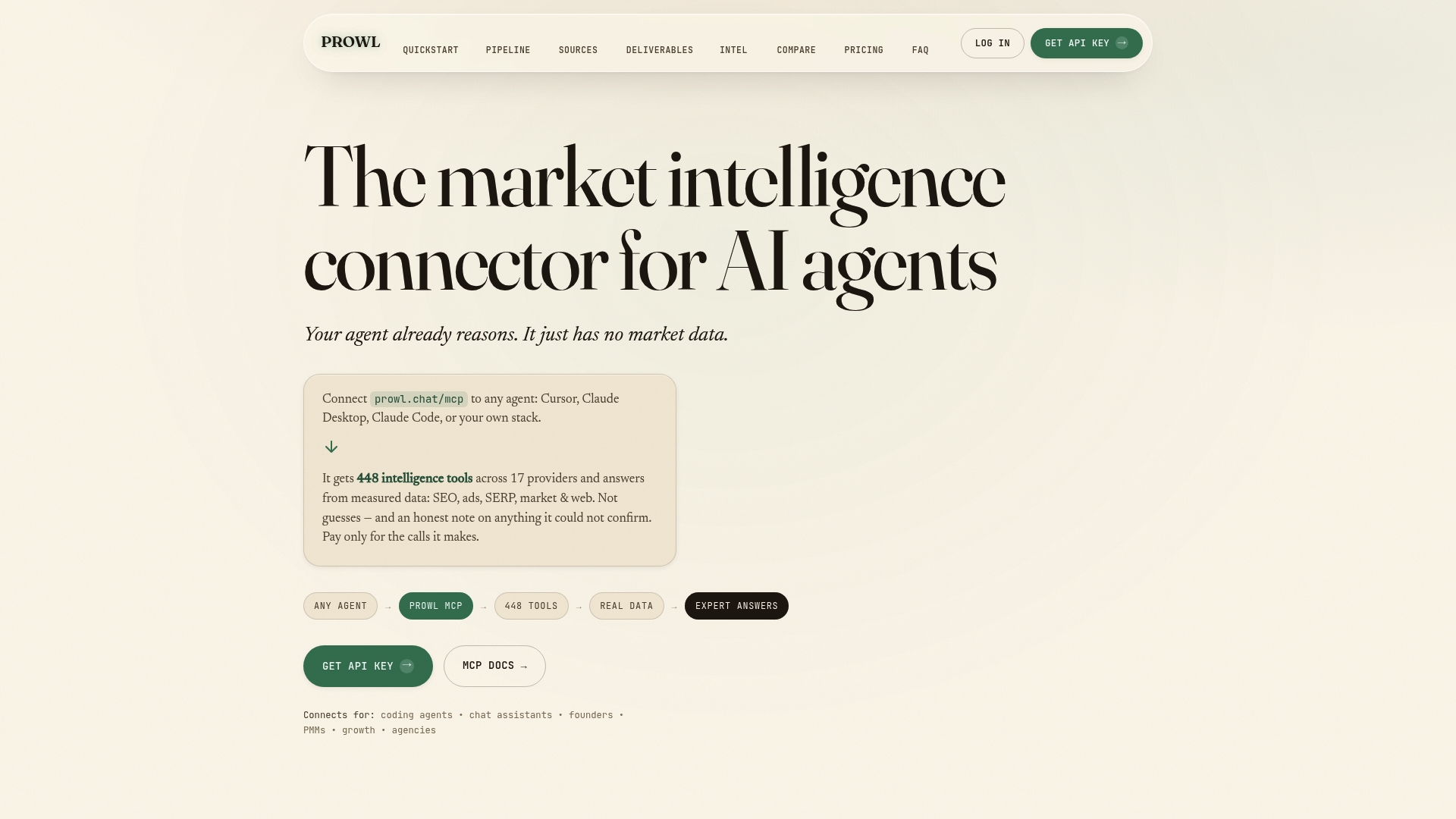
That matters most for teams who don’t have a spare engineer to babysit scraping infrastructure but still need a competitor pricing brief before Friday’s roadmap meeting. Prowl’s MCP connector generates reports as interactive dashboards, PDFs, PPTX decks, or even video summaries, depending on who’s consuming them, and the use cases page walks through what those outputs look like for pricing, SEO, and competitor synthesis specifically. If you’re ready to see your first report instead of planning a 90-day build, connect your agent to Prowl and run your first competitor query today.
Sources
- How to automate competitor analysis with AI agents
- G2 category: competitive intelligence
- parallel-web on PyPI