
AI market research uses machine learning and generative models to collect, analyze, and synthesize consumer data at a speed and scale traditional methods cannot match. It cuts research cycles from weeks to hours, processes unstructured sources like reviews and social posts automatically, and lowers the cost of running multiple market scans in parallel. It works best as a force multiplier for human researchers, not a replacement for their judgment.
TL;DR:
- AI market research dramatically accelerates insights, reducing study timelines from weeks to hours and enabling real-time trend detection and competitor monitoring.
- The technology excels at processing unstructured data like social posts and reviews at scale, providing rapid thematic analysis and automated reporting.
- Using AI for market research is most effective when piloted on specific decisions first, with validation steps such as cross-checking sources and confirming patterns with primary data.
- Limitations include hallucinations, data bias, and reduced accuracy in niche markets or recent events, making AI outputs useful as directional proxies, not definitive evidence.
- A hybrid approach, combining AI automation with human judgment, best supports strategic research goals without replacing comprehensive traditional methods entirely.
Table of Contents
- What Does AI Market Research Actually Deliver?
- Where Does AI Create the Most Practical Value?
- Where Does AI Market Research Fall Short?
- How Do You Pilot AI Without Betting the Budget?
- What Should You Specify When Evaluating AI Research Tools?
- How Prowl Shortens the Research Cycle in Practice
- What Data Privacy Rules Apply to AI Market Research?
- Does AI Replace or Complement Traditional Research Methods?
- Where Is AI Market Research Technology Headed Next?
- Where Should Research Leaders Focus Next?
- Ready to Put AI Market Research to Work?
- Sources
What Does AI Market Research Actually Deliver?
The value shows up first in speed. A traditional bespoke study takes weeks of fielding, cleaning, and cross-tabbing before anyone sees a finding. AI-driven market research compresses that timeline into hours for many routine tasks, according to a16z’s analysis of AI in research workflows, because language models can ingest and summarize raw data the moment it’s collected.
Scale is the second lever. AI tools read social posts, app reviews, forum threads, and support tickets at a volume no analyst team could manually code. That unstructured data used to sit unused because tagging it by hand cost too much. Now it becomes a live signal feed.
The benefits compound when you look at what teams actually get:
- Faster turnaround on competitive scans and trend checks, often same-day instead of multi-week
- The ability to run several market questions in parallel instead of queuing one study at a time
- Lower per-project cost versus commissioning long-form bespoke research for every question
- Synthetic personas and digital twins that let teams pressure-test messaging before recruiting a single respondent
A significant majority of surveyed professionals report using or planning to use generative AI to monitor competitive environments, according to Columbia Business School’s research on generative AI in market research. That adoption rate reflects a shift already underway, not a future prediction.
Where Does AI Create the Most Practical Value?
The use cases that matter most cluster around problems every research team already has, just solved faster.
- Trend detection and sizing proxies. AI models scan search volume, social chatter, and pricing shifts to flag emerging categories before they show up in a formal study.
- Competitive intelligence and share-of-voice tracking. Instead of manually logging competitor mentions, AI aggregates press coverage, ad creative, and review sentiment into a running score.
- Open-text sentiment and thematic analysis at scale. Thousands of open-ended survey responses or app reviews get clustered into themes in minutes, work that used to take a coder day.
- Synthetic-data simulation for concept and messaging tests. Digital twins model how segments might react to a new tagline or feature, letting teams test directionally before fielding a full quantitative study, a use case Harvard Business Review documents as one of the fastest-growing applications in the field.
- Automated reporting and insight synthesis. AI drafts the narrative summary, pulls the supporting charts, and flags the outlier finding a stakeholder will ask about first.
None of these replace a full mixed-methods study when the stakes are high. They replace the guesswork teams used to do between studies, when there wasn’t budget or time for a formal one.
Where Does AI Market Research Fall Short?
Every model has blind spots, and pretending otherwise is how bad decisions get made with confidence. Large language models hallucinate: they generate plausible-sounding but false details, especially when asked about niche markets or recent events outside their training data. Bias creeps in from the data itself, skewed review platforms, overrepresented demographics on certain social channels, and models trained predominantly on English-language content.
Comparative studies that replicate traditional survey questions using large language models find real value alongside real variability, according to a ScienceDirect study on generative AI in market research. The outputs are useful directional proxies, not a drop-in substitute for a probability-based sample.
Generative AI is a powerful enabler, but Columbia Business School’s research is clear that it cannot fully replicate traditional human methods and should complement primary research rather than replace it.
Before trusting an AI-generated finding, run this checklist:
- Randomize a sample of the AI’s source data and check it against the original raw text
- Cross-check any surprising finding against a second, independent data source
- Run a handful of live interviews or a short pulse survey to confirm the pattern holds with real people
- Ask whether the finding would change a real budget or product decision, if yes, escalate to primary research
Pro Tip: Treat any AI-generated insight that would trigger a six-figure decision as a hypothesis, not a fact, until a human has spot-checked it against at least one independent source.
How Do You Pilot AI Without Betting the Budget?
Rolling out AI market research works best as a staged process, not a wholesale swap of your existing toolkit.
- Define the question first. Write down the exact decision the research needs to inform, along with the KPIs and acceptance criteria that will tell you whether the AI output is good enough to act on.
- Design a narrow pilot. Pick one data source, public social listening, a review aggregator, or a proprietary customer database, and scope the pilot to a single market question. Pragmatic Institute’s best-practices guide for AI in market research recommends starting with pilots narrow enough to answer one decision, not five.
- Validate before you scale. Run a small primary check, a dozen interviews, a short survey wave, against the AI’s output before treating it as ground truth.
- Integrate into existing workflows. Feed validated outputs into the dashboards and reports your stakeholders already trust, rather than standing up a parallel reporting track nobody reads.
- Govern and revalidate. Set a cadence, quarterly is common, to recheck the model’s outputs against fresh primary data, since consumer behavior and platform algorithms both shift underneath you.
What Should You Specify When Evaluating AI Research Tools?
Buying by capability instead of brand name keeps you from locking into a tool that solves last year’s problem. When you write requirements for an evaluation or RFP, specify what the platform needs to do, not who needs to build it.
- Social listening and multi-source ingestion, the ability to pull from review sites, forums, and social platforms without custom scraping for each one
- Synthetic-data generation and simulated audiences for early-stage concept and messaging testing
- Automated survey design, text analytics, and segmentation that turns open-ended responses into structured themes
- Signal aggregation through connectors or APIs, so data updates in near real time instead of requiring manual refreshes
- Export flexibility, PDF, PPTX, and interactive dashboard formats that match how your stakeholders actually consume findings
Specify capabilities first, evaluate vendors second. That order keeps the evaluation honest.
How Prowl Shortens the Research Cycle in Practice
Prowl connects any AI agent or workflow to 444 marketing intelligence tools through a single MCP (market intelligence connector), so a research team can query competitor pricing, ad performance, review sentiment, and SEO signals without standing up a separate tool for each one. That single-connector approach is what most teams are missing when they try to piece together AI research from five disconnected point solutions.
In practice, that means:
- Real-time analytics reports generated on demand instead of assembled manually from exports
- Consolidated competitor signals (pricing, ad creative, review trends) pulled into one report instead of five browser tabs
- Automated deliverables in the format a stakeholder actually needs, PDF, PPTX, interactive dashboard, even video or audio summaries
To trial it, connect Prowl’s MCP to your existing agent, run one pilot query against a real competitive question, and validate the output with a quick primary check before it goes into a board deck.
Pro Tip: Start your first Prowl pilot with a question you could already answer manually, so you have a baseline to check the automated output against.
What Data Privacy Rules Apply to AI Market Research?
AI market research tools often ingest customer reviews, survey responses, and social posts that contain personally identifiable information, even when the source looks anonymous. Aggregating that data across platforms increases the risk of re-identifying individuals who never expected their comments to feed a competitive intelligence report.
The practical rule is simple: know where your training and input data actually came from, and confirm it was collected with appropriate consent for research use. Public social posts fall into gray areas depending on the platform’s terms of service and the jurisdiction you operate in. Scraping a review site’s content for competitive benchmarking is common practice, but redistributing that raw data outside your organization can trigger different obligations than simply summarizing patterns from it.
Bias compounds the ethical risk. If your input data overrepresents certain demographics, urban English-speaking social media users, for instance, the AI’s “consumer insight” reflects that skew, not the market. Presenting a biased sample as representative of a broader market is a data-quality failure with real business consequences, not just an academic concern.
Set internal guardrails before scaling any AI research workflow: document data provenance, restrict PII exposure to what a human reviewer actually needs, and build a review step before any AI-generated consumer insight reaches a client or executive deck. Treat model outputs the way you’d treat an intern’s first draft, useful, fast, and in need of a second set of eyes before it goes out the door.
Does AI Replace or Complement Traditional Research Methods?
Neither camp has this right. AI market research doesn’t replace focus groups, ethnography, or probability-sampled surveys, and it doesn’t sit as a separate discipline either. The practical model is a hybrid stack where AI handles the volume work and humans handle the judgment work.
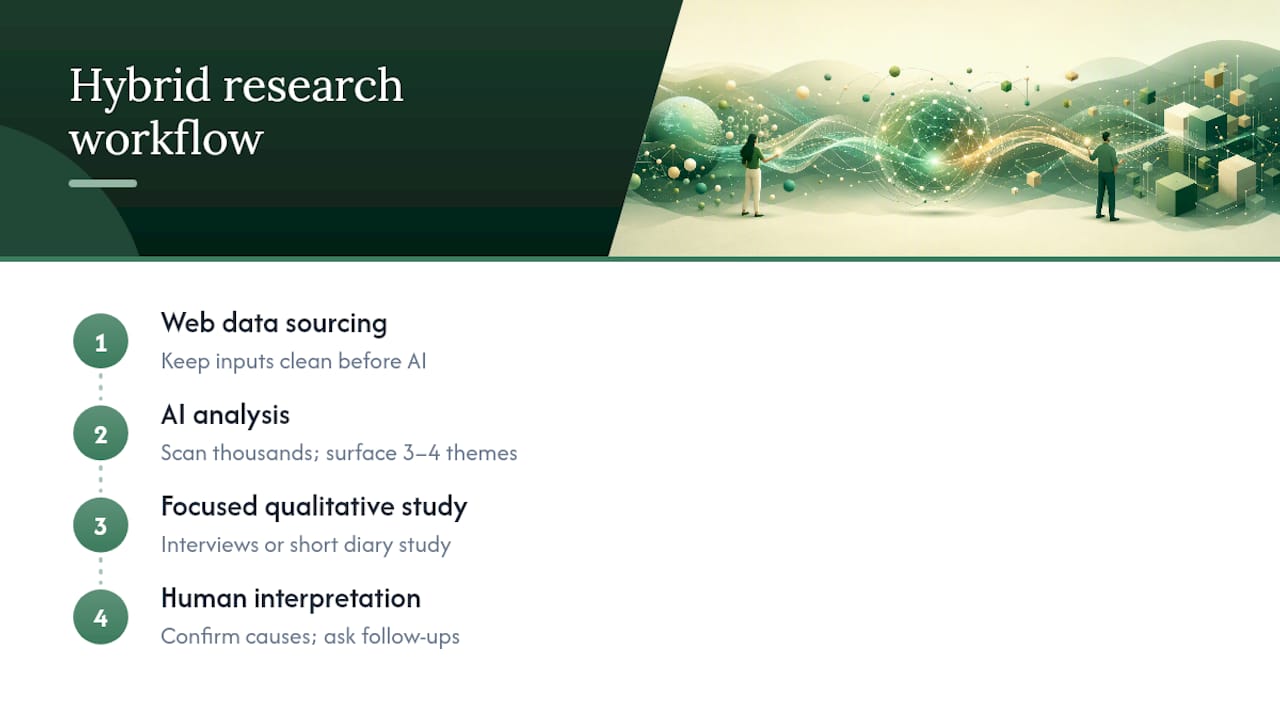
A typical hybrid workflow looks like this: AI tools scan thousands of reviews and social posts to surface three or four candidate themes. A researcher then designs a focused qualitative study, a handful of interviews or a short diary study, to test whether those themes actually reflect customer motivation or just noise in the data. The AI narrows the search space; the human confirms what’s real.
This division of labor tracks with how Columbia Business School frames the relationship: AI excels at synthesizing unstructured data and automating repetitive analysis, while human oversight remains essential for strategic interpretation. It can’t tell you whether that drop reflects a pricing problem, a seasonal blip, or a competitor’s new ad campaign, without a human asking the follow-up question.
Web data sourcing sits at the foundation of this hybrid approach, since AI outputs are only as good as the raw signals feeding them. Teams building competitive-intelligence pipelines benefit from disciplined data-sourcing practices for competitive intelligence that keep the input clean before AI ever touches it. Skip that step and you’re automating garbage faster than you used to produce it by hand.
Where Is AI Market Research Technology Headed Next?
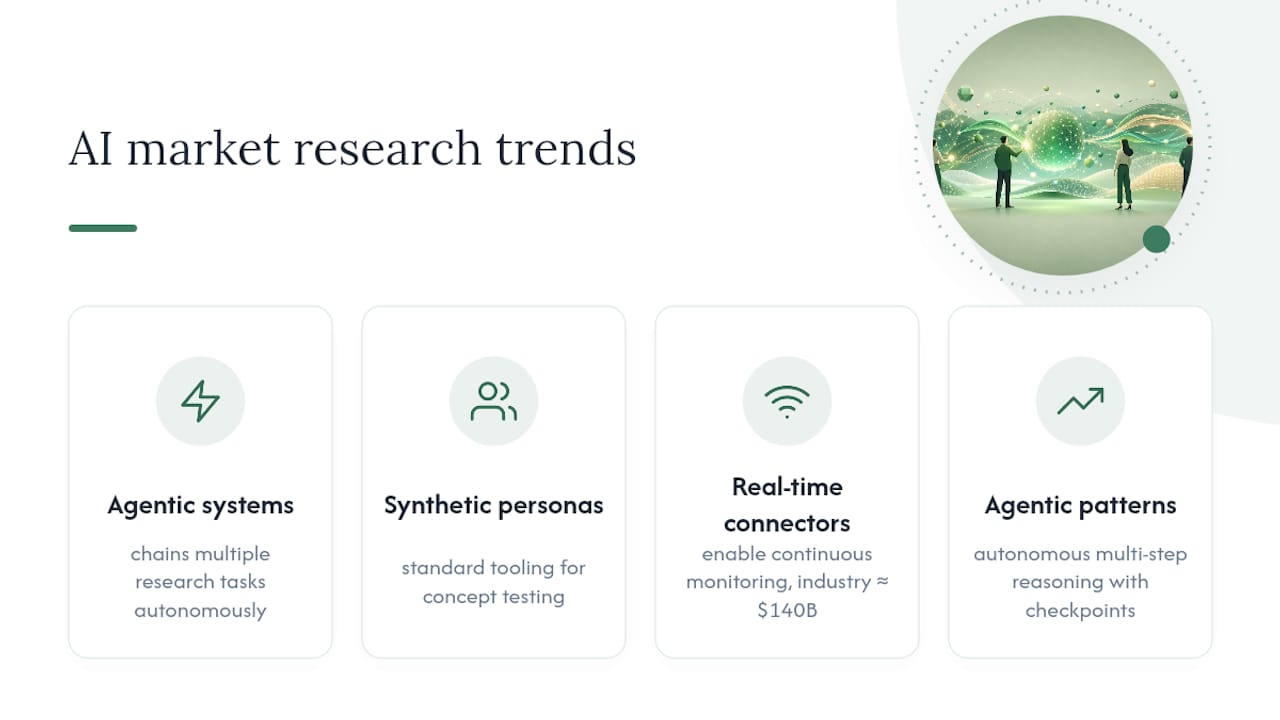
The next wave of AI market research tools is moving from single-question chatbots toward agentic systems that chain multiple research tasks together. Instead of asking a model one question and reading one answer, an agent can pull competitor pricing, cross-reference it against review sentiment, and draft a summary report without a human triggering each step individually.
Synthetic personas and digital twins are shifting from experimental novelty to standard tooling for concept and message testing, a transition Harvard Business Review tracks closely as more research teams build simulation into their standard workflow rather than treating it as a one-off experiment. Expect these simulated audiences to get more sophisticated as models are trained on richer behavioral data, though the gap between a simulated response and a real customer’s reaction won’t close entirely anytime soon.
Real-time connectors are becoming the differentiator between tools that produce a static report and platforms that keep monitoring continuously. A one-time competitive scan tells you where things stood last week. A live connector tells you the moment a competitor changes pricing or a review sentiment trend shifts. The industry, estimated at $140 billion, is large enough that this shift toward continuous, agent-driven monitoring will likely define which providers win the next few years of adoption.
Agentic design patterns from adjacent fields, including how AI agents operate in prediction markets, offer a useful preview of where research automation is headed: less single-shot querying, more autonomous, multi-step reasoning that a human reviews at checkpoints instead of at every keystroke.
Where Should Research Leaders Focus Next?
The clearest ROI sits in competitive intelligence, concept testing, and recurring reporting, not in replacing your flagship annual study. Spend the next year running tightly scoped pilots against real decisions, not open-ended exploration. Balance experimentation with governance from day one; a validation step bolted on after scaling is a much harder fix. If you do one thing next quarter, pick a single recurring report your team dreads compiling and automate it first.
— Sergey
Ready to Put AI Market Research to Work?
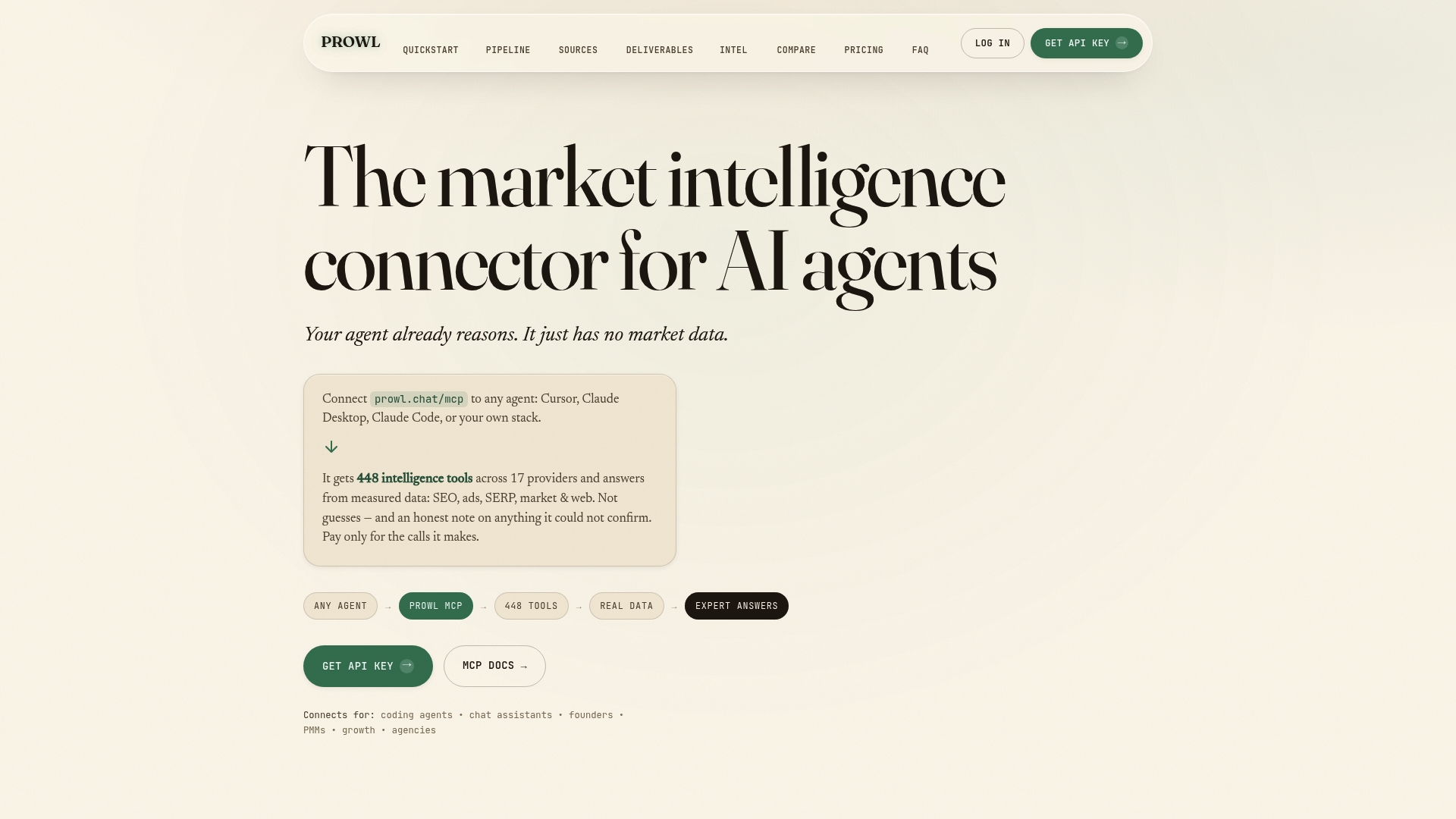
Prowl gives you a shortcut most AI market research setups can’t: one connector, 444 intelligence tools, and no separate subscription or login for each one. Instead of stitching together a social listening tool, a competitor tracker, and a reporting dashboard, you point your agent at Prowl’s MCP and pull competitor pricing, ad performance, SEO signals, and review sentiment through a single pipeline.
The practical path forward: check out real examples on the Prowl use cases page to see how teams run competitor scans and market pilots today, then follow the Getting Started guide to connect Prowl to your existing agent and run your first pilot query this week. Pick one recurring report you’re already producing manually and let Prowl generate it once, side by side with your current process, before deciding how much of your workflow to hand over.
Sources
- How Gen AI Is Transforming Market Research | Columbia Business School
- The AI Tools That Are Transforming Market Research | Harvard Business Review
- Harnessing AI for Market Research: A Guide to Best Practices and Pitfalls | Pragmatic Institute