
An agentic research workflow is a loop in which an AI agent plans a question, pulls evidence from live sources, checks what it found and writes a report, with a person reviewing the result. For market teams, the quality of that loop depends on two things: how well the stages are defined, and whether the data the agent reaches is live and traceable. Prowl connects any agent to 444 market-intelligence tools through one MCP endpoint, so the data layer is a single connection instead of a dozen separate integrations. The rest of this guide shows how to build the workflow around it.
TL;DR
- An agentic research workflow has four stages: plan, search, explore and report. Each needs a defined output and a stopping rule.
- Build it in small steps with bounded loops, review points between stages and every claim tied to a source from the moment it is written.
- Citations show where to look, not that a claim is true. Verification belongs inside the workflow, not after it.
- The data connection is the part that usually slows teams down. One endpoint covering many sources keeps the workflow itself simple.
- Keep a person accountable for any decision the report feeds.
Table of Contents
- What an agentic research workflow is
- Workflow or agent: how much freedom to give
- The four stages every research agent runs
- Patterns: sequential, parallel and multi-agent
- How to build an agentic research workflow, step by step
- Where agentic market research pays off
- Verification: build it in, not on top
- Human review and governance
- Perspective
- Run your first workflow on Prowl
- FAQ
- Sources
What an agentic research workflow is
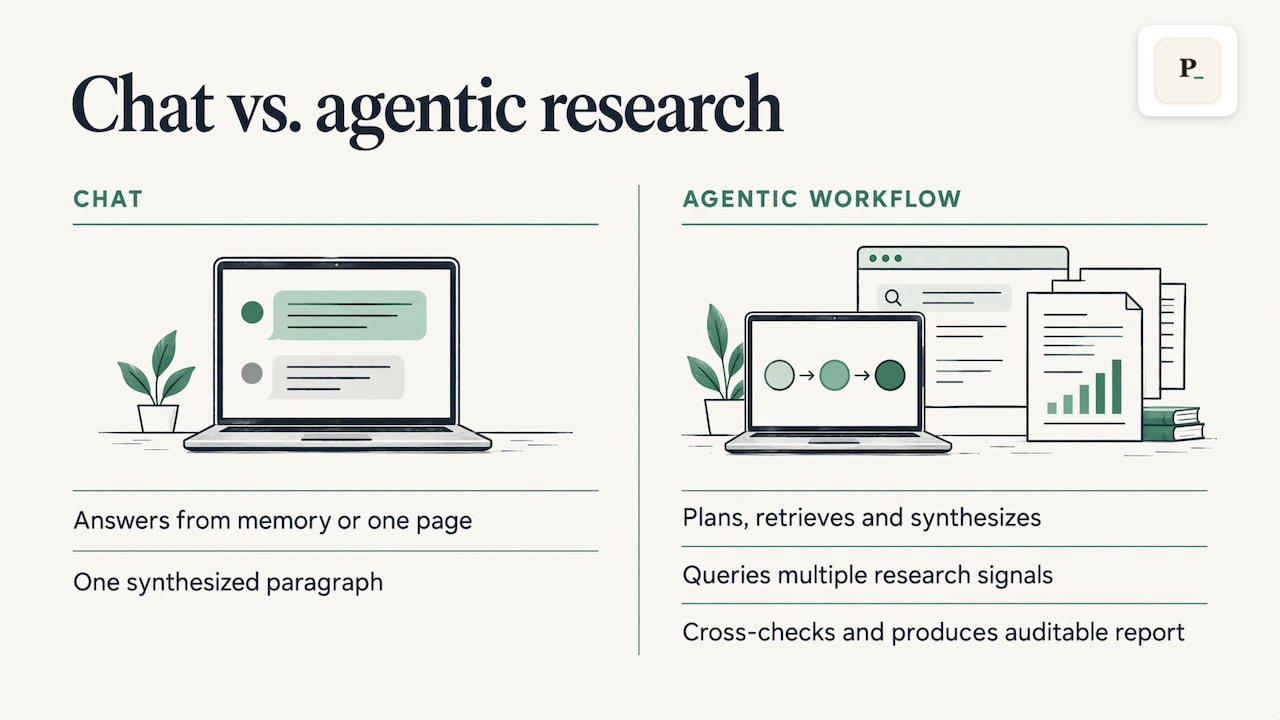
Conventional AI-assisted research is a chat: you ask, the model answers from memory or from one retrieved page. An agentic workflow gives the model a goal and lets it act. Academic surveys describe this as a shift from passive retrieval to active, goal-driven interaction with external knowledge, where agents plan, retrieve and synthesize into a report grounded in evidence.
A more formal definition comes from a systematic review of deep research agents. It describes LLM-powered agents that combine dynamic reasoning, adaptive planning and iterative tool use through browsers, structured APIs and the Model Context Protocol (MCP, an open standard that lets an agent call outside tools). The same review separates them from plain retrieval, which lacks sustained reasoning, and from fixed tool pipelines, which follow steps written in advance.
For a marketing agency, a product manager or a founder, the practical difference is this. A chat answer to “how is the project-management software category moving?” gives you one synthesized paragraph. An agentic workflow decomposes the question into competitor traffic, ad activity, pricing changes, review sentiment and search demand, queries each, cross-checks them and hands back a report you can audit.
Workflow or agent: how much freedom to give
Not every research job needs an agent that decides its own path. GoDaddy’s engineering team, writing about its market-analysis system, argues that reliable research comes from shaping the flow around model calls: planning is explicit, iteration is bounded and synthesis is deliberate. Their view is that a fixed workflow fits when you know how deep the research must go, and an agent is needed when you do not.
A simple rule for your team:
- Known scope, repeated output: a monthly competitor report, a weekly SEO and ad snapshot. Use a fixed sequence of steps with the agent filling in each one.
- Open question, unknown depth: “is there room for a new entrant in this niche?” Let the agent decide which follow-up queries to run, inside a cap on depth and number of calls.
Most teams start with the first kind, because the output can be compared month over month, and move to the second once the data connection and review habits are stable.
The four stages every research agent runs
The deep research survey breaks the pipeline into four core stages: planning, question developing, web exploration and report generation. Here is what each means in a market-research job.
1. Planning
The agent turns the goal into sub-questions. “Should we enter the UK meal-kit market?” becomes demand trend, top competitors, pricing bands, ad angles, review complaints and regulatory factors. Write these dimensions down as a schema before you run anything. A fixed schema is what makes two reports comparable.
2. Question developing
For each dimension the agent writes several different queries: different phrasing, different sources, different time windows. GoDaddy’s pipeline generates queries conditioned on industry, geography and business goals and runs them concurrently, which is why research that takes an analyst an afternoon can finish in minutes.
3. Exploration
The agent calls tools, reads results and decides whether a dimension has gaps. The same GoDaddy design issues follow-up queries only for dimensions that still have gaps, and stops at set depth and breadth limits. Without those limits, agents either quit early or wander.
4. Report generation
The agent fuses findings across sources into the deliverable. GoDaddy uses a single synthesis call that receives all findings in the schema’s order, so the report mirrors the plan. What matters for you is the output format: a table for the analyst, a slide deck for the client, a PDF for the founder.
Patterns: sequential, parallel and multi-agent
Three shapes cover most market-research builds.
| Pattern | How it works | Best for |
|---|---|---|
| Sequential | One agent runs plan, search, write in order | Recurring reports with a fixed template |
| Parallel | Several queries or sub-agents run at once, results merge at the end | Wide scans across competitors, channels or regions |
| Multi-agent | Specialist agents with roles such as researcher, reviewer, writer | Long reports where a second pass catches errors |
The MaRGen paper is a good picture of the multi-agent shape. Its Researcher, Reviewer, Writer and Retriever agents produced 6-page market reports in about 7 minutes at roughly $1 per report, and its automated scoring reached a Pearson correlation of 0.6 with expert human ratings. That correlation is a reminder that automated scoring supports human review and does not replace it.
Microsoft’s own description of a market research assistant agent follows the same logic: it fetches market signals from social media, third-party reports, customer sentiment and competitor insights, identifies emerging trends and produces reports with recommendations for campaigns, content and creative.
How to build an agentic research workflow, step by step
This sequence works whether you use a code framework, a low-code builder or a chat client such as Cursor with MCP.
Step 1: Define the decision, not the topic
Write the decision the report will feed: “Which three channels do we test for this launch?” A topic (“the CRM market”) produces a sprawling report. A decision produces a short list of sub-questions with a clear finish line. Where it goes wrong: goals phrased as topics, which make agents over-explore and hand back generic summaries.
Step 2: Fix the schema
List the dimensions the report must cover and the format of each: for example, competitor set, share of search, ad creative themes, pricing, review themes, open risks. This is the backbone of every later stage and the thing that makes reports comparable.
Step 3: Connect the data layer
This is where most builds stall. Each data source normally means its own account, authentication, rate limits and response format, and an agent that has to juggle a dozen of them is slow and error-prone. Prowl gives your agent one endpoint to 444 tools across 17 market sectors, with live data for market research, SEO, ad performance, funnel and review analysis and pricing research. You set up one connector, not one integration per tool. If your team works in an editor, the Cursor MCP server page shows the setup. For a wider view of how connected systems work, see our guide to AI agent integrations.
Step 4: Set the loop limits
Give the agent a maximum depth, a maximum number of calls and a stopping rule per dimension: stop when two independent sources agree, or when the cap is reached. Applied AI’s build guide found that weaker models need more tightly controlled workflows, because they drift from the request and chase irrelevant search results. Breaking the task into smaller components, with a critic check at each stage, is their remedy.
Step 5: Require evidence at the point of writing
Every number in the draft must arrive with its source. Prowl supports deep reporting in which every number is traceable back to its source, which makes this requirement something the workflow can enforce instead of something a reviewer reconstructs afterward.
Step 6: Choose the deliverable
Decide upfront whether the output is an interactive report, PDF, infographic, PPTX, video or audio. Prowl can generate these formats from the same research, so an agency can send the client a deck and keep the underlying report for the team.
Step 7: Add review gates and run it twice
Run the workflow on a question whose answer you already know, compare, then fix the schema or limits. Only then schedule it.
For a hands-on walkthrough of a one-day setup, read our post on launching AI agent market research with one MCP.
Where agentic market research pays off
The fit is strongest where the work is repeated, multi-source and time-sensitive:
- Agencies: monthly client reports that mix SEO, ads and competitor movement. Templates plus an agent replace the copy-and-paste work; see our agency reporting templates.
- Product managers: validating a trend before committing roadmap time, by checking search demand, competitor launches and review complaints together.
- Founders: sizing an opportunity in a day, using live, sourced market research data.
- Growth teams: scanning rival hooks and formats for new tests, as in ad creative research for agents.
Verification: build it in, not on top
The most useful finding in the recent literature is that checking has to happen while the report is being written. The Kempner Institute’s computing handbook advises that every claim carries its evidence from the moment it is produced: a chain of evidence linking each number or conclusion to its record. Citations should be grounded in retrieval from real sources, not model memory, and prompts, data versions and tool outputs should be logged so a result can be rerun.
Why this matters: an audit of deep-research tools summarized in a 2026 guide found citation accuracy between 40 and 80 percent across configurations, with a large share of unsupported statements. The guide’s rule of thumb is useful: a citation tells you where to look, not that the claim is true.
A practical verification routine:
- Keep a claim ledger. One row per checkable claim: the number or statement, the source, the date observed and a status.
- Check dates. Record how old each observation is. A traffic figure from last quarter and one from last week should not be blended silently.
- Recalculate numbers. Have a reviewer recompute totals and percentages from the raw figures.
- Compare versions. When the agent revises a draft, diff it against the previous one so that earlier correct content does not quietly disappear.
- Set a review date. Market data goes stale on different schedules: pricing pages change faster than market size estimates.
Steps 1 to 3 are far easier when the data comes through one source-attributed connection, because the ledger can store the tool call and the original source for each figure in a single format.
Human review and governance
The Kempner handbook recommends explicit review points between stages, treating outputs as drafts, and keeping a person accountable for consequential actions, with autonomy matched to the stakes. In market research that means: the agent may draft freely, but a named analyst signs off before a report reaches a client or a budget decision.
The Corporate Finance Institute lists the common failure points as hallucination, weak sourcing, missing context and overconfident synthesis, and notes that accountability for the output stays with the analyst even when agents gather the data. Writing down who approves what is part of the build. Teams drafting those rules can adapt sample LLM policy rules for how agents and staff may use AI tools.
Two habits keep the review light. First, review at the stage boundaries (after the plan, after the evidence is gathered), not only at the final report, so errors do not compound across stages. Second, scale the review to the stakes: a competitor summary for an internal stand-up needs a spot check, while a market-entry recommendation needs every key figure confirmed.
Perspective
We built Prowl around a simple observation: the agent is rarely the weak point of a research workflow. The data connection is. Every extra integration is another account to manage, another format to normalize and another place where a number loses its source.
That is why we offer one endpoint to 444 tools across 17 market sectors. Your agent connects once, calls what it needs and gets live data for SEO, ads, pricing, reviews and funnels in one workflow. Because the sources are cross-referenced and every number in a deep report traces back to where it came from, the claim ledger your reviewers keep is a by-product of the run, not a separate project.
We think teams should judge a research workflow by what it lets them decide, not by how clever the agent sounds. A report that arrives in minutes, with its evidence attached and its coverage gaps stated plainly, is one an analyst can approve quickly and a client can trust. That is the standard we design for.
Prowl Team
Run your first workflow on Prowl
Prowl bills in two ways: monthly plans and pre-paid credits. The Exploit plan is $60 per month, Blackops is $120 per month and Syndicate is $240 per month. If you would rather pay as you go, credits come in $10, $50 and $200 one-off amounts. Recon is also on the plan list. Full details are on the pricing page.
A sensible start is a small credit top-up and one recurring report: pick the decision, fix the schema, connect the agent and run it twice. You can also browse the use cases to find the report closest to yours.
FAQ
What is the difference between an agentic workflow and an AI agent?
A workflow is the defined sequence of stages and limits around the work. An agent is the model that acts inside those stages. Fixed workflows suit research whose depth you know in advance, while agents with more freedom suit open questions. Most reliable research systems combine the two.
How long does an agentic market research run take?
It depends on the number of dimensions and the depth cap you set. Published examples show the range: a multi-agent research framework generated 6-page market reports in about 7 minutes, at around $1 per report in model costs. Your time also includes connecting data and reviewing the output.
How do I know the numbers in an agent’s report are right?
Require a source for every claim at the moment it is written, keep a ledger of claims with dates, recalculate key figures and have an analyst sign off. Citations show where to look, so a reviewer should open the sources behind any figure that drives a decision.
Do I need to write code to build one?
Not necessarily. Many teams connect an existing agent or an editor such as Cursor to an MCP endpoint and describe the workflow in plain language. The planning work, meaning the decision, the schema and the limits, matters more than the code.
Which data should an agentic market research workflow use?
Use live sources that match your schema: search demand, ad activity, pricing, reviews, funnels and competitor movement. Prowl offers these through one connection across 17 market sectors, with each number traceable to its source.
Sources
- Deep Research: A Survey of Autonomous Research Agents
- Deep Research Agents: A Systematic Examination and Roadmap
- Building a Deep Research Agent: How GoDaddy Automated Market Analysis
- MaRGen: Multi-Agent LLM Approach for Self-Directed Market Research
- Market research assistant agent, Microsoft Adoption
- Building with Low-Code AI Tools, Applied AI
- Agentic AI in Research, Kempner Institute Computing Handbook
- Agentic Research: How AI Research Agents Work
- AI Agents for Market Research: Guide and Use Cases, Corporate Finance Institute
- LLM policy examples